

What is primerkit?
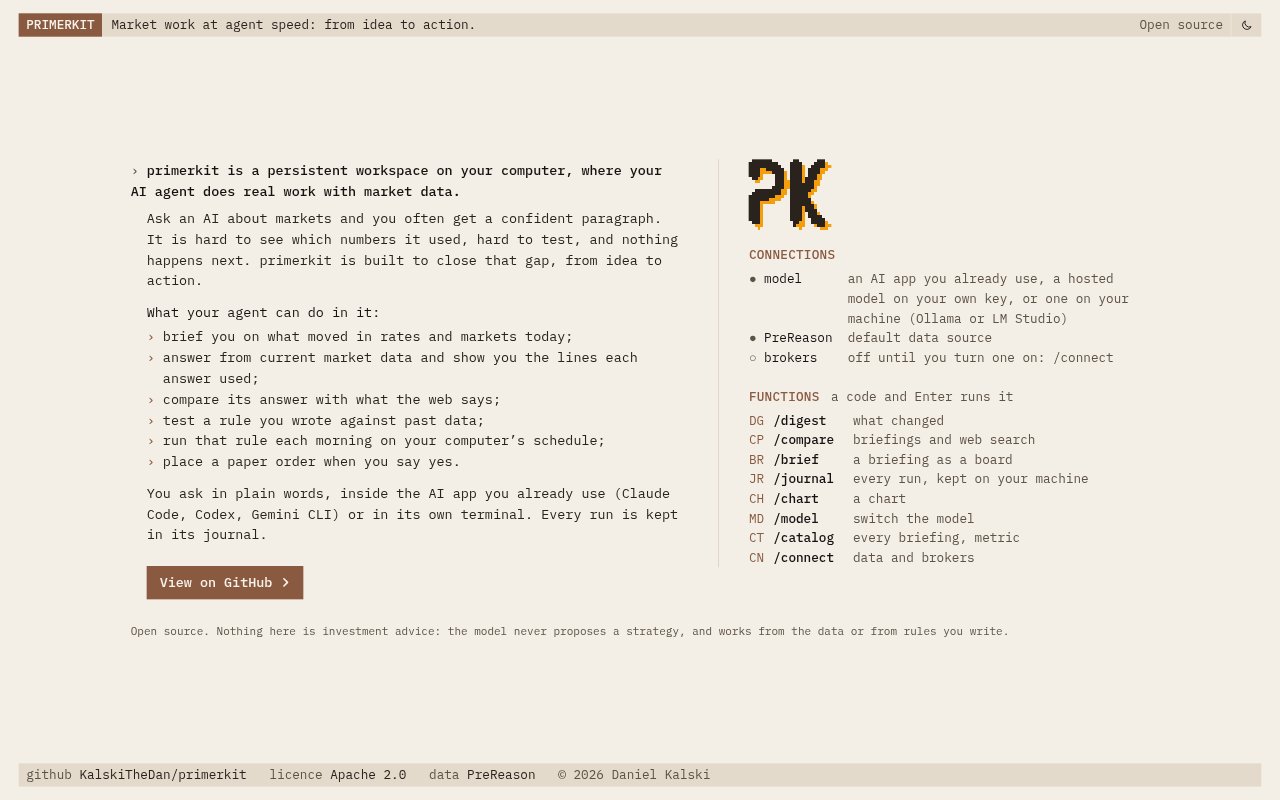
primerkit is an open-source workspace that runs on a user’s computer, where an AI agent can work with market data and carry out research tasks. Users interact in plain language through Claude Code, Codex, Gemini CLI, or primerkit’s terminal, and can use an AI app, a hosted model with their own key, or a local model through Ollama or LM Studio. It keeps each run in a local journal and supports work from market briefings through rule testing and paper orders.
primerkit Features:
Market Data Answers: It answers market questions using current market data and shows the data lines behind each response.
Daily Market Briefings: It can brief users on daily changes in rates and markets, with briefings presented as a board.
Web Comparison: It compares a market answer with web information through a workflow that includes briefings and web search.
Historical Rule Tests: Users can test rules they write against past data; the model does not propose an investment strategy.
Scheduled Rule Runs: A user-written rule can run each morning according to a schedule on the user’s computer.
Paper Orders: It can place a paper order after the user approves, with broker connections off until the user turns one on.
Local Run Journal: Every run is kept on the user’s computer, creating a record of the agent’s market work.
primerkit Benefits:
Inspectable Answers: Seeing the data behind a response gives users a way to examine its basis before relying on it in further analysis.
Tested Ideas: Historical rule tests help users see how a self-written rule would have behaved before deciding whether to use it.
Consistent Reviews: Putting a recurring rule on a computer schedule can make a regular market check part of a morning routine.
User-Controlled Actions: Approval before paper order placement keeps simulated trading actions behind an explicit user decision.
Research Continuity: Keeping a record of each run makes earlier work available for review instead of leaving it as a one-off conversation.
Second Reference Point: A web comparison gives users another source to consider when reviewing an AI-generated market response.
Use Cases:
Morning Market Review: Get a briefing on what moved in rates and markets at the start of a workday.
Checking Market Data: Ask a question about current markets and inspect which data lines informed the answer.
Cross-Checking Briefings: Compare an agent’s market response with web information while reviewing a research note.
Testing Trading Rules: Write a rule and test it against past data to explore its historical behavior before deciding what to do.
Routine Rule Monitoring: Schedule a self-written rule to run each morning as part of a repeated market-checking routine.
Simulated Order Review: Review a potential action through a paper order, approving placement only when ready to proceed.