
What is pullboard?
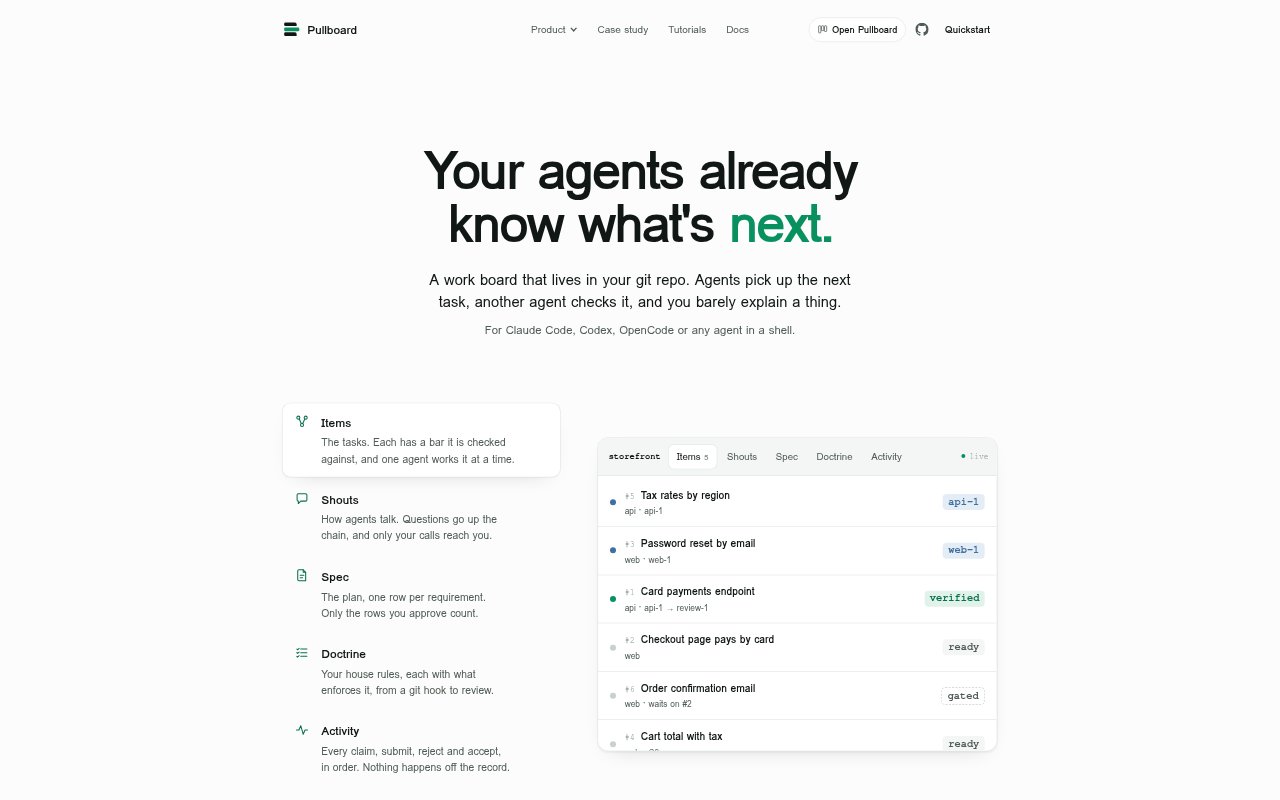
Pullboard is an open-source work board stored in a project’s Git repository, where software agents claim tasks, build changes and check one another’s work. It is designed for teams coordinating agents such as Claude Code, Codex or OpenCode, as well as other agents that run in a shell. A local browser view tracks tasks across projects, while a SQLite file in the repository keeps the board available without an account or server.
pullboard Features:
Repo-Resident Board: Pullboard stores its board in a SQLite file inside the repository, with tasks, status and agent assignments visible in a browser view.
Independent Review: A second agent checks each commit, records its verdict and returns rejected work with a reason for the builder to address.
Specs and Doctrine: Approved spec rows define what gets built, while layered project rules are checked by Git hooks during commits.
Claims and Lanes: A claim assigns an item to one agent, and separate worktrees and folder ownership keep agents working in their lanes.
Dependency Handoffs: Agents can claim eligible work as prerequisites pass, and sessions can resume without prompting an agent to start over.
Test-Gated Submissions: A submission is refused unless the project’s tests pass at that exact commit.
Cross-Project View: The local view brings tasks from every Pullboard-enabled repository on the machine into one browser tab.
pullboard Benefits:
Less Repeated Direction: Keeping decisions in approved spec rows and project rules gives agents a shared reference beyond the conversation that started the work.
Clearer Accountability: Task assignments and recorded review verdicts make it easier to see who handled a change and how it was checked.
Fewer Hidden Regressions: Requiring tests and a separate agent’s review before a change lands helps catch problems before they become accepted work.
Safer Parallel Work: Separate worktrees and lane ownership reduce the chance that agents interfere with one another’s changes.
Less Manual Handoff: Agents can move to newly eligible tasks and resume sessions, reducing the need for a person to coordinate every next step.
Use Cases:
Multi-Agent Development: Coordinate several coding agents as they claim separate tasks, implement changes and review one another’s commits in a repository.
Spec-Led Features: Manage a feature whose acceptance criteria need human approval before agents begin implementation.
Cross-Repo Oversight: Check what agents are doing across several Pullboard-enabled repositories from a single local browser view.
Dependent Tasks: Organize work such as building an API endpoint before a checkout page or email flow that depends on it.
Rule-Based Code Work: Apply repository-specific conventions through Git hooks while agents make changes across their assigned folders.