

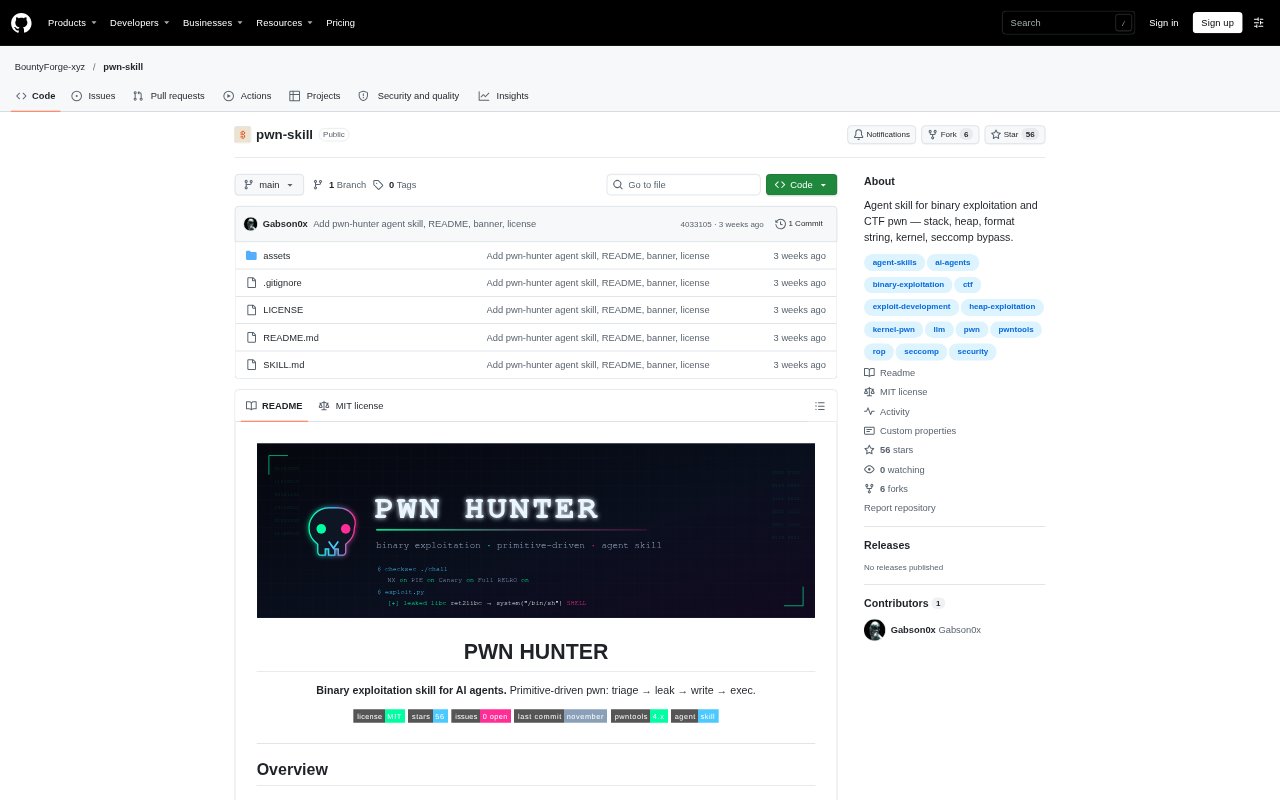
What is PWN HUNTER?
PWN HUNTER is a single-file skill that guides AI agents through binary exploitation and memory-corruption work. It is intended for CTF participants, researchers working with local lab binaries, and developers conducting authorized exploit development. The skill organizes analysis into a repeatable process, from fingerprinting a target and identifying an exploitable primitive to building an exploit and presenting a working proof of concept.
PWN HUNTER Features:
Target Triage: The workflow uses checksec, readelf, libc identification, and kill signals to assess a binary and its execution environment.
Stack Exploitation: It covers ret2libc, ret2csu, SROP, ret2dlresolve, stack pivots, and alignment for constructing stack-based exploit chains.
Format Strings: The skill guides format-string offset discovery and writes using fmtstr_payload, including arbitrary reads and writes.
Heap Techniques: Heap coverage includes tcache poisoning, safe-linking, use-after-free, off-by-one errors, FSOP, and House techniques.
Sandbox and Kernel: For seccomp and kernel targets, it includes ORW or sendfile approaches and techniques involving modprobe_path, commit_creds, and security mitigations.
Exploit Deliverable: The process calls for measured offsets and a working exp.py proof of concept, with local and remote execution shown in its example.
PWN HUNTER Benefits:
Structured Analysis: A consistent triage-to-execution sequence gives exploit work a clear next step instead of leaving each investigation to start from scratch.
Technique Coverage: Researchers can consult one skill across stack, format-string, heap, sandbox, and kernel scenarios rather than switching between unrelated workflows.
Testable Results: Requiring measured offsets and a proof of concept makes it easier to check whether an exploit works against the target.
Focused Agent Output: The skill directs the agent toward producing exploit code, helping users get an actionable artifact rather than only a conceptual explanation.
Lab-Oriented Use: Its stated focus on CTFs, local binaries, and authorized work helps users frame testing around legitimate security practice.
Use Cases:
CTF Challenges: Use it to analyze a pwn challenge binary, identify a vulnerability primitive, and build an exploit for the challenge.
Local Lab Binaries: Apply the workflow when investigating a program in a controlled lab and testing whether a memory-corruption bug can reach code execution.
Stack Overflow Analysis: Use its stack techniques to work through a binary where an overflow may control the instruction pointer or support a ret2libc chain.
Heap Bug Investigation: Turn to the heap coverage when examining a lab target involving a use-after-free, tcache behavior, or an off-by-one error.
Seccomp Challenges: Use the sandbox guidance for a challenge where seccomp blocks execve and an ORW or sendfile approach is relevant.