

What is radian?
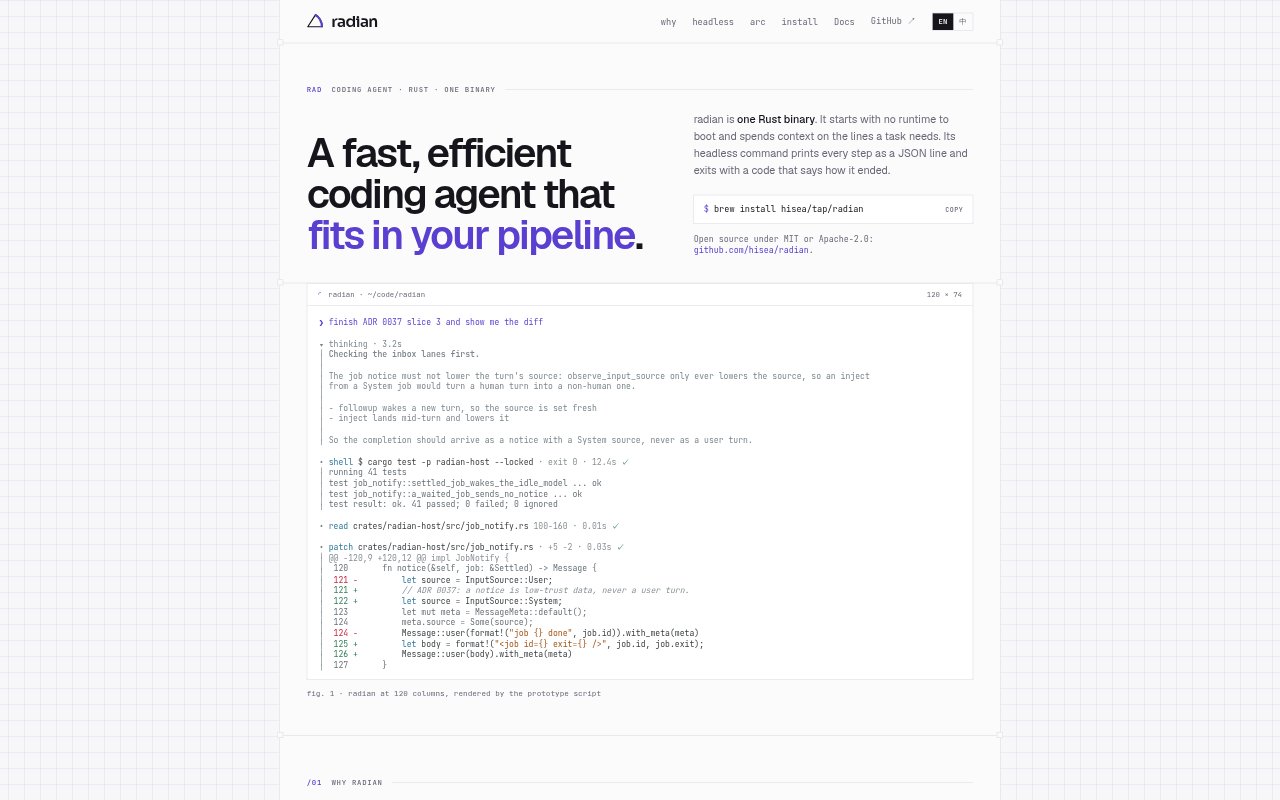
radian is a coding agent packaged as a single Rust binary, with a full-screen terminal app for interactive work and a headless command for scripts, CI, and other orchestrators. It records each step in a journal and can expose headless runs as JSON lines with an exit code for the outcome. It is aimed at developers who want to run coding-agent tasks themselves or incorporate them into automated workflows.
radian Features:
Interactive and Headless: Use the full-screen terminal app for keyboard-driven work or run radian exec with a prompt to handle tasks without the interactive interface.
JSON Step Output: The headless command prints each step as a JSON line and reports the outcome with an exit code, including whether a run failed or ran out of budget.
Journaled Sessions: Every step is recorded in a journal that can be resumed or forked, and a headless session can be continued in the full-screen app.
Context Controls: Reads can target specific line ranges, while a budget guard compacts context before it overflows and a footer shows token use and cost.
Project Compatibility: radian can use workspace instruction files, shared skills, MCP server configuration, supported hooks, imported themes, and global or project memory.
Task Orchestration: The included arc command turns a request into tasks, runs each as a headless worker, and merges work only when it passes a fixed gate.
radian Benefits:
Pipeline Visibility: Structured output and an explicit completion status make it easier to inspect a run and decide how an automated workflow should respond.
Easier Recovery: A saved session gives developers a way to continue or branch work later instead of losing progress when they leave a task.
Context Awareness: Seeing token use and cost while a task runs helps developers judge its resource use and decide whether to continue or adjust the work.
Clearer Boundaries: Keeping approvals with the operator and making sandbox settings only narrow permissions helps teams retain control over agent actions.
Less Setup Work: A native binary with no runtime to boot, plus support for familiar project configuration, can reduce friction when adding the agent to a workflow.
Use Cases:
CI Coding Tasks: Run a coding task from a CI job and use its JSON output and exit code to track the steps and determine whether it completed successfully.
Agent Orchestration: Have an external orchestrator send a prompt to radian exec and consume the resulting steps as part of a larger automated process.
Resuming Script Work: Start a task headlessly, then open its saved session in the full-screen app to continue working with the same journal.
Parallel Task Work: Break a larger coding request into separate tasks with arc, run them as headless workers, and merge only changes that pass its gate.
Existing Project Setup: Use radian in a repository that already has instruction files, skills, MCP server settings, supported hooks, or imported themes.