

What is rag-search?
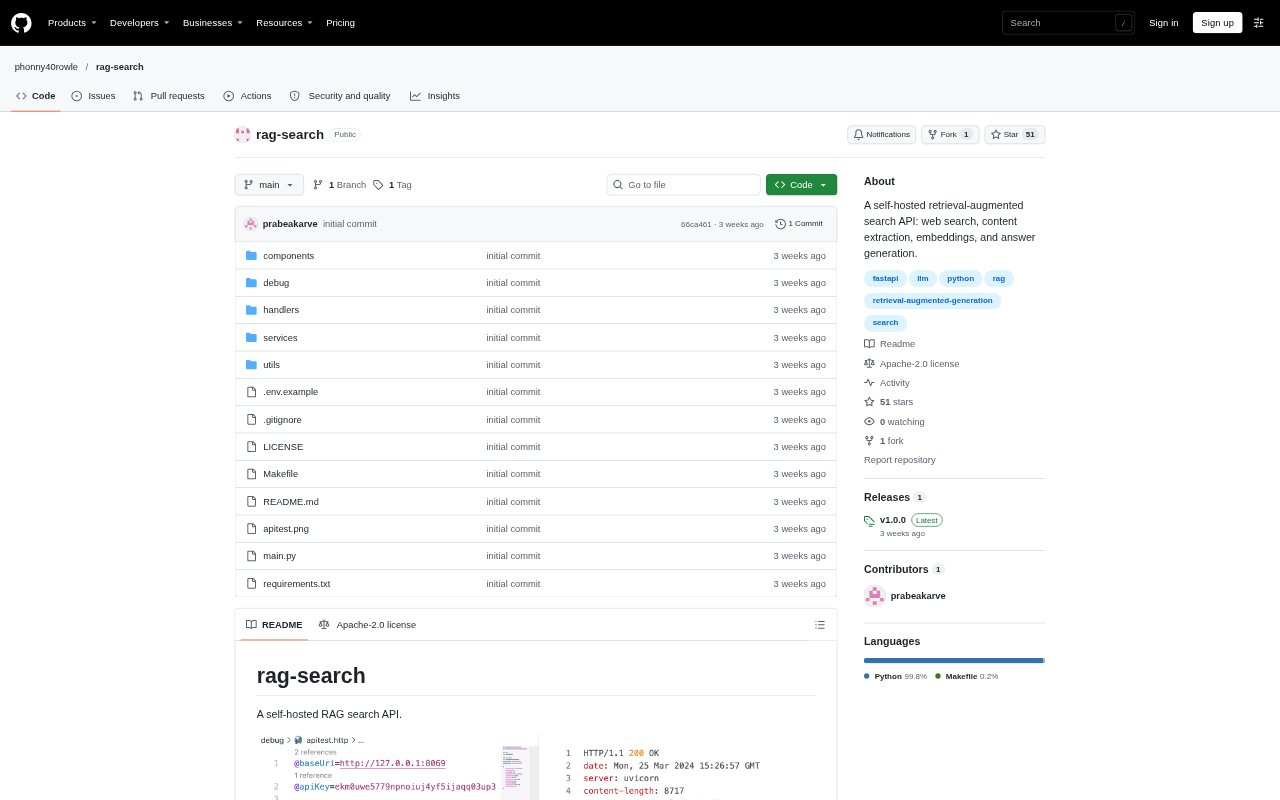
rag-search is a self-hosted retrieval-augmented search API for developers building search and answer-generation into their own applications. It combines web search, content extraction, embeddings, and answer generation behind a FastAPI server. The project is configured with credentials and model settings, then exposes a request endpoint for search queries. Its setup uses OpenAI-compatible model settings and a Zilliz collection, with a search provider configurable for requests.
rag-search Features:
Web Search: The API accepts a query and a search-provider setting, with Google shown as an option in the example request and Serper API credentials included in configuration.
Content Extraction: The project describes content extraction as part of its retrieval-augmented search process, bringing material found through search into the pipeline for further processing.
Embedding Models: Configuration includes an OpenAI-compatible embedding model setting, along with a Zilliz URI, token, vector dimension, and collection for the search setup.
Answer Generation: An OpenAI-compatible endpoint, API key, and model can be configured for answer generation, with GPT-3.5-turbo provided as the example model.
Retrieval Controls: Requests can specify whether to rerank results, return details, or filter results, and can set minimum scores and top-result counts for detail and filtering.
API Authentication: The sample search request uses a bearer API key, and the project configuration includes a separate authentication API key setting.
rag-search Benefits:
Self-Hosted Operation: Running the API on infrastructure you manage gives a team a way to place its search service within its own application environment rather than relying on a hosted search interface.
One Search Backend: Combining search, extraction, embeddings, and generated answers in one service can reduce the amount of separate search plumbing an application team needs to assemble.
Tunable Results: Adjustable reranking, filtering, score thresholds, and result counts give developers room to balance result relevance and the amount of detail returned for their application.
Model Choice: Configurable model endpoint and model-name settings let teams adapt the service to the OpenAI-compatible model configuration they choose to provide.
Use Cases:
Search in an App: A developer can call the search endpoint from an application when a user asks a question and the product needs to retrieve web material and generate an answer.
Web Research: Teams can use the API as a backend for workflows that search the web for a query, extract relevant content, and return a generated response.
RAG Prototyping: Developers exploring retrieval-augmented search can run the FastAPI server locally, configure the required services, and test requests against its search endpoint.
Retrieval Tuning: An application team can adjust reranking, filtering, score thresholds, and top-result counts while evaluating how much retrieved detail its search workflow should return.