

What is Railspike?
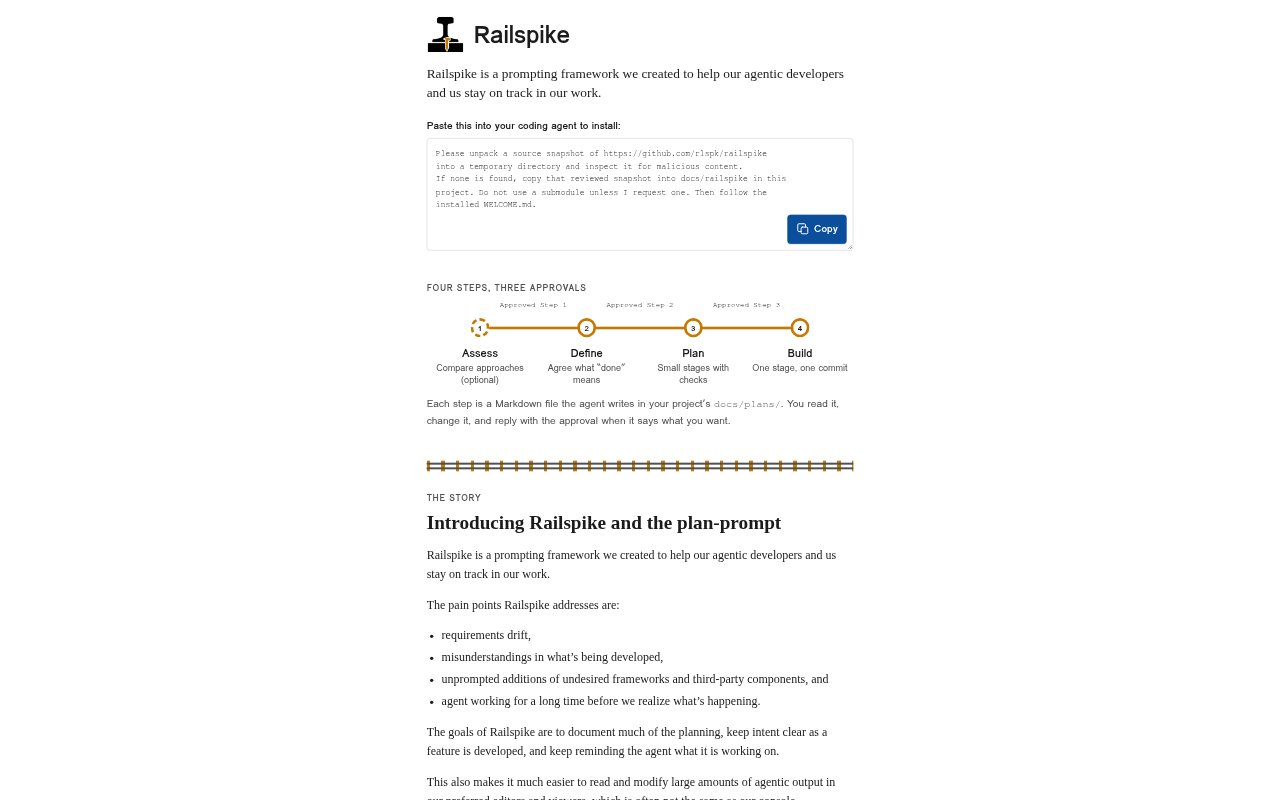
Railspike is a prompting framework for developers using coding agents to plan and carry out software work. It breaks a task into staged documents that the agent creates in the project, giving the developer chances to review and approve the direction before implementation. The framework is designed to keep work aligned with requirements across agents and sessions, and can also record bounded one-shot tasks without the full approval sequence.
Railspike Features:
Approval-Based Stages: The workflow moves from optional approach assessment to defining completion, planning checked stages, and building one stage per commit, with approval checkpoints.
Markdown Plan Files: Agents write each step as a Markdown document in the project's docs/plans/ directory, where developers can inspect and edit the proposed work.
Plan-Prompt Workflow: Railspike has the agent draft the prompt it will follow, so the developer can correct the task framing before code changes begin.
Persistent Project Records: Plans remain searchable in the repository, preserving task intent and decisions beyond a conversation's context window or a change of session.
One-Shot Task Records: For explicitly authorized bounded work, the agent can keep a proportionate record in one evolving file without intermediate approvals.
Agent-Agnostic Process: The same prompting process can be used with coding agents including Cursor, Windsurf, Copilot, Claude Code, and Codex.
Railspike Benefits:
Fewer Misunderstandings: Reviewing the agent's interpretation before implementation helps catch mismatched expectations before they turn into unwanted code.
Less Re-Explaining: Having the agent develop and document its understanding of the task can reduce the amount of manual clarification developers need to provide.
Clearer Work History: Keeping plans with the project makes it easier for developers and later agents to understand why a feature was built in a particular way.
More Workflow Continuity: A consistent process and durable records make it easier to hand work between coding agents or resume it in another session.
Fewer Unwanted Choices: Agreeing on the approach and scope in advance can help prevent agents from adding frameworks or third-party components that were not wanted.
Use Cases:
New Feature Development: Use the staged workflow to clarify a new feature's intended outcome, agree on a plan, and then guide the agent through implementation.
Feature Reshaping: Document the intended changes to an existing feature before asking a coding agent to reshape it.
Bug Fixes: Use a bounded one-shot record for a small fix, or plan a more involved bug investigation through the staged process.
Project Documentation: Guide an agent through planning and writing documentation while preserving the requirements and decisions behind the work.
Multi-Cycle Checklists: Create a checklist for larger work that spans multiple cycles, giving the agent and developer a record to follow.