
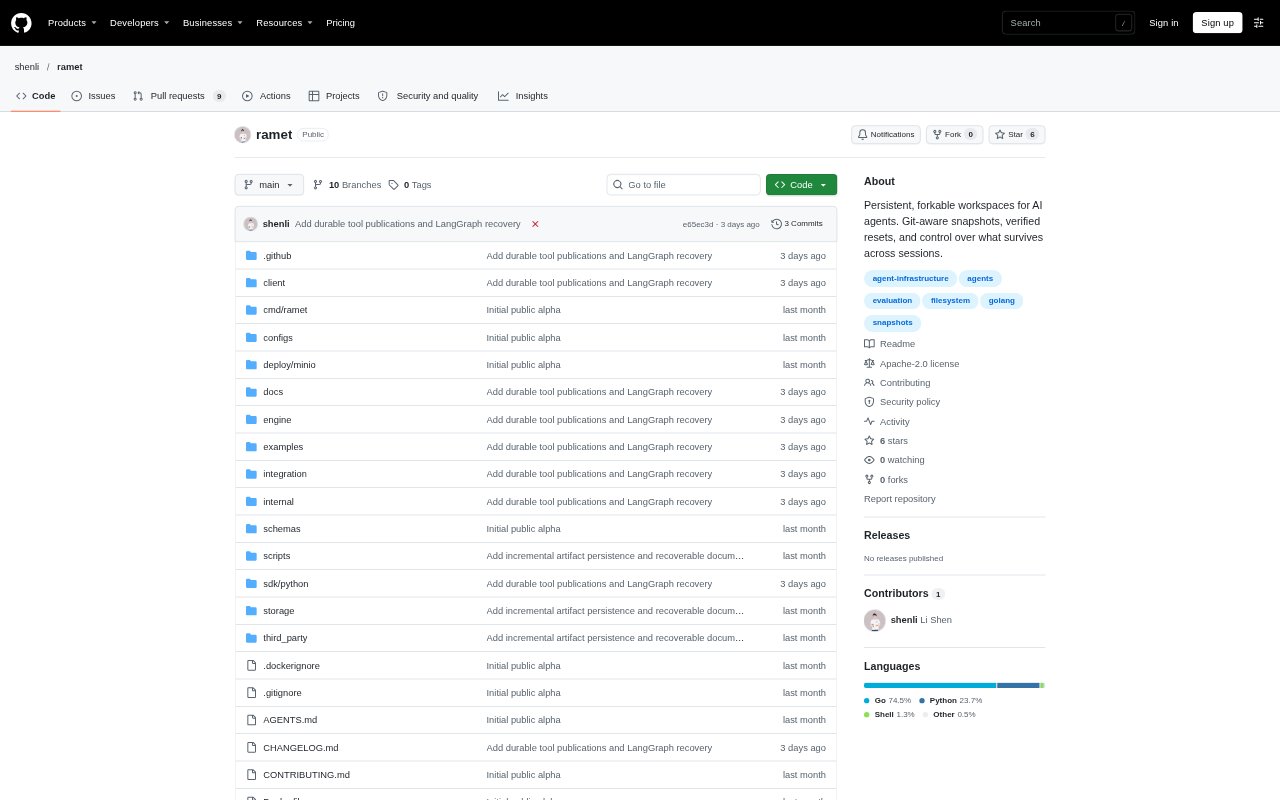
What is Ramet?
Ramet manages persistent, forkable workspaces for AI agents, keeping filesystem changes available across sessions and sandbox replacements. It sits between an agent harness and its runtime: the harness chooses when to capture or promote state, while the runtime runs the agent in an isolated workspace. Teams can connect through Python, Go, or HTTP and bring their own framework and sandbox. Ramet is a development-alpha project for Linux and macOS, licensed under Apache-2.0.
Ramet Features:
Persistent Snapshots: Capture a workspace explicitly, then restore saved files and local Git state in a later session.
Forkable Workspaces: Create independent writable attempts from a shared immutable base, then choose which attempt and state to preserve.
Path Policies: Classify paths as durable, rebuildable, ephemeral, or shared, and preview what promotion will save; unclassified paths are preserved by default.
Reset And Reuse: Release an execution to reset its workspace, with verification checks available before the workspace is used again.
Artifact Checkpoints: Checkpoint PDFs, documents, spreadsheets, and presentations, reusing unchanged chunks of large files.
Session Recovery: Pair persistent files with a pinned runtime image and check dependencies before restoring a session.
Ramet Benefits:
Keep Valuable Work: Useful edits and local commits can survive a replaced sandbox instead of having to be recreated.
Reduce Repeated Setup: Prepared repositories and compatible dependencies can be reused, avoiding repeated setup work for agent runs.
Limit Saved Clutter: Separating durable results from rebuildable or temporary files helps keep saved work focused on what matters.
Compare Independent Attempts: Parallel runs can be evaluated without their changes interfering, making it easier to keep a preferred result.
Make Evaluations Repeatable: Reusing prepared inputs and resetting workspaces helps teams run agent evaluations from a consistent starting point.
Use Cases:
Parallel Coding Agents: Give each coding attempt its own workspace from the same repository, then promote selected changes from the strongest result.
Document Generation: Resume a task that creates PDFs, documents, spreadsheets, or presentations after a sandbox has been replaced.
LangGraph Recovery: Publish tool results in workspace files before advancing graph progress, so completed work can be reconciled after an interruption.
Agentic RL Rollouts: Reset filesystem state between rollouts and verify the workspace before reusing it for another run.
Repeatable Agent Evaluations: Prepare a repository and its dependencies once, then reuse them across evaluation runs with isolated agent workspaces.