

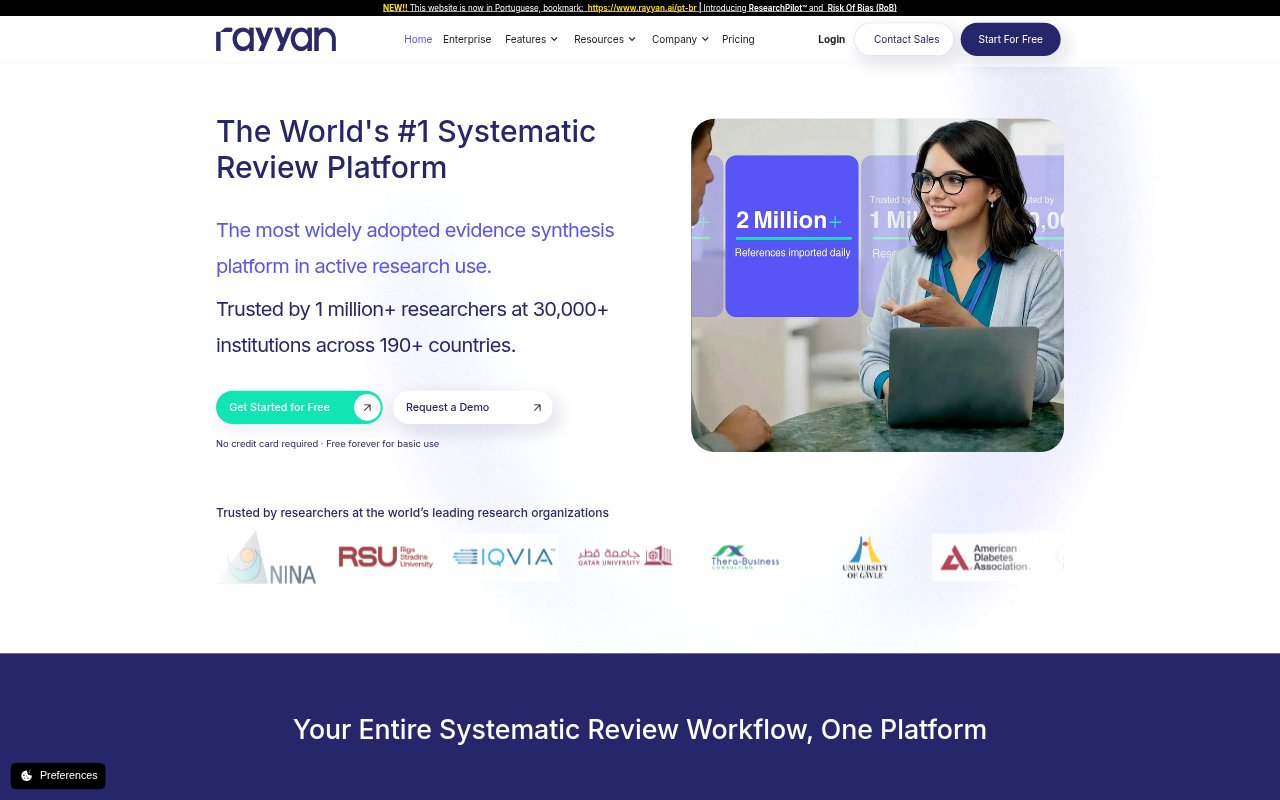
What is Rayyan?
Rayyan is a platform for systematic reviews and evidence-synthesis work, built for researchers working alone or with a review team. It brings reference organization, screening, data extraction, risk-of-bias assessment and reporting into a shared workflow. Teams can import references, apply inclusion and exclusion criteria, resolve screening conflicts and prepare publication outputs, with AI-assisted tools for prioritizing and analyzing studies. The platform also supports collaborative work across large reference libraries.
Rayyan Features:
Reference Library: Import references from different sources, combine them and organize the records into a structured library for a review.
Duplicate Resolution: Detect and merge duplicate records, or use the Systematic Auto-Resolver to deduplicate up to 200,000 references using your protocol.
AI Review Tools: ResearchPilot includes zero-shot relevance ratings, AI Analyzer, AI Reviewer and Auto-Extract Data for different stages of research.
Screening Workflow: Screen titles, abstracts and full articles, apply inclusion or exclusion decisions, and tag and label studies.
Team Sampling: Create randomized subsets of references, divide the review workload and coordinate screening among team members.
Risk Assessment: Define extraction fields, capture study data and record evaluations using risk-of-bias criteria.
Reporting Tools: Export review results and generate PRISMA flow diagrams, with decisions and actions available in an audit trail.
Rayyan Benefits:
Less Manual Sorting: Deduplication and AI-assisted prioritization can reduce the repetitive work involved in organizing and screening large sets of references.
Clearer Teamwork: Shared access, assigned roles and conflict resolution help reviewers coordinate decisions and keep work moving across a team.
Defensible Decisions: Traceable review decisions give teams a record they can inspect when explaining how studies were assessed.
More Reproducible Reviews: Structured workflows and generated reporting materials make it easier to document and replicate a review process.
Flexible Review Time: Mobile access, offline work and keyboard shortcuts give researchers options for fitting review tasks into different work settings.
Use Cases:
Abstract Screening: Reviewers can sort through titles and abstracts, apply eligibility criteria and label studies during the first screening stage.
Full-Text Eligibility: A review team can assess full articles after initial screening and resolve disagreements about whether studies qualify.
Large-Scale Deduplication: Researchers combining references from multiple sources can identify and merge duplicate records before beginning screening.
Study Data Extraction: Teams can define fields and capture study information consistently once eligible articles have been selected.
Review Publication: Researchers preparing results for publication can export findings and create a PRISMA flow diagram for reporting.