

What is RDST?
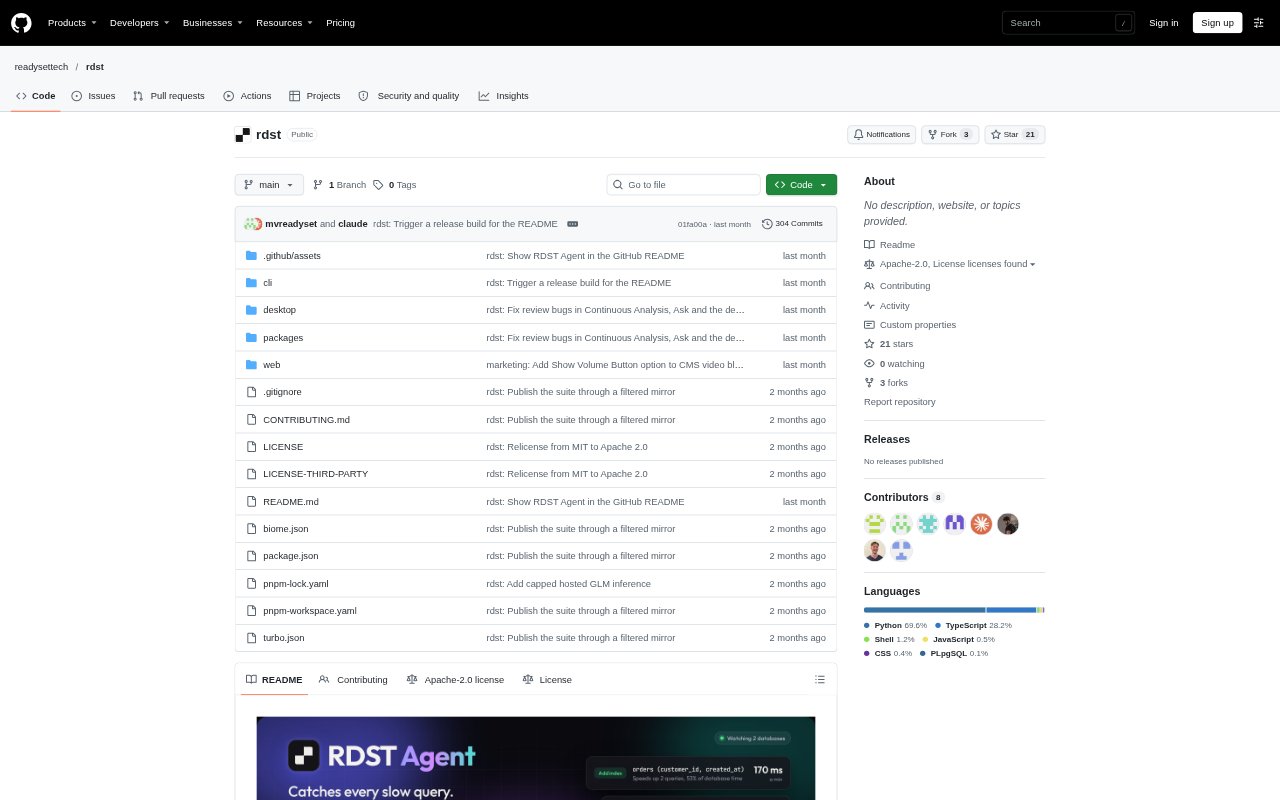
RDST is a desktop app and local agent for monitoring and improving PostgreSQL and MySQL query performance. It reads database query statistics, identifies costly or changing queries, then builds a ranked plan of possible fixes such as indexes, configuration changes, query rewrites, or vacuuming. Database developers and operators can review the evidence, copy suggested SQL, and track whether a change helped, without giving RDST write access to the database.
RDST Features:
Query Monitoring: The agent reads PostgreSQL or MySQL query statistics every minute, without requiring a proxy or changes to application code.
Query Prioritization: It ranks queries by their share of database time and highlights those that have slowed down, spiked, or stopped running.
Fix Analysis: For important queries, RDST examines the execution plan and schema to recommend a relevant index, setting change, rewrite, or vacuum.
Action Details: Recommendations include estimated time savings, affected queries, application instructions, and copyable SQL with undo SQL where applicable.
Change Tracking: You can mark recommendations as done, and the agent checks whether each change helped.
Local Operation: RDST connects with a read-only database user and keeps monitoring history, reports, and settings on your machine.
Desktop and CLI: The desktop app is available for macOS, Windows, and Linux, while the CLI includes live query viewing and analysis commands.
RDST Benefits:
Clear Priorities: Ranking by database time helps teams focus tuning work on queries with the greatest effect on overall database activity.
Less Guesswork: Execution plans and schema-based recommendations give operators a concrete starting point instead of leaving them to diagnose slow queries alone.
Safer Review: Read-only access lets teams investigate performance and review proposed changes without allowing the agent to modify production data.
Easier Implementation: Copyable SQL and server-specific application steps make it simpler to take a recommendation from review to a controlled change.
Visible Results: Checking completed changes helps teams see whether their tuning work improved the queries it was meant to address.
Use Cases:
Production Triage: A database operator can investigate a rise in database load by finding queries that recently became slower or began consuming more time.
Index Review: A developer can assess a frequently run query and review whether RDST recommends adding or dropping an index.
Query Tuning: A team can examine a costly query's plan and schema when deciding whether to rewrite the query or change a database setting.
Cloud Database Work: An operator can use the provided instructions when applying a recommendation on RDS, Aurora, Cloud SQL, or Azure.
Change Verification: After applying a suggested fix, a database team can mark it done and check whether the agent sees an improvement.