
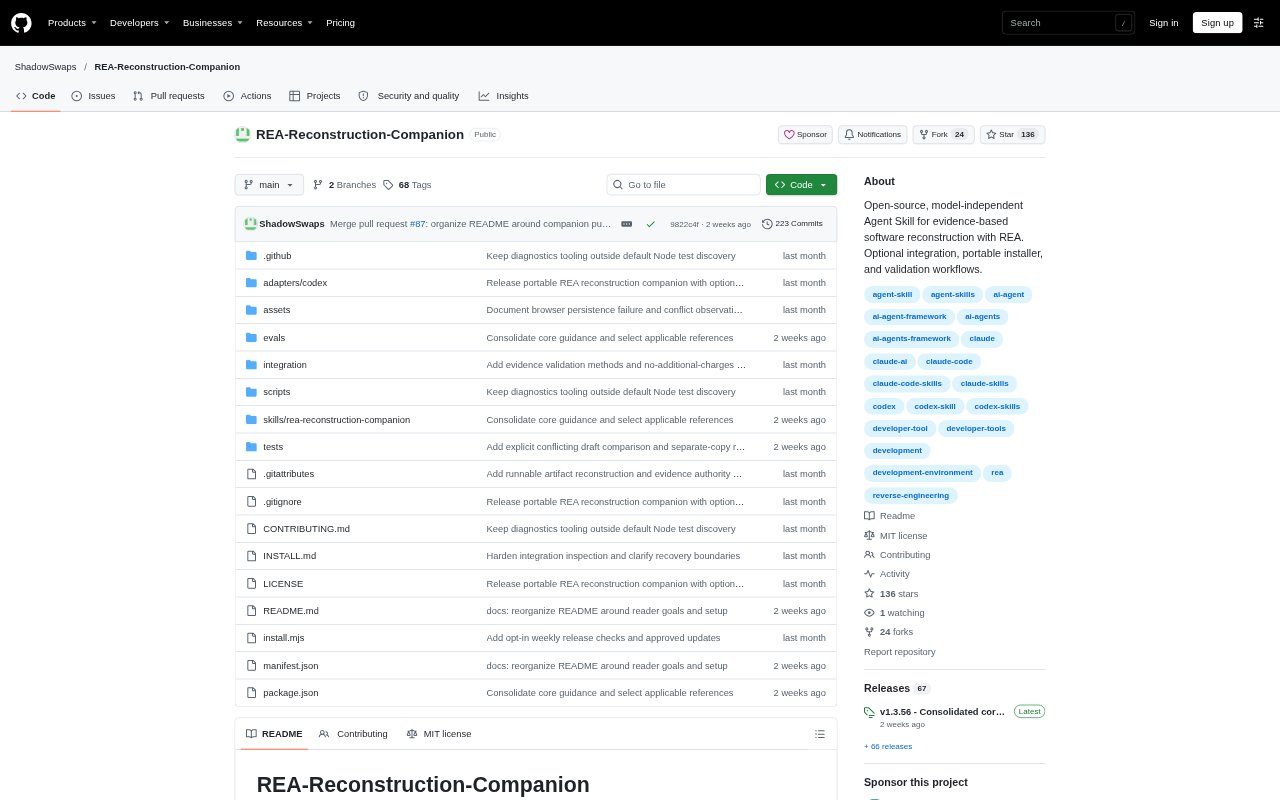
What is REA Reconstruction Companion?
REA Reconstruction Companion is an open-source skill that guides AI agents through understanding existing software, planning a reconstruction, implementing selected behavior when asked, and validating the result. It is intended for people who need to study an app, workflow, file format, or function and build or improve a similar implementation. It works with REA evidence or supplied evidence, does not require a particular model or AI provider, and is available under the MIT licence.
REA Reconstruction Companion Features:
Evidence Analysis: Turns observations, files, recordings, or REA evidence into descriptions of behavior, requirements, and unanswered questions.
Scope Breakdown: Breaks software into capabilities, workflows, interactions, state, and dependencies to clarify what a reconstruction needs to cover.
Requirements Planning: Links requirements, contracts, expected behavior, and acceptance criteria to the evidence used to define them.
Incremental Implementation: Guides work in coherent, testable steps and only proceeds with implementation when requested.
Reconstruction Checks: Supports differential fuzzing, targeted mutation tests, executable interface contracts, and end-to-end validation where appropriate.
Progress Records: Keeps observations, inferences, unknowns, decisions, and checkpoints distinct for later work.
REA Reconstruction Companion Benefits:
Clearer Scope: Separating known behavior from gaps helps teams avoid treating assumptions as confirmed requirements.
Safer Planning: Keeping investigation and implementation as separate choices helps preserve control over when development begins.
Focused Validation: Evidence-linked acceptance criteria make it easier to identify what a reconstruction has actually been checked against.
Useful Handoffs: Recorded decisions and unknowns give later sessions a clearer starting point than relying on memory alone.
Cost Awareness: Its workflow avoids initiating paid services or metered usage, helping teams keep chargeable actions under their control.
Use Cases:
Workflow Study: Use it to document how an existing app handles a particular user journey, including what happens when a save fails.
Feature Rebuild: Use it to plan and implement one selected capability from a larger product rather than attempting a whole-app rebuild.
Format Compatibility: Use it to investigate a file format and define the behavior a compatible implementation should preserve.
Existing Prototype: Use it to compare a current reconstruction with available evidence and decide what needs improvement or further checking.
Performance Investigation: Use it to assess proposed performance changes with representative workloads and measurements relevant to the implementation's stack.