
What is ReliaMesh?
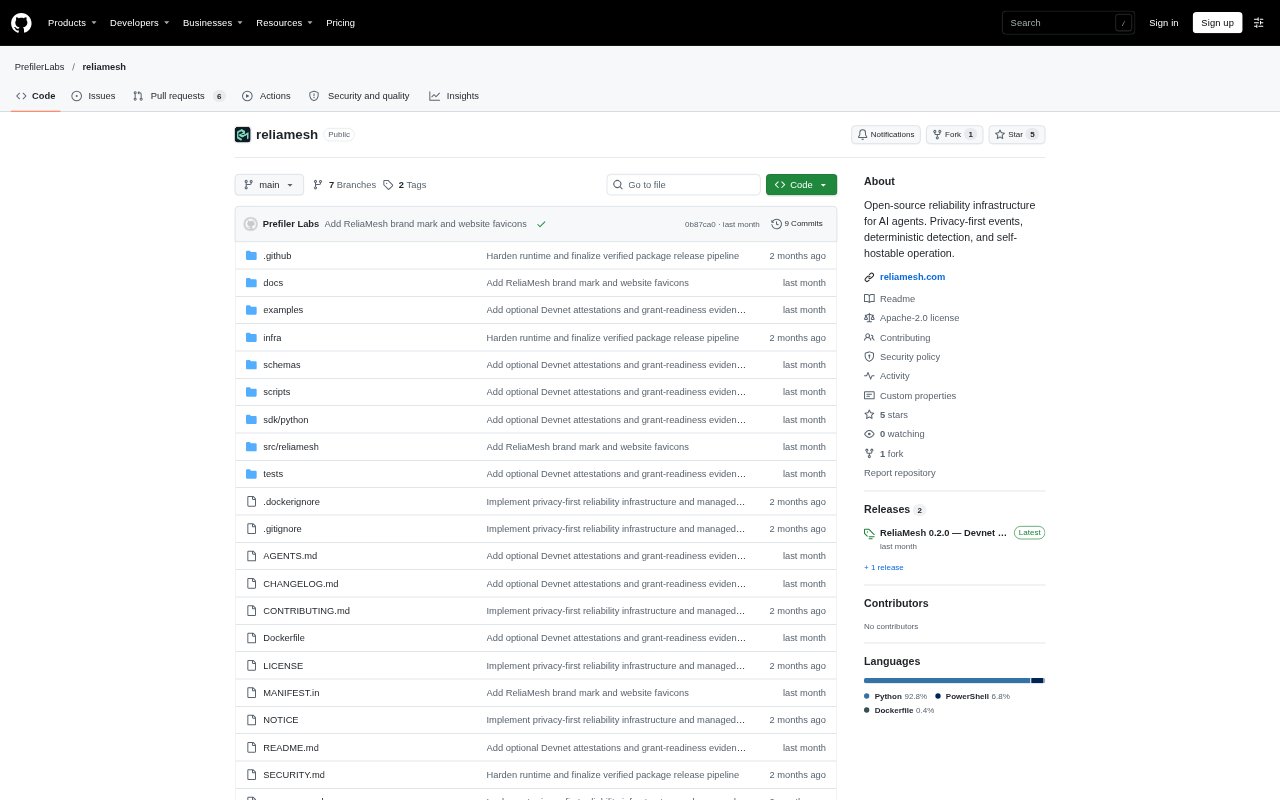
ReliaMesh is open-source reliability infrastructure for developers and operators building AI agents. It collects structured task outcomes and operational measurements, then detects deterioration and tracks recovery without collecting prompts, model responses, or tool content. A Python SDK and authenticated API support event ingestion and inspection, while SQLite enables self-hosting and a Firestore adapter supports Cloud Run deployments. The early release provides tenant-local analysis; it does not establish root cause or assess whether model text is correct.
ReliaMesh Features:
Structured Events: A versioned event contract records outcomes, failure types, counters, elapsed time, and opaque version labels while rejecting prompts, responses, tool arguments, and exception messages.
Python SDK: The SDK creates and queues reliability events, supports bounded synchronous delivery through flush, exposes delivery counters, and provides methods to inspect summaries and incidents.
Tenant Ingestion: Authenticated ingestion uses tenant-scoped keys with rotation and revocation, alongside bounded payloads, per-tenant quotas, duplicate detection, and tenant deletion.
Deterministic Detection: Detection covers high failure rates and changes in failure rate, latency, token consumption, and retries using tenant-local observations.
Incident Tracking: Version-associated observations and failure fingerprints support incident opening and recovery tracking, with authenticated endpoints for summaries and incident history.
Self-Hosted Storage: The service can run with SQLite or a Firestore storage adapter for Cloud Run, and a SQLite self-hosted service sends no outbound telemetry.
Solana Reports: An optional operator-triggered Devnet adapter commits explicitly selected count-only reliability reports and provides a verifier for report hashes and publishers.
ReliaMesh Benefits:
Task-Level Visibility: Teams can assess whether agent tasks succeeded instead of relying on HTTP uptime, which does not show whether an agent completed its work.
Reduced Content Exposure: Keeping prompts, responses, and tool content out of reliability events reduces the amount of sensitive application data sent for monitoring.
Release Comparison: Opaque version labels make it possible to associate reliability changes with releases and investigate which versions coincide with observed deterioration.
Recovery Evidence: Incident history and recovery tracking give operators a way to see whether observed reliability problems have subsided after a change.
Operational Control: Self-hosting the SQLite service avoids a managed account and keeps the core reliability path independent of a cloud account or blockchain connection.
Use Cases:
Agent Release Monitoring: Instrument a production agent with opaque release labels to check whether task failures or latency change after a deployment.
Failure Investigation: Record failure categories and fingerprints for an agent operation so operators can review recurring patterns without sending prompts or responses.
Latency and Usage Checks: Track elapsed time, token consumption, and retries for agent operations when reviewing changes in operational behavior.
Private Self-Hosting: Run the service locally with SQLite when an operator wants tenant-level reliability records without outbound telemetry from the service.
Solana Report Verification: Commit a selected count-only reliability report to Devnet and independently verify its hash and publisher.