
What is Renor?
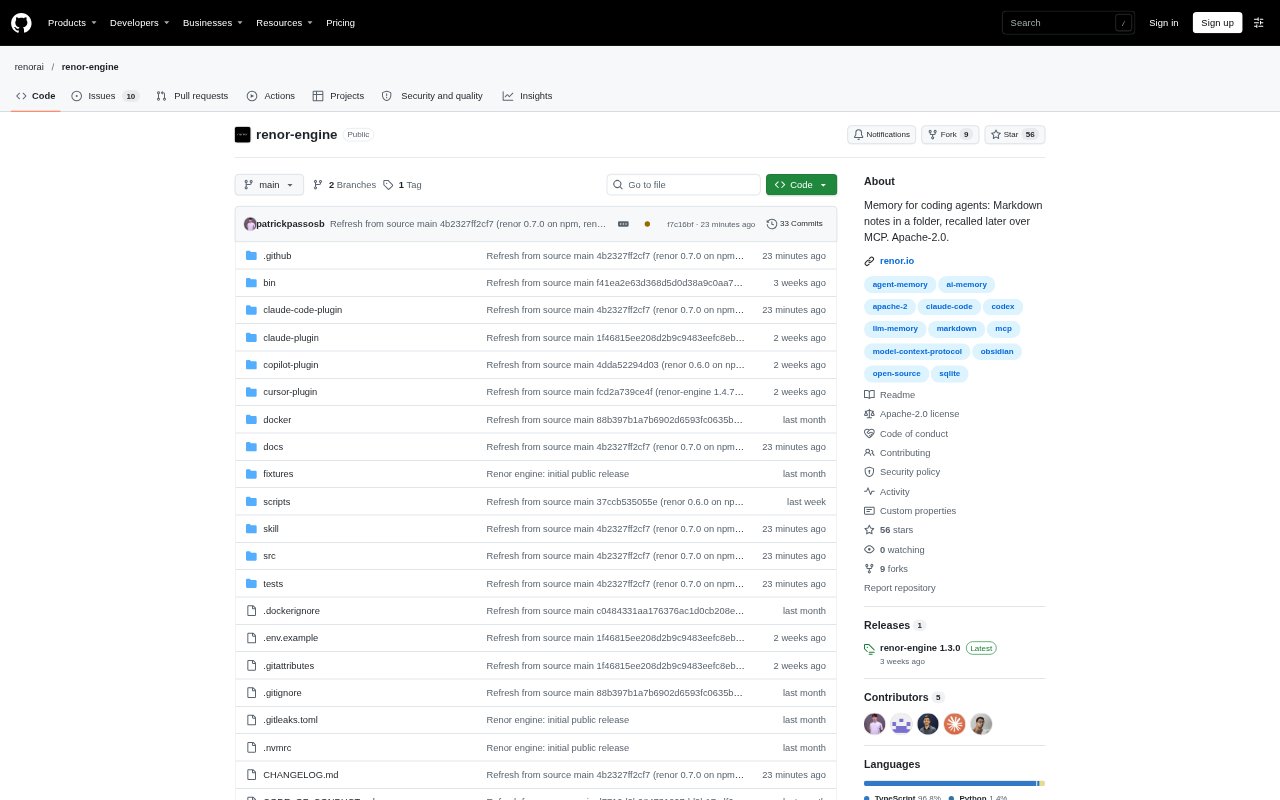
Renor gives coding agents a shared memory they can save to and recall across sessions through MCP. It is for developers who work with multiple agents, including Claude Code, Codex, Cursor, OpenCode and other MCP clients. The hosted service has a free option with 3,000 memory calls a month and a Pro plan for $10 per month. A self-hosted engine is also available for keeping memory in a folder on your machine.
Renor Features:
MCP Connections: Connect supported agents to Renor through MCP, with ready-made setup for Claude Code, Codex, Cursor, OpenCode and Pi.
Cross-Tool Recall: Agents can retrieve shared facts and notes from the same workspace, so information saved in one tool is available to others.
Facts And Notes: Save a current value as a fact or keep a statement in its original wording as a searchable note.
Correction History: When a fact changes, Renor returns the latest value while retaining earlier values and the dates they were current.
Markdown Export: Review memory in a dashboard, search it, and export the workspace contents as portable Markdown.
Scoped Memory: Keep information in global or project scopes, with a separate memory directory and search index for each hosted workspace.
Renor Benefits:
Fewer Repeated Prompts: Developers spend less time re-explaining project decisions and preferences at the start of each agent session.
Consistent Agent Work: Agents working in different tools can follow the same current project context instead of relying on separate, conflicting recollections.
Clear Decision Trail: Keeping prior values makes it easier to understand what changed and avoid treating an outdated decision as current.
Portable Memory: Markdown files and full export give users a readable copy they can inspect, edit, back up or move.
Flexible Ownership: The hosted workspace provides a managed option, while self-hosting lets developers keep memory in a local folder they control.
Use Cases:
Project Conventions: Tell one coding agent a repository rule, such as which package manager to use, and have another agent recall it later.
Technical Decisions: Record a project's database choice or deployment target so agents can use the current decision when changing code or setting up services.
Team Corrections: Save a correction after an agent uses the wrong approach, giving later sessions a chance to avoid repeating the same mistake.
Agent Switching: Move between Claude Code, Codex and Cursor while retaining the context that would otherwise stay in separate sessions.
Project Handoffs: Use saved facts and notes when returning to a project after a break or asking a different agent to continue the work.