
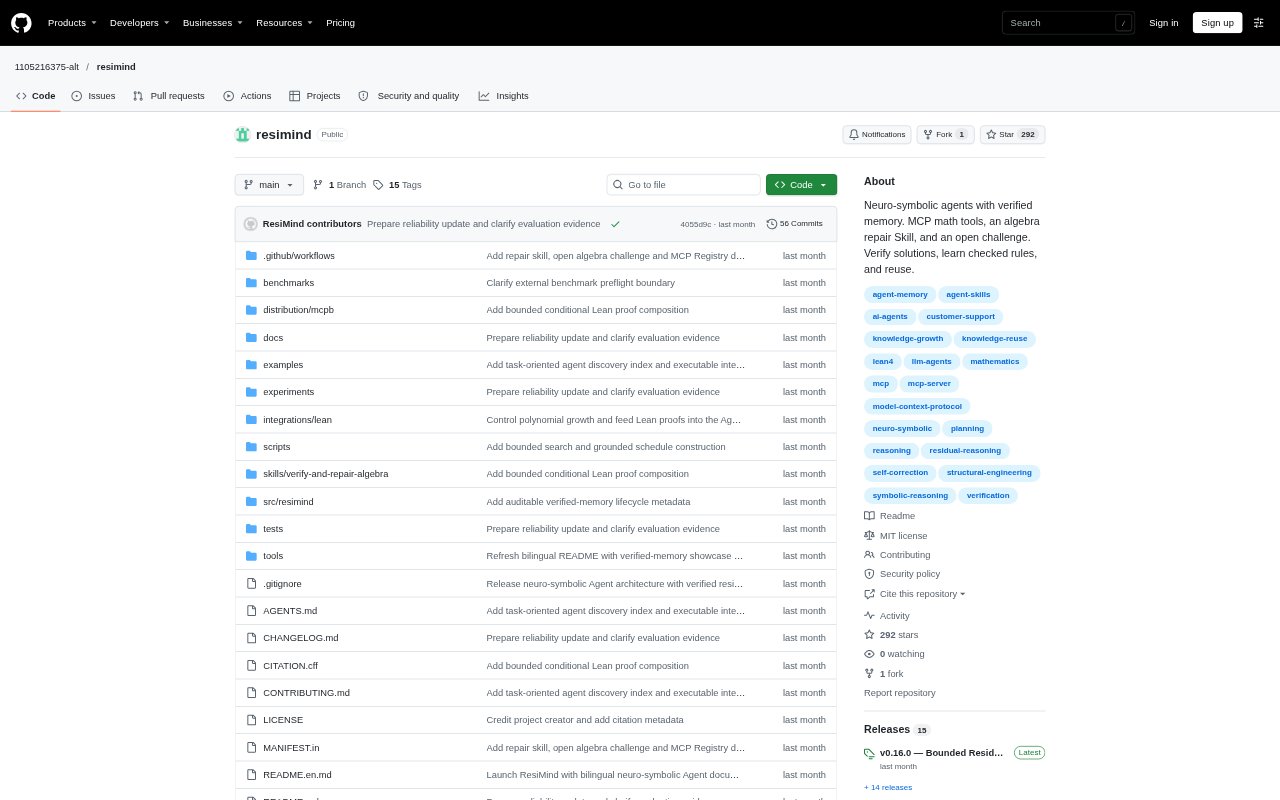
What is ResiMind?
ResiMind is an open-source neuro-symbolic architecture for AI agents that checks proposed steps with independent domain verifiers and uses failed checks to guide repair. It can extract reusable rules from completed derivations, verify them before storing, and check each application without changing a model’s weights. The Python core supports bounded polynomial reasoning, while an optional MCP server makes tools available to existing agents. The project is experimental, and its formal-planning features have a bounded scope.
ResiMind Features:
Residual-Guided Repair: When a check fails, ResiMind can direct the next attempt toward a smaller task, a verified rule, a symbolic rewrite, or a checked checkpoint.
Verified Rule Memory: Candidate rules are independently checked before admission, saved in the Python library, checked again on reload, and verified when applied to new tasks.
MCP Math Tools: An optional MCP server provides five tools for adaptive algebra and rule learning over bounded rational polynomials.
Exact Computation: Shared expressions and sparse rational certificates support long expansions within explicit resource limits.
Lean Proof Feedback: An optional Lean 4.29.0 integration checks generated rational equalities, and unfinished goals can inform the next proposal.
Composed Lean Plans: A bounded planner can introduce conditions, apply verified conditional lemmas, solve residual subgoals, and compile the full plan as one Lean proof.
Domain Verifiers: The architecture includes examples with separate checks for bridge engineering, constrained optimization, customer support, and open-ended planning.
ResiMind Benefits:
Catch Wrong Steps: Independent checks can reject a plausible but incorrect proposal before it is treated as a valid result.
Carry Work Forward: Residual feedback gives a repair attempt a concrete remaining task instead of requiring it to restart from scratch.
Reuse Checked Knowledge: Rules learned from completed derivations can help with later tasks without retraining the model.
Reduce Model Calls: Supported local math routes can handle work with zero model calls when local rules or tools are sufficient.
Inspect Decisions: JSON output and runnable examples let teams examine checks, state changes, and rule reuse in their own tests.
Use Cases:
Repair Algebra: Use the verify-and-repair workflow to find the first incorrect step in a polynomial derivation and attempt a correction.
Learn Algebra Rules: Run repeated polynomial examples to derive a checked rule, save it, and apply it to expressions with new variables or coefficients.
Add Agent Tools: Connect an existing agent to the MCP tools when it needs exact checks or bounded polynomial operations.
Check Bridge Designs: Evaluate bridge load cases where balanced forces may still leave incompatible rotations at a shared pier.
Validate Refunds: Check a customer-support refund proposal against a configured calculation before accepting the amount.
Test Constrained Plans: Use the planning examples to check whether a proposed itinerary satisfies time, budget, and route constraints.