

What is Return Ledger?
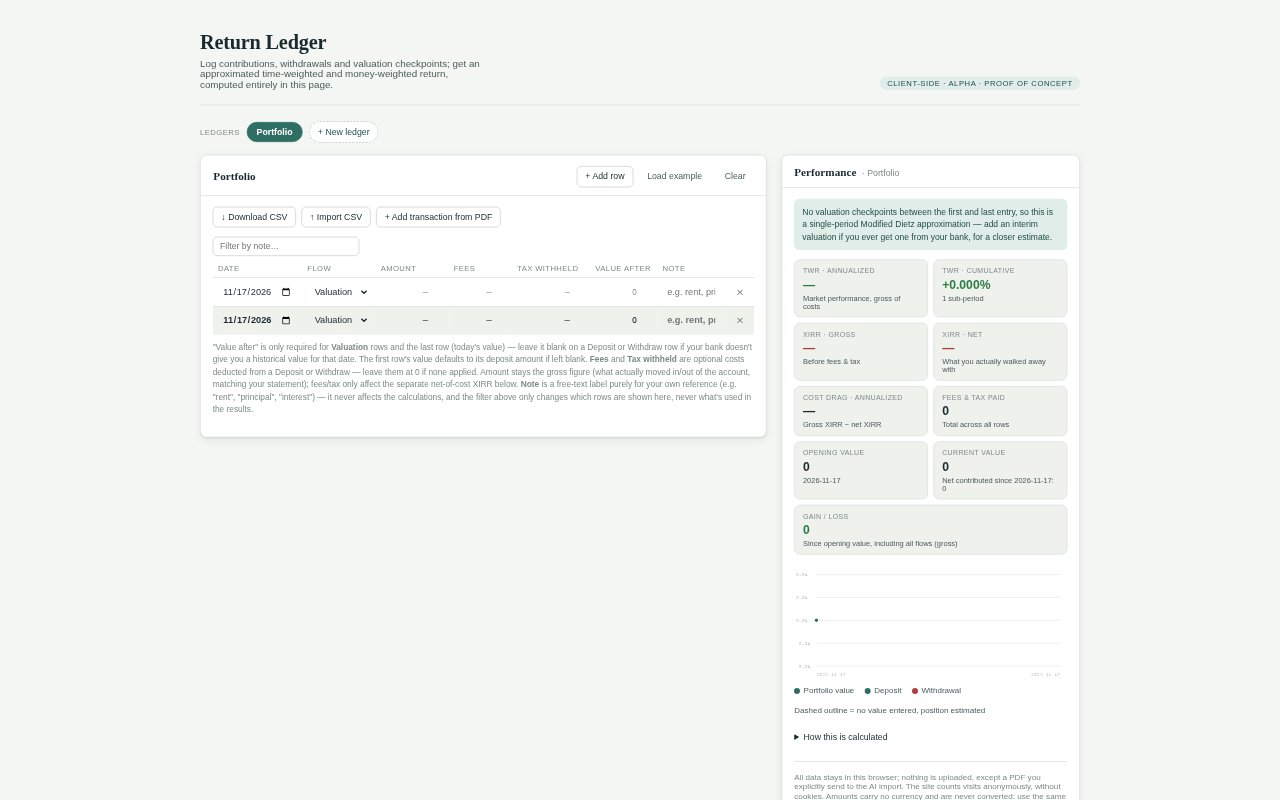
Return Ledger helps investors track contributions, withdrawals, valuation checkpoints and investment performance in a ledger. Users can enter rows themselves or upload broker and bank documents for AI-assisted entry, then check and confirm each proposed row. It calculates approximate time-weighted and money-weighted returns, including separate gross and net figures, and provides tools to compare ledgers and review yearly performance. The tool is experimental and has been tested mainly with Italian broker documents.
Return Ledger Features:
Document Reading: Upload a buy or sell confirmation, coupon or dividend notice, or position statement to have an AI model propose a ledger row.
Confirm Before Adding: Review each proposed document entry and confirm it before it becomes part of the ledger.
Ledger Entries: Record dated deposits, withdrawals and valuation checkpoints, along with amounts, fees, tax withheld, value after and a personal note.
Return Calculations: Calculate annualized time-weighted returns using chain-linked Modified Dietz estimates and money-weighted XIRR from dated cash flows.
Cost Reporting: Keep gross XIRR alongside net XIRR, which accounts for fees and tax recorded against deposits or withdrawals, and show the difference as cost drag.
Performance Views: Compare separate ledgers by return measures and view yearly TWR, gross and net XIRR, start and end values, and gain or loss.
Return Ledger Benefits:
Less Manual Entry: Document-based row suggestions can reduce the amount of transaction information users need to type into the ledger themselves.
Clearer Return Picture: Seeing TWR beside XIRR helps distinguish an asset’s estimated performance from the effect of when money entered or left.
Visible Cost Impact: Separate gross and net XIRR makes the effect of recorded fees and taxes easier to assess alongside returns.
Flexible Valuations: Users can estimate performance without entering a value for every cash flow, provided there are known values to anchor the TWR periods.
Easier Comparisons: Separate ledger comparisons let users review investments without combining valuations from different dates into a misleading total.
Use Cases:
Broker Account Tracking: Maintain a dated record of deposits, withdrawals and valuation checkpoints for an investment account.
Document-Based Logging: Turn a broker confirmation, dividend notice or position statement into a suggested entry, then verify the figures against the original.
Incomplete Valuations: Estimate TWR for an account when there are opening and closing values but no valuation for every contribution or withdrawal.
Investment Comparison: Compare separate investment ledgers using XIRR to assess money-weighted results or TWR to compare asset performance.
Annual Return Review: Review yearly returns and gain or loss for a ledger using its start and end values alongside TWR and XIRR.