
What is RevisePulse?
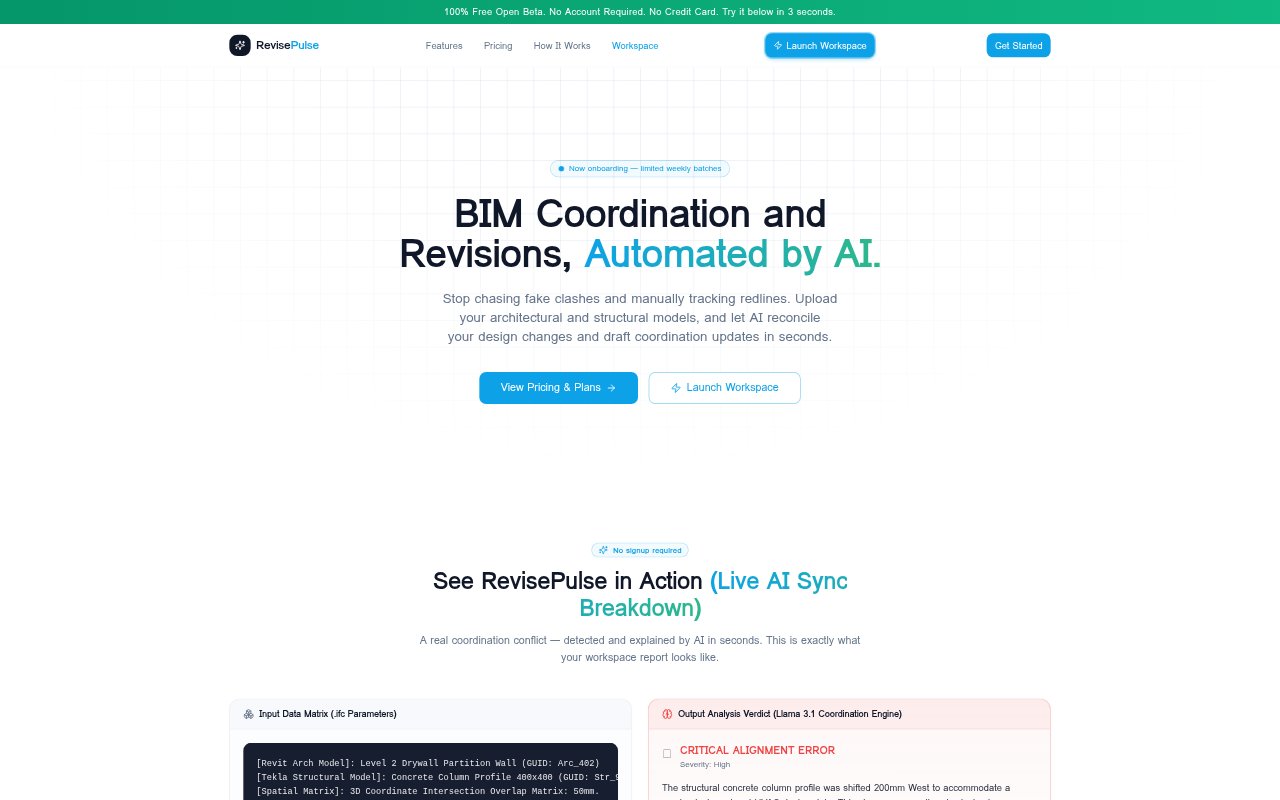
RevisePulse is a BIM coordination tool for AEC professionals who need to review design changes across architectural and structural models. It accepts IFC files, compares the models, and uses AI to assess whether nearby elements represent genuine coordination conflicts or expected junctions. The tool returns a prioritized report with issue severity, descriptions, and suggested fixes. It is aimed at engineers, draftsmen, and firms coordinating projects with multiple disciplines.
RevisePulse Features:
IFC Model Extraction: The tool parses walls, columns, slabs, and beams from IFC files, including their property sets and global coordinates.
Semantic Conflict Review: Llama-3.1 evaluates element properties and spatial context to distinguish potential coordination problems from expected connections.
Cross-Discipline Comparison: Architectural and structural IFC models can be compared side by side to identify design changes and conflicts between them.
Spatial Proximity Search: PostGIS stores model elements as 3D geometries and uses GiST spatial indexing to find nearby element pairs for review.
Prioritized Reports: Coordination findings include severity, a description, and a suggested fix, with reports formatted as JSON.
Project Workspaces: The Growth tier includes a team collaboration workspace, while project and processing limits vary by coordination tier.
RevisePulse Benefits:
Less Review Noise: Filtering out false positives helps coordination teams spend less time sorting through clashes that do not represent real issues.
Quicker Decisions: Prioritized findings give engineers a clearer starting point for deciding which coordination problems need attention first.
Faster Turnaround: Automated model review can reduce the wait associated with manually checking revisions and preparing coordination updates.
Clearer Handoffs: Descriptions and suggested fixes give project participants shared context when discussing how to resolve a reported conflict.
Less Manual Tracking: Automated comparison reduces the need to chase redlines and keep a separate manual record of design changes.
Use Cases:
Revision Checks: Compare updated architectural and structural IFC files to see what changed and whether those changes create coordination conflicts.
HVAC Coordination: Review a mechanical routing update against structural columns and architectural partitions before finalizing the surrounding layout.
Issue Triage: Use severity-ranked findings to decide which model conflicts an engineering team should address first.
Coordination Updates: Prepare issue descriptions and suggested fixes for teams drafting updates after a cross-discipline model review.
Project Team Review: Coordinate multi-discipline model reviews in a shared workspace for projects handled by a growing firm.