

What is Rezonant?
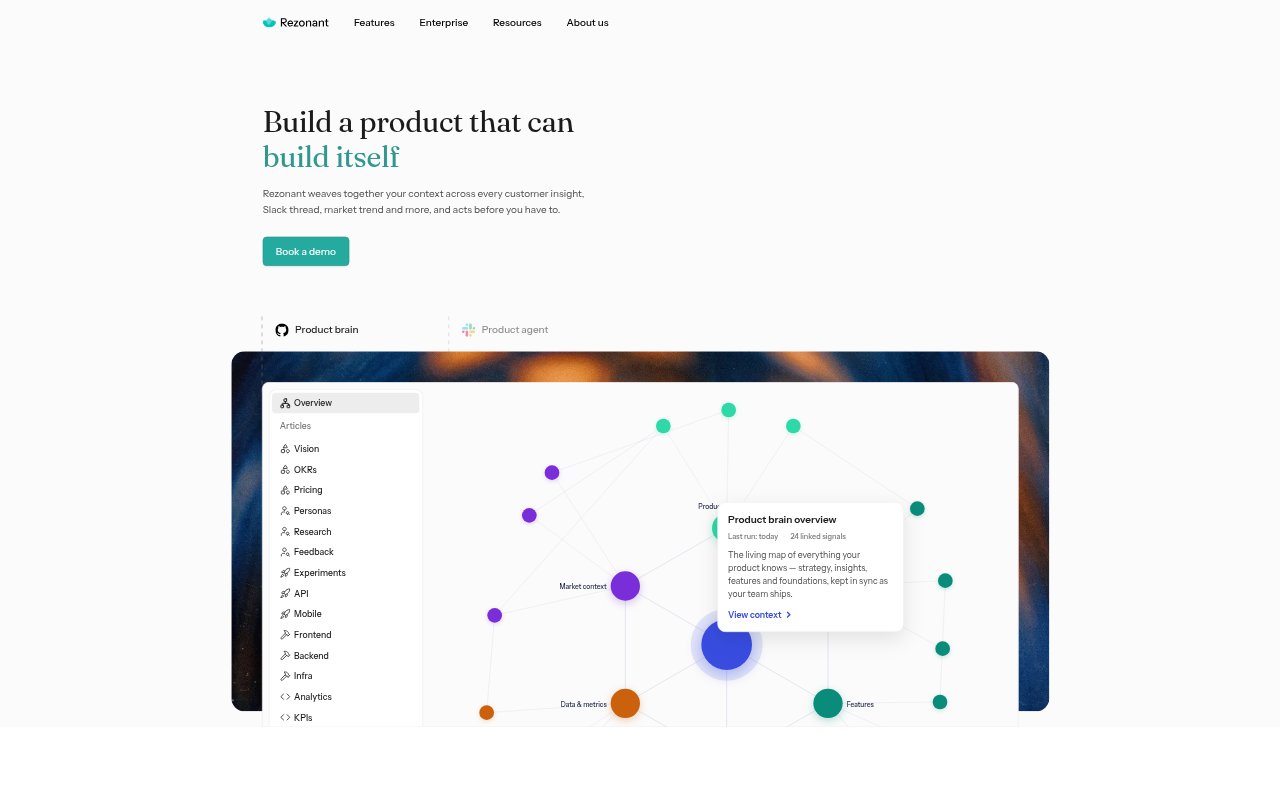
Rezonant is a product context and agent platform for product teams at technology companies. It gathers company knowledge from connected tools, codebases, customer calls, and manually added information, then organizes it into a product brain stored in GitHub. Its agent uses that context to create product work such as prototypes, specs, tickets, and pull requests, while Slack approvals keep people involved in decisions that need human judgment.
Rezonant Features:
Product Brain: A living map organizes product strategy, customer insights, features, and foundations, and updates as new context comes in.
Connected Context: Rezonant can gather information from GitHub, Linear, Granola, Slack, Notion, Google Suite, customer calls, and manual additions.
Product Artifacts: The agent can produce prototypes, product requirements documents, specs, tickets, and pull requests using the product brain.
Slack Approvals: The agent can ask for decisions and approval in Slack when work needs a person’s judgment.
Coding Agent Context: The product brain supplies shared company and product context to coding agents, including OpenClaw, Hermes, Claude, and Codex.
GitHub Storage: The product brain can be hosted in a team’s own GitHub organization, keeping its context under the team’s control.
Rezonant Benefits:
Less Context Hunting: Teams can spend less time piecing together scattered decisions because product knowledge from multiple sources is organized in one place.
Faster Routine Work: Delegating specs, tickets, prototypes, and straightforward pull requests gives product teams more time for customer conversations and strategy.
More Consistent Decisions: Agents can draw on product principles, OKRs, and prior context to make work more consistent with the team’s direction.
Human Oversight: Slack approval requests let teams keep people involved in consequential calls without requiring them to handle every routine task.
Shared Agent Context: A common product brain helps prevent teams and coding agents from working with isolated or incomplete company information.
Use Cases:
Customer Request Triage: After a customer asks for a feature on a call, use the transcript and product context to assess the request and prepare a fix or decision document.
Backlog Review: Have the agent comb through product backlog items to identify duplicate work or requests that conflict with strategy.
Product Specification: Use existing customer insights, product foundations, and goals to prepare a spec or PRD for a proposed feature.
Prototype Preparation: Ask the agent to build a prototype informed by the team’s product context before deciding how to proceed.
Coding Agent Setup: Give a coding agent the wider product picture, including customer feedback, backlog context, and upcoming OKRs.