

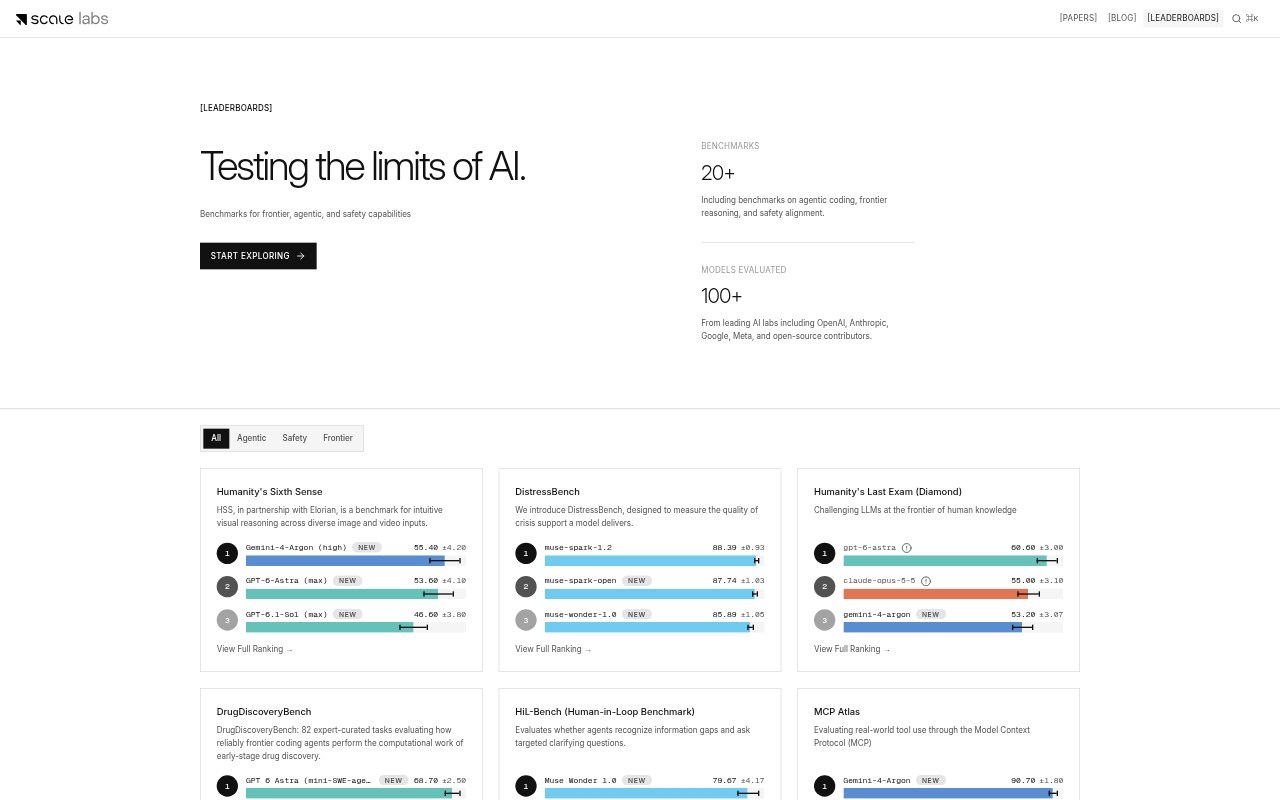
What is SEAL LLM Leaderboard?
SEAL LLM Leaderboard is a collection of rankings that compares AI models on benchmarks for reasoning, coding, agent tasks, safety, and other capabilities. It is aimed at people evaluating frontier and open-source models, including teams choosing models for a particular kind of work. Each leaderboard presents benchmark results for named models, giving readers a way to compare performance across specific evaluation tasks.
SEAL LLM Leaderboard Features:
Benchmark Rankings: View model rankings across a range of evaluations, including Humanity’s Last Exam, MultiChallenge, and the Remote Labor Index.
Coding Evaluations: Compare coding agents on long-horizon software tasks, codebase comprehension, test writing, and refactoring.
Professional Reasoning: Review separate finance and legal practice rankings from the Professional Reasoning Benchmark.
Agent Tool Use: See results for MCP Atlas, which evaluates real-world tool use through the Model Context Protocol.
Safety Benchmarks: Explore evaluations covering crisis support, safety alignment, and risks related to national security and public safety.
Multimodal Tasks: Compare models on visual reasoning with image and video inputs, as well as spoken dialogue in multi-turn interactions.
Evaluation Approach: Benchmarks combine human-designed criteria with LLM-scaled evaluation and curated private and open-source datasets.
SEAL LLM Leaderboard Benefits:
Focused Comparison: Task-specific rankings help narrow a model shortlist around the work that matters, rather than relying on a single overall score.
Clearer Tradeoffs: Separate results for areas such as test writing and refactoring make it easier to see where coding agents differ.
Broader Assessment: Coverage across capabilities helps teams consider strengths and limitations beyond general reasoning or coding.
More Informed Choices: Seeing scores for multiple named models gives evaluators concrete evidence to weigh when deciding what to test further.
Evaluation Context: Benchmark descriptions clarify the task being measured, helping readers judge whether a result is relevant to their needs.
Use Cases:
Model Selection: Compare candidate LLMs before choosing which ones to evaluate for an internal product or workflow.
Coding Agent Review: Check how coding agents perform on repository-level tasks, code questions, test writing, or refactoring.
Finance and Legal: Review benchmark results when assessing models for professional reasoning tasks in finance or legal practice.
Agent Evaluation: Look up model performance on tool use, remote work, or tasks that test whether an agent asks clarifying questions.
Safety Research: Examine evaluations of crisis support and public-safety risks when researching model behavior in sensitive settings.
Multimodal Comparison: Compare visual reasoning or spoken-dialogue results when considering models for image, video, or audio interactions.