

What is Search2o?
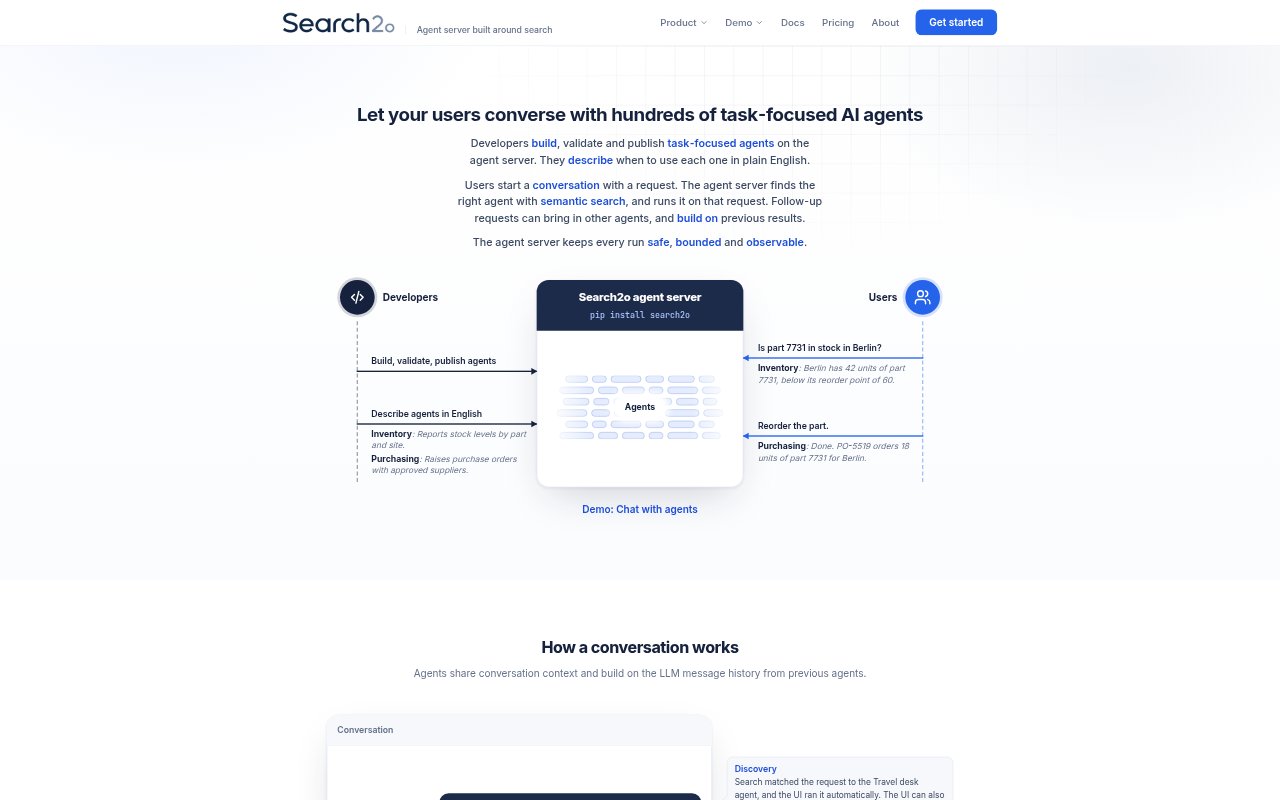
Search2o is a platform for developers and organizations to create, publish, and run task-focused AI agents through search. Users make a request in a conversation, and the agent server finds an appropriate agent; follow-up requests can involve other agents while retaining conversation context. The server runs in an organization, with state stored in Search2o Cloud. The server has no license fee, and Cloud is free during beta, with paid service planned at general availability.
Search2o Features:
Semantic Agent Routing: Developers describe when an agent should be used in plain English, and the server searches for a suitable agent to run on a user's request.
Shared Conversation Context: Agents can use the conversation history and results from earlier agents, while follow-up requests can bring additional agents into the same conversation.
AI-Assisted Drafting: Developers can draft agents with AI and use a schema-aware code editor to define them in JSONC, a format that supports comments.
Controlled Agent Runtime: Agents are defined as functions and commands, with runs kept bounded and observable; Python expressions are evaluated in a controlled runtime.
Organization Environments: The stateless agent server can run in an organization, and profile names let agents use separate development and production systems without changes to the agent.
Security and Access: Secrets can be stored in a vault, conversations and memories are encrypted by default or end to end, and access includes four roles, service accounts, and single sign-on.
Integration Options: Organizations can connect their code through Python expressions inside agents, the REST API, or hooks at server decision points.
Search2o Benefits:
Less Manual Routing: People can describe what they need instead of choosing from a catalog of agents, while search directs requests to an agent suited to the task.
More Continuous Work: Shared conversation history lets later agents build on earlier results, reducing the need for users to repeat context during a multi-step request.
Faster Agent Creation: AI drafting and schema-aware editing give developers a guided way to turn a task description into an agent definition.
Consistent Environments: Using profile names for development and production systems helps teams keep one agent definition as it moves between environments.
Clearer Oversight: Observable runs and configurable logging help teams inspect agent activity and understand calls made to the cloud.
Use Cases:
Internal Request Triage: An organization can route employee requests to task-specific agents by describing each agent's intended purpose in plain English.
Multi-Step Workflows: A user can start with one request and involve additional agents in follow-ups that build on the same conversation history.
Agent Prototyping: A developer can use AI drafting and the editor to create and validate an agent before publishing it for users.
Environment Testing: A team can run an agent against development systems through one profile and use a production profile for live systems.
Custom Integrations: Developers can connect an agent service to organizational code or systems using Python expressions, REST API calls, or server hooks.