

What is Secret Guard?
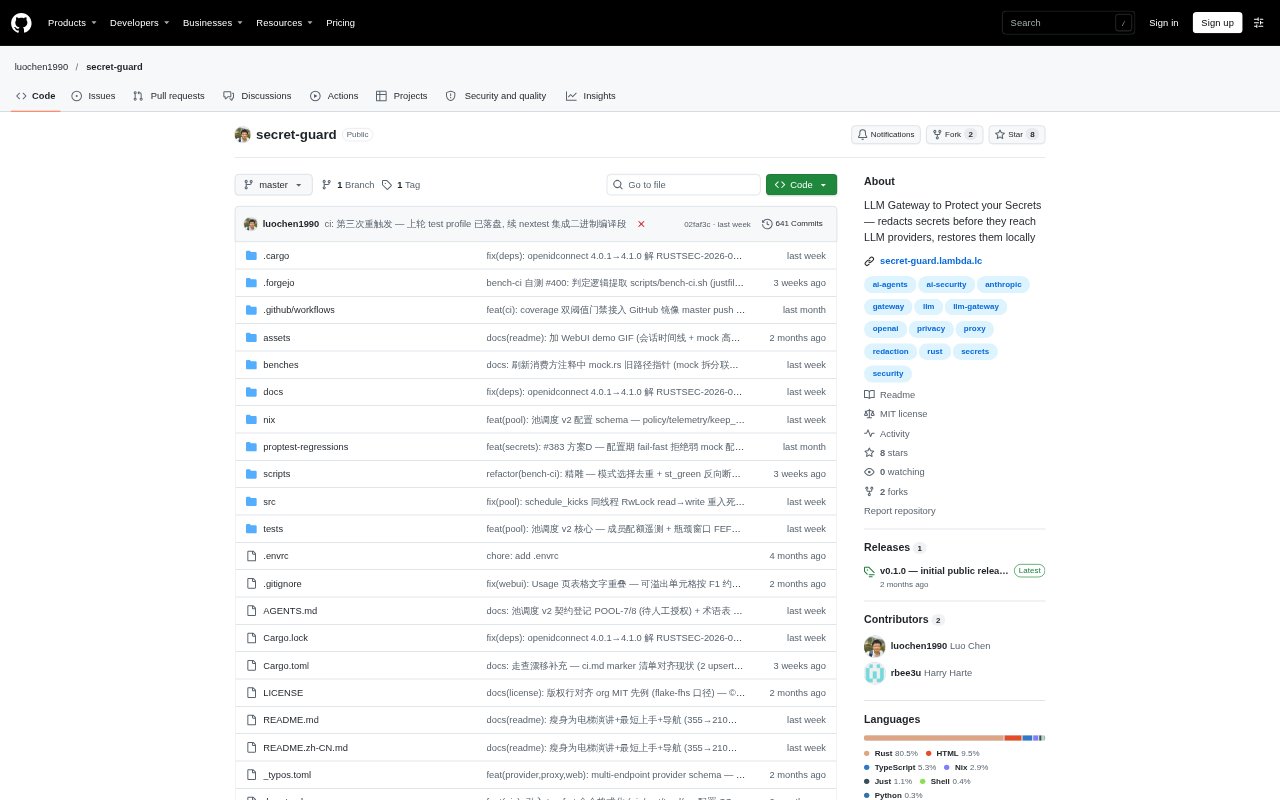
Secret Guard is a local gateway between AI agent tools and LLM providers. It replaces registered secrets in supported outbound requests with realistic mock values, then restores the real values in returned responses, including tool-call arguments. The gateway is designed for people using coding agents and other LLM-powered tools that need credentials to act on real systems. It also provides provider routing, protocol translation, and a WebUI for inspecting forwarded traffic.
Secret Guard Features:
Secret Replacement: Replace registered secrets in supported outbound requests with equal-length, same-character-set mock values before forwarding them to an LLM provider.
Response Restoration: Restore mock values to their corresponding real secrets in responses, including tool-call arguments returned to the local agent.
Secret Policies: Set a per-secret strategy to redact, reject the request, substitute a visible placeholder, or pass the value through with auditing.
Provider Routing: Route requests to configured providers using model-wildcard rules, or connect multiple coding-plan subscriptions through a failover pool.
Protocol Translation: Translate between OpenAI, Anthropic, and Responses API formats, including streaming; Gemini and Ollama are forwarded without secret-redaction support.
Traffic Inspection: Review session timelines and request details in the WebUI, with an option to capture full request and response bodies for troubleshooting.
Secret Guard Benefits:
Protect Credentials: Keep real passwords, tokens, private keys, and cookies out of supported requests sent to LLM providers while agents continue working with credentials locally.
Preserve Tool Workflows: Maintain authenticated agent actions, since restored values can reach local tools in returned commands and other tool-call arguments.
Choose Risk Controls: Match handling to the sensitivity of each credential, from replacing it to blocking a request or allowing an audited pass-through.
Investigate Requests: Use recorded request details to understand what the model received and troubleshoot issues without relying only on a brief log summary.
Reduce Setup Friction: Connect an agent by pointing its API base URL at the local gateway, without changing how the agent works with its tools.
Use Cases:
Coding Agent Work: Run a coding agent against a project whose files or terminal output may contain API keys, while keeping registered values from reaching the model provider.
Authenticated Commands: Let an agent prepare or run commands that need a token, then restore the real credential in the returned tool-call arguments.
Provider Switching: Connect an agent using one supported API format to a provider using another, such as routing OpenAI-format traffic to an Anthropic endpoint.
Plan Pool Failover: Keep coding-agent traffic moving across configured coding-plan subscriptions when a usage window is exhausted, and return to a plan after its reset.
Request Troubleshooting: Inspect a session after an unexpected agent response, comparing the request view sent to the LLM with the restored response.
Unknown Secret Review: Check the privacy-scan panel for token-shaped values not covered by registered secrets, then review and register a value when appropriate.