

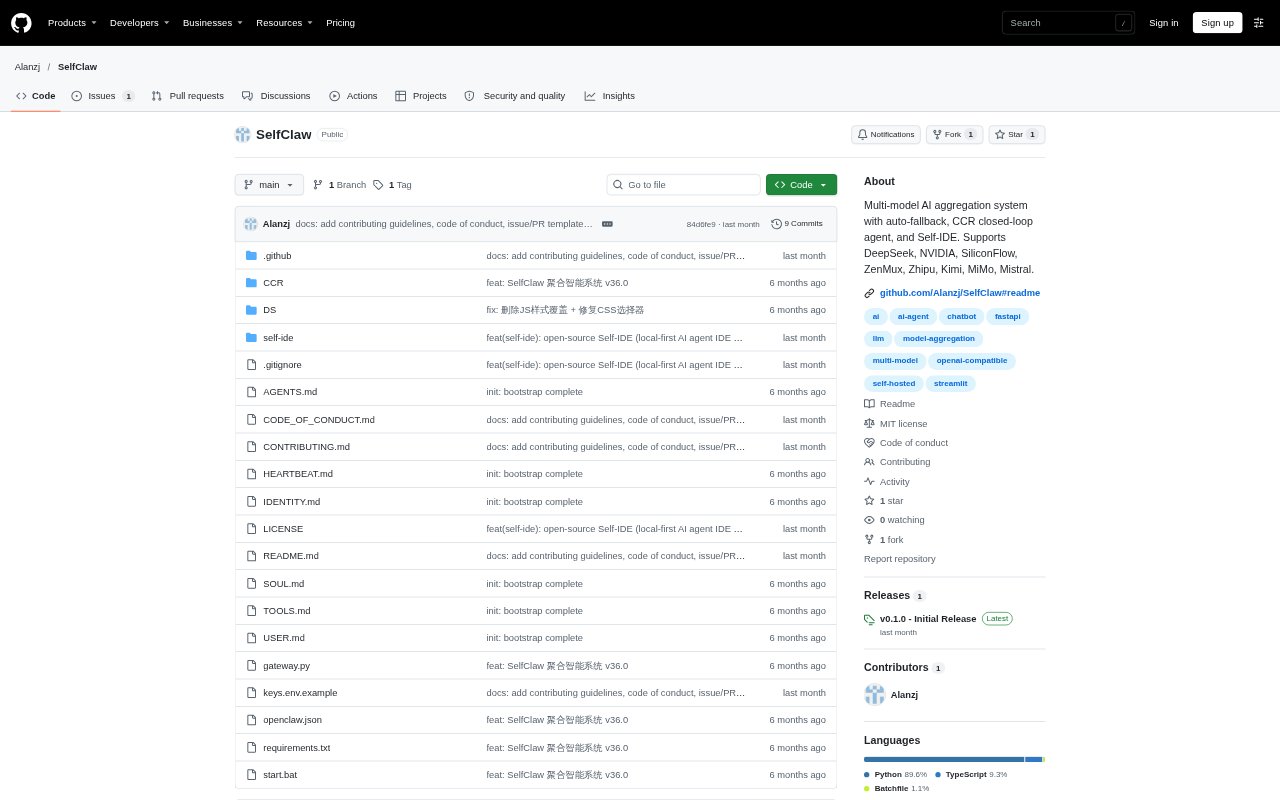
What is SelfClaw?
SelfClaw is a locally run AI conversation system that routes requests across multiple model providers through a Streamlit web interface and FastAPI gateway. It is for people who want a configurable model pool, fallback handling, and agent tools in one Python-based setup. The project also includes Self-IDE, a local AI agent service with a VS Code extension, for developers who want a proxy and agent orchestration workflow alongside the chat system.
SelfClaw Features:
Model Provider Pool: Connect models from providers including DeepSeek, NVIDIA, SiliconFlow, ZenMux, Zhipu, Kimi, MiMo, and Mistral through a configurable model pool.
Automatic Fallback: When a model fails, the system can retry temporary errors, switch models, blacklist persistent failures for 24 hours, and cool down after broad outages for three minutes.
CCR Agent Workflow: The CCR agent combines tool calling, memory management, reflection and repair, and strategy evolution in a closed-loop workflow.
File and Web Tools: Read, write, and list files and directories, parse PDF, Word, and Excel documents, and search the web with Bing and Baidu.
Voice Interaction: Use speech recognition for voice input and edge-tts for spoken responses.
Model and IDE Controls: Manage models with visual add, edit, delete, and drag-sorting controls; Self-IDE adds a local proxy, goal engine, subagent orchestration, and cost meter.
SelfClaw Benefits:
Fewer Manual Switches: Automatic routing and retries reduce the need to intervene whenever a selected model encounters a temporary error or persistent failure.
Flexible Model Choice: Provider options and model ordering let users shape how requests are handled instead of relying on a single provider.
Less Context Switching: Working with documents and web search in the same system can reduce the effort of moving between chat, file inspection, and lookup tools.
Alternative Interaction: Voice input and spoken replies give users an option beyond composing every prompt by keyboard or reading each response on screen.
Local IDE Workflow: The local agent service and VS Code extension keep Self-IDE's proxy and orchestration tools available in a developer-focused setup.
Use Cases:
Configure Model Routing: Set up a prioritized model pool for a personal or business chat workflow that should try available providers in a chosen order.
Run Agent Tasks: Use the CCR agent for tasks that call tools, manage memory, and can benefit from a reflection-and-repair step.
Work With Documents: Inspect PDF, Word, or Excel files and use directory listing or file read and write operations as part of a chat workflow.
Search for Answers: Use Bing and Baidu search when gathering web information to help answer a question in the chat system.
Develop With Self-IDE: Run the local agent service with its OpenAI-compatible proxy, goal engine, and subagent orchestration as a developer workflow.