

What is SelfJev?
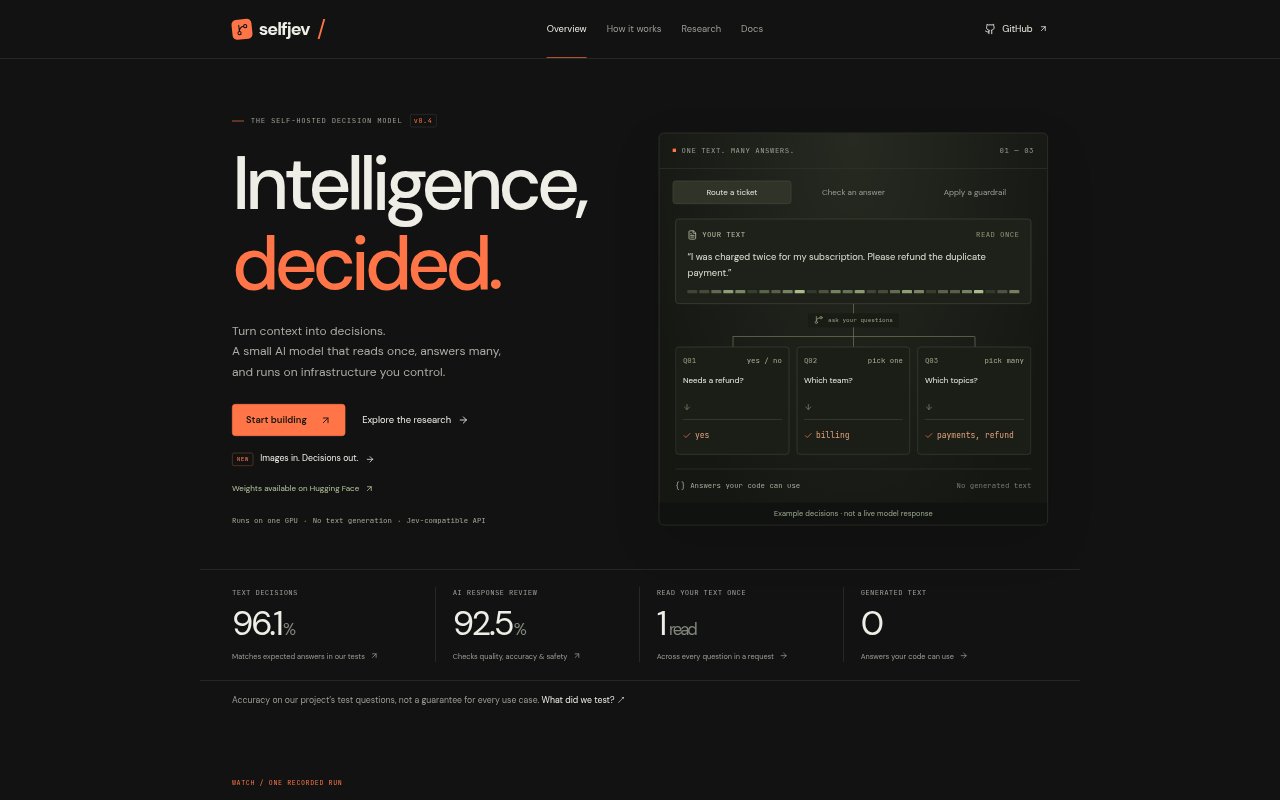
SelfJev is a self-hosted 4B model for turning text, images, and questions into structured decisions. It returns choices and probabilities rather than a generated conversational response, with answer formats for yes or no, choosing one option, rating a result, or selecting multiple options. It is designed for teams that want to run decision workflows on their own GPU, including developers building applications that need to route requests, apply policies, or review AI outputs.
SelfJev Features:
Structured Answers: Choose from four answer formats: yes or no, pick one, rate a result, or select all that apply.
Shared Context: Ask several questions about the same text while reusing its initial processing, so each question does not start from scratch.
Image Inputs: Use images alongside text through the native API, passing a file path, image bytes, a PIL image, or an HTTP data URL.
Self-Hosted API: Run the model on your own GPU and serve requests through an API, with a Python SDK and Docker deployment support.
Workflow Fine-Tuning: Adapt the model with labeled examples from your workflow using supervised fine-tuning tools or fine-tuning jobs over HTTP.
Configurable Context: Set the text context limit for your deployment, with a default of 32,768 tokens and larger windows requiring sufficient memory and validation.
SelfJev Benefits:
Less Repeated Processing: Reusing a text’s initial processing across questions can reduce duplicated work when an application needs several decisions about one input.
Data Control: Keeping inference on infrastructure you control lets teams process sensitive inputs without sending them to an external model API.
Faster Decisions: Direct, structured outputs give applications results they can route, filter, or review without waiting for a conversational response.
Workflow Fit: Training on verified examples can help align decisions with a team’s labels, policies, vocabulary, and edge cases.
Deployment Choice: Support for local machines and dedicated GPUs gives teams room to choose infrastructure suited to their workload.
Use Cases:
Support Request Routing: Classify a customer message by issue, responsible team, or next action, then use the results to direct the request.
Refund Triage: Review a message about a duplicate subscription charge to identify whether it needs a refund and which team should handle it.
Agent Review: Check an AI agent’s response against questions or criteria before deciding whether the output is ready to use.
Policy Decisions: Apply a policy to a document or request by asking a set of questions and using the resulting choices in an application.
Photo Classification: Fine-tune image decisions for categories such as pets, clothing, plant health, rice, satellite land use, or waste.