

What is Sentient?
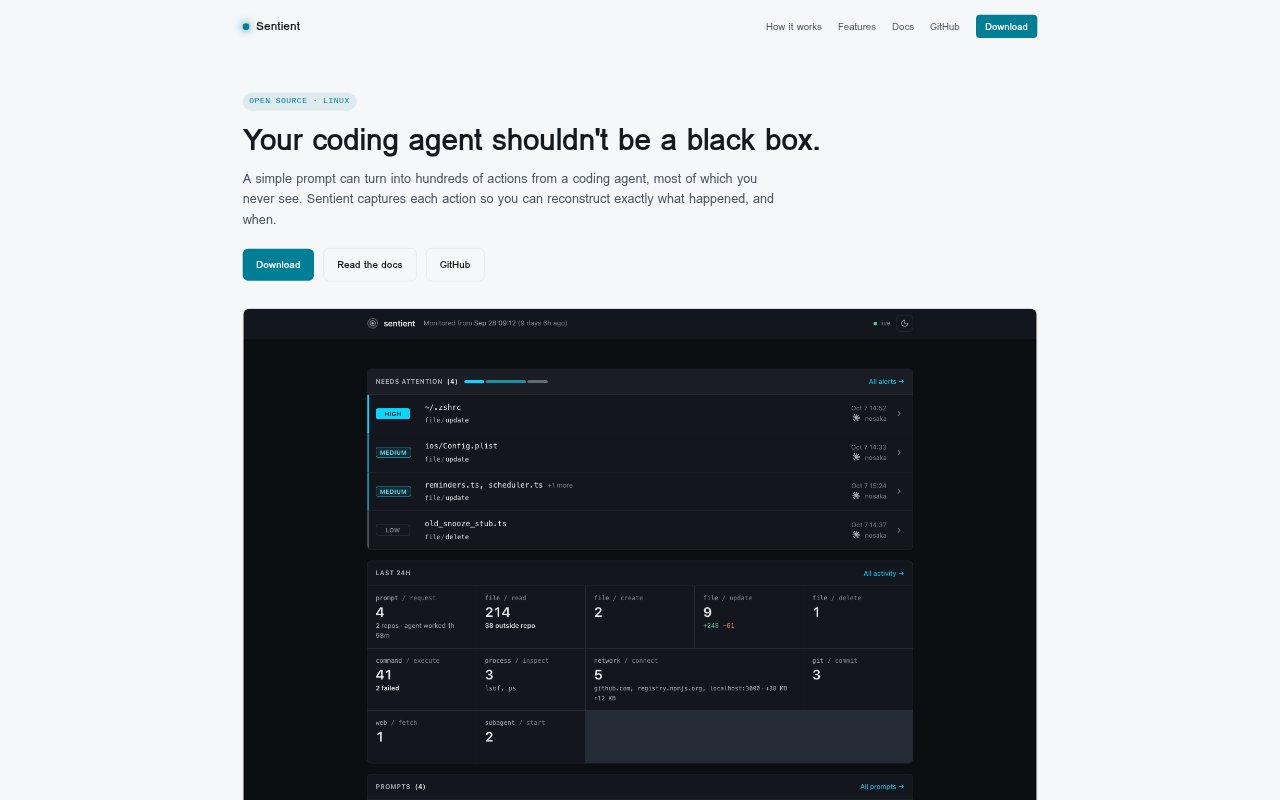
Sentient is an open-source monitor for coding agents that records activity beyond the visible chat, including file, process, and network events. It combines kernel-level records with agent session logs so developers can connect actions to the prompts that led to them and inspect what changed. A local dashboard and command-line summary support session review. Sentient is designed for Linux and runs separately from the coding agent.
Sentient Features:
Action Timeline: Review a timeline of files read, created, changed, or deleted, alongside commands, processes, network connections, and source control operations.
Kernel Event Capture: Capture file, process, and network events with eBPF through Tetragon while the agent runs as a regular user.
Prompt Context: Connect recorded actions to the relevant agent session and prompt, including the reason the agent gave for its work.
Risk Ranking: Bring operations such as edits outside the repository, file deletions, sudo use, and shell profile changes to attention with high, medium, or low severity.
Change Diffs: Inspect the lines added and removed for each file change, including changes to files outside the repository.
Command Breakdown: Unpack long pipelines and inline scripts to show what they touched, making complex commands easier to inspect.
Local Review Tools: Use sen status for a command-line summary or open the localhost dashboard to drill into a flagged change, its diff, command, and prompt.
Sentient Benefits:
Fewer Blind Spots: A record beyond the chat helps developers account for agent work carried out through scripts and shell commands, not only visible edits.
Clearer Reviews: Seeing the prompt, command, and resulting change together gives reviewers more context for judging whether an agent's work matches its task.
Focused Attention: Surfacing potentially risky operations helps developers direct review toward changes that may need closer inspection.
Easier Investigation: Breaking down cryptic commands and showing file diffs makes it easier to understand what happened during an agent session.
Tamper Resistance: Because the monitor runs separately under systemd and the agent cannot edit or switch off its record, session evidence is less dependent on the agent's own account.
Use Cases:
Agent Code Review: Review an agent's completed coding task before accepting its work, checking the changes alongside the prompts and commands that produced them.
Deletion Investigation: Trace a surprising file deletion to the command and session behind it, then inspect which lines were removed.
Script Inspection: Check what a long pipeline or inline script touched when an agent's command is difficult to interpret from the terminal history.
Repository Boundary Checks: Investigate an agent session that may have changed files outside the project repository or altered a shell profile.
Remote Session Checks: Check a session's summary or review a flagged change from a phone by reaching the local dashboard through an SSH tunnel or Tailscale.