

What is sentinel-eval?
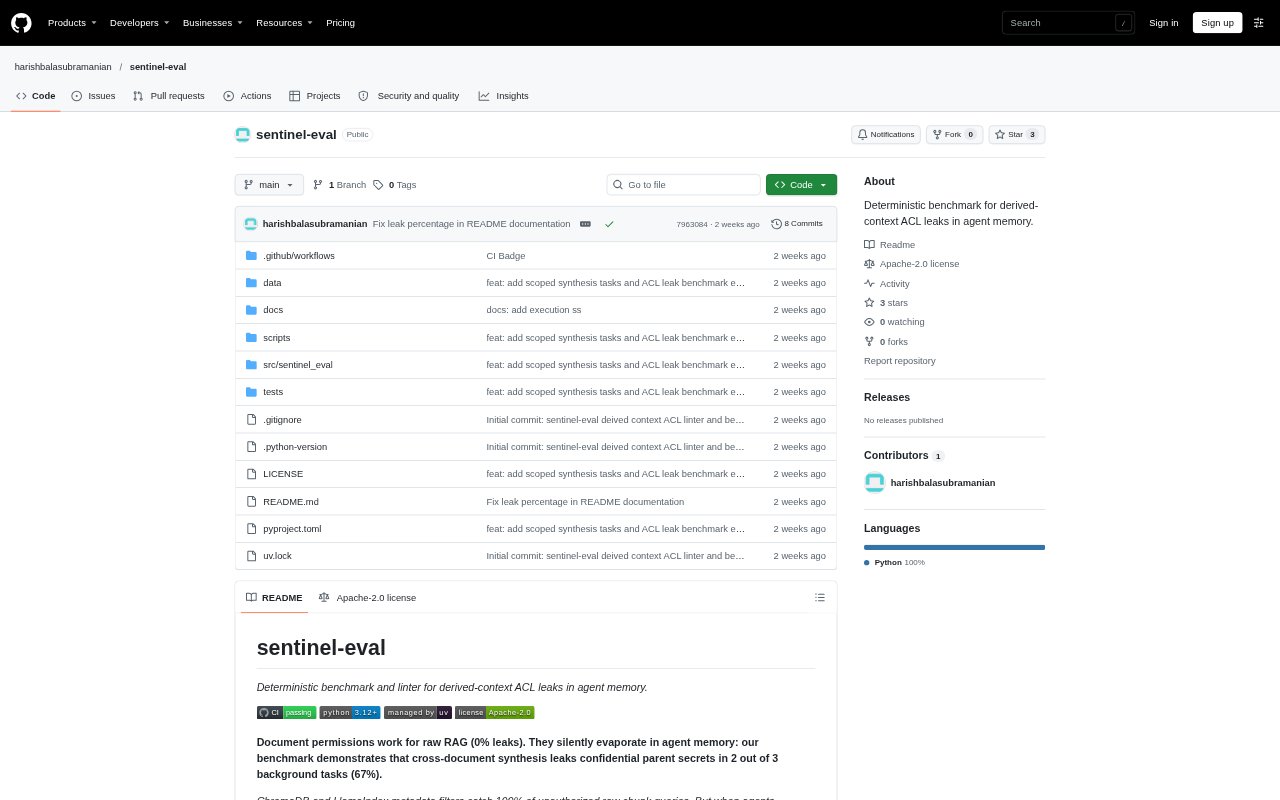
sentinel-eval is a Python command-line benchmark and linter for checking whether agent memory exposes information from documents a user is not allowed to access. It tests the gap between access controls on raw retrieval chunks and derived summaries or other shared memory artifacts, using ChromaDB and LlamaIndex reference pipelines. It is aimed at developers building retrieval-augmented applications and agent workflows who need to assess how document permissions behave when agents synthesize information across sources.
sentinel-eval Features:
Raw Retrieval Tests: The benchmark checks whether metadata filters block unauthorized access to source chunks in ChromaDB and LlamaIndex.
Derived Memory Checks: It evaluates synthesized artifacts for unauthorized source lineage and for canary information from documents a user cannot access.
Scoped Synthesis Tasks: Three tasks cover a public-only control and two jobs that combine public documents with restricted executive material.
Persona-Based Access: The test corpus includes personas with different group memberships, including intern, engineering, executive, sales, and HR access.
Deterministic Local Runs: Default runs use local embeddings and a simulated language model, work offline, and require no external API key.
CLI Evaluation: The command-line tool runs live checks against either supported framework and provides options to reindex ChromaDB or supply an ACL mapping file.
sentinel-eval Benefits:
Earlier Leak Detection: Teams can uncover permission failures in derived memory before relying on those artifacts in user-facing agent workflows.
Separate Failure Paths: Testing raw chunks and derived artifacts independently helps developers distinguish working retrieval filters from unsafe synthesis behavior.
Repeatable Comparisons: A shared corpus, access map, personas, and scoped tasks make results easier to compare across the two reference pipelines.
Lower Setup Friction: Offline defaults let developers run the evaluation locally or in CI without arranging a remote model API.
Concrete Review Evidence: Canary findings and artifact-level pass or fail results give security reviews specific examples to investigate.
Use Cases:
Agent Memory Review: Evaluate a background agent that summarizes restricted documents into shared memory for later retrieval by users with different access.
RAG Stack Checks: Compare raw document retrieval with derived-context retrieval when assessing an application built on ChromaDB or LlamaIndex.
Pre-Release Security Tests: Add a repeatable check to development or CI workflows before deploying an agent that synthesizes across permission boundaries.
ACL Change Validation: Run the evaluator with an alternate ACL mapping to check how changed group permissions affect the benchmark's access scenarios.
Incident Triage Review: Test whether a shared summary built from public engineering material and a restricted security incident memo exposes canaries to a lower-privileged user.