
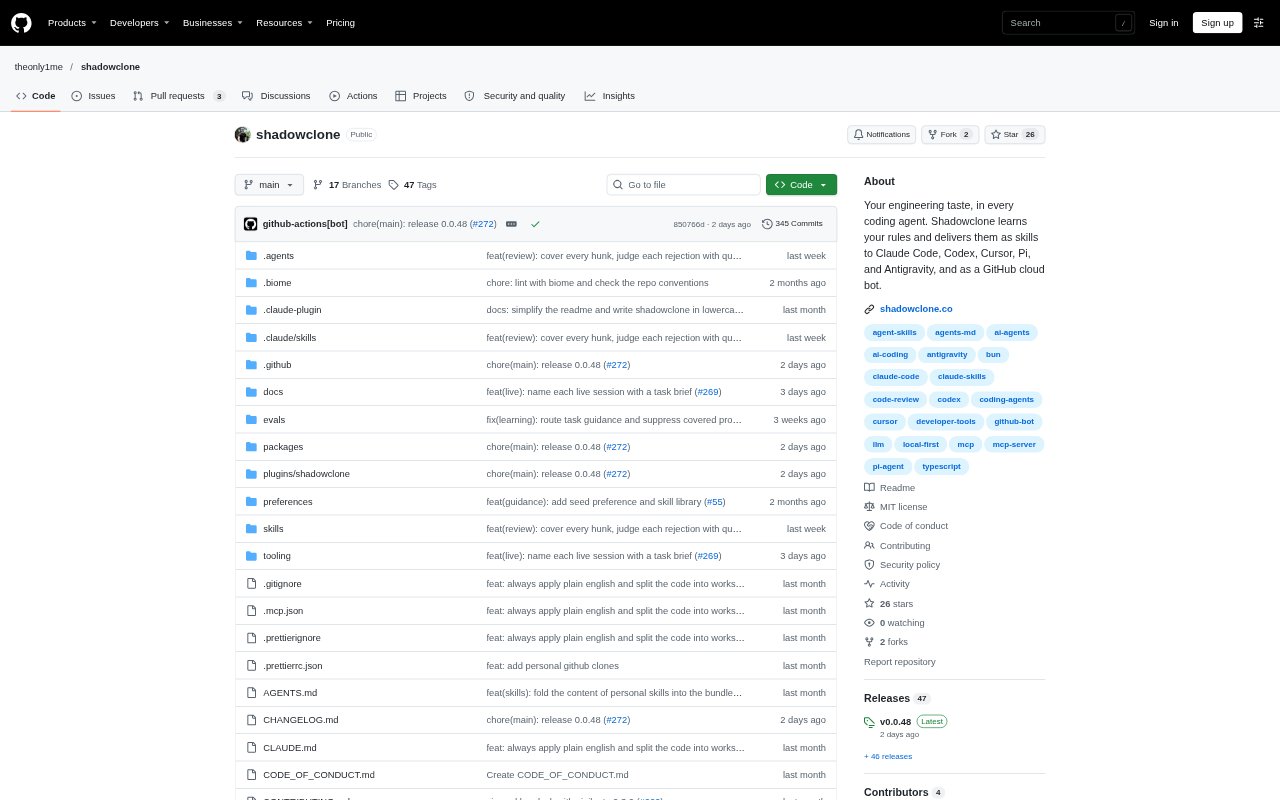
What is shadowclone?
Shadowclone gives software engineering teams one set of skills and instructions to use across coding agents, including Claude Code, Codex, Cursor, Pi, Antigravity, and OpenCode. It can learn reusable preferences from sessions you choose to share, then keep that guidance readable and editable. Developers can also run coding-agent clones on their own machines or set up a GitHub Actions bot, using the skills and instructions they have selected.
shadowclone Features:
Cross-Agent Skills: A single set of skills and instructions can be used across six coding agents, so you can choose different agents without maintaining separate copies of your guidance.
Workflow Skills: The included collection has 15 skills for planning, debugging, implementation, verification, and review, which you can select through a browser-based wizard.
Preference Learning: With your consent, Shadowclone reviews enabled sessions and turns reusable corrections into skills or short native guidance, keeping repository-specific rules in their own scope.
Configurable Builds: The wizard lets you make a personal build, a private build for one repository, or a shared build that a team commits, with skills selected for each.
Local Clone Jobs: Claude Code or Codex can run a requested task in a fresh Docker container on a machine you own, then open a draft pull request without pushing to the default branch.
Code Reviews: Shadowclone supports local reviews, guided HTML reviews with diffs and behavior traces, and a GitHub Actions bot that can post review findings on pull requests.
Team Actions Bot: A GitHub Actions bot can use selected skills to work on issues, open pull requests, and respond to checks and review feedback, with a provider API key stored in a GitHub environment.
shadowclone Benefits:
Consistent Guidance: Your preferred engineering practices carry across coding agents and repositories, reducing the need to repeat or reconcile instructions when switching tools.
Fewer Repeated Corrections: Reusable preferences from allowed sessions can become ongoing guidance, so future work can reflect decisions you have already made.
Reviewable Learning: Because learned rules remain readable, editable, and reversible, you can inspect changes to your guidance and undo ones that do not fit.
Controlled Delegation: Clone work stays on a machine you own and produces a draft pull request, leaving changes reviewable before they reach the default branch.
Team Oversight: The bot follows checks and review feedback while leaving the merge decision to your team, giving people a chance to inspect its work.
Use Cases:
Standardize Agent Setup: Give developers using different coding agents the same planning, implementation, and review skills without copying guidance between tools.
Delegate a Bug Fix: Ask a clone to investigate a flaky test or another defined repository task while you work on something else, then inspect its draft pull request.
Review Before Opening: Run a local review of committed branch changes against repository standards and mechanical checks before creating a pull request.
Guide Multiple Reviews: Prepare an HTML guide for several pull requests that brings together their diffs, behavior traces, and a suggested reading order.
Automate Team Issues: Let teammates with write access tag the GitHub Actions bot to work on issues, open pull requests, and follow project checks and feedback.