

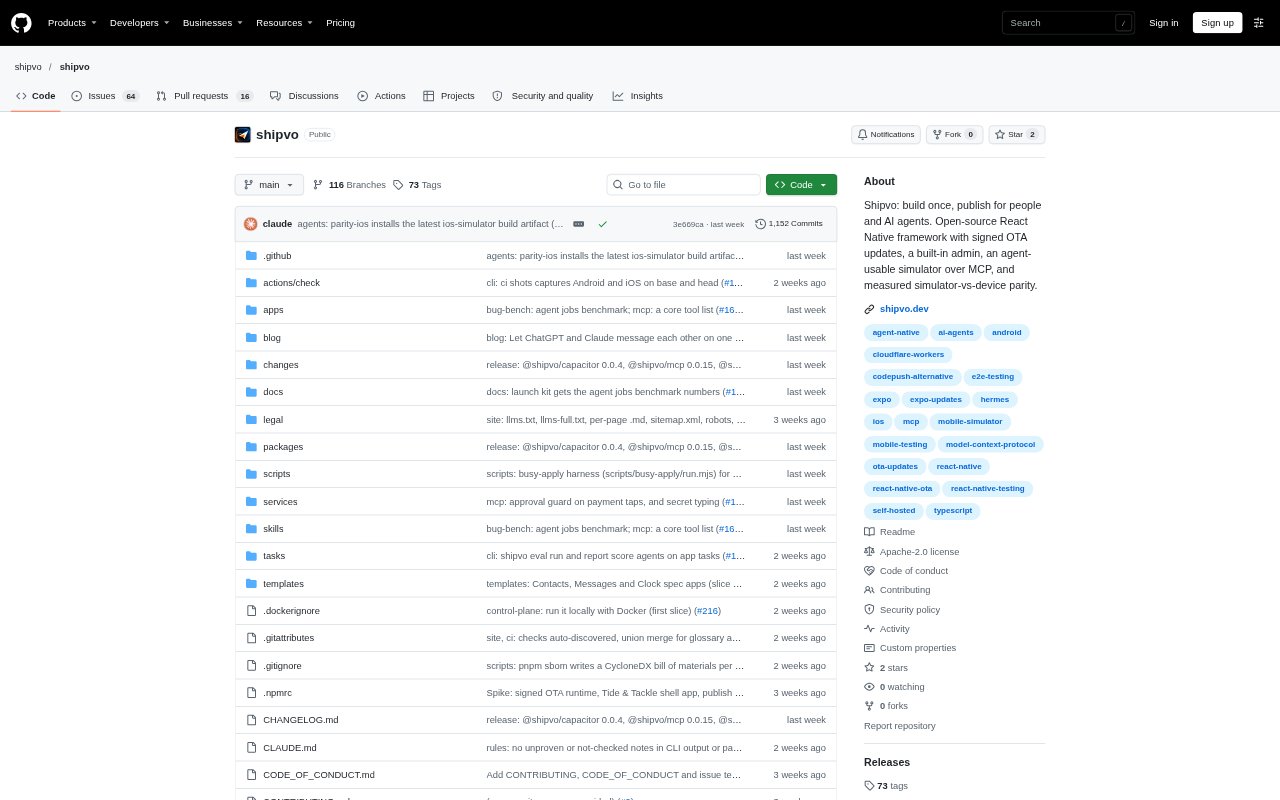
What is Shipvo?
Shipvo is an open-source mobile framework for teams building React Native apps, with signed over-the-air updates and a phone simulator that AI agents can operate over MCP. Developers can run app flows in a browser-based Android- or iPhone-style phone, test them in CI, and publish updates to installed apps. The simulator exposes app screens through an accessibility tree, letting agents tap, type, and scroll while developers observe the same session.
Shipvo Features:
Signed OTA Updates: Publish signed JavaScript updates with integrity checks, staged cohort rollouts, crash-loop protection, and a command for rolling back a release.
Agent Phone Simulator: Run an app in a browser-based Android or iPhone frame where MCP-connected agents can inspect screens and tap, type, and scroll.
Device API: Use one API for camera, location, biometrics, payments, and notifications, with capabilities real on phones and explicitly simulated for agents.
Typed App Tests: Write tests with plain-English steps, explore app flows, repair broken test steps, and prevent promotion when flows fail.
CI Parity Checks: Run the same scripted flows in the simulator, an Android emulator, and an iOS Simulator, then compare screens and actionable elements.
Self-Hosted Control Plane: Host the update control plane on Cloudflare Workers, KV, and D1, or use Shipvo's hosted beta service.
Shipvo Benefits:
Catch Bugs Earlier: Running app flows on pull requests can expose problems before a change is merged or an update reaches installed users.
Avoid Repeated Builds: The headless simulator runs on a standard Linux CI runner without requiring an iOS binary build for each test run.
Reduce Update Risk: Signature and integrity checks, staged rollouts, and automatic crash-loop reverts help limit the impact of a faulty release.
Lower Hosting Costs: The software is Apache-2.0 licensed, and self-hosting has no Shipvo per-user fee, though infrastructure costs are separate.
Review Agent Actions: Watching an agent use the same simulated phone as a developer makes its app interactions easier to observe and assess.
Use Cases:
Test Purchase Flows: Have an agent navigate a mobile checkout and interact with payment sheets before the team releases an update.
Check Permissions: Exercise camera, location, or notification permission prompts in automated flows without setting up a physical device.
Gate Pull Requests: Run app tests and exploratory checks in CI so failures can block a change before it is merged.
Roll Out Fixes: Send a JavaScript fix to installed Android and iOS apps in staged cohorts without waiting for a store update.
Test Sign-In: Use a session's private inbox to read an email code or magic link and complete sign-in during an app test.