

What is Simple Reviewer?
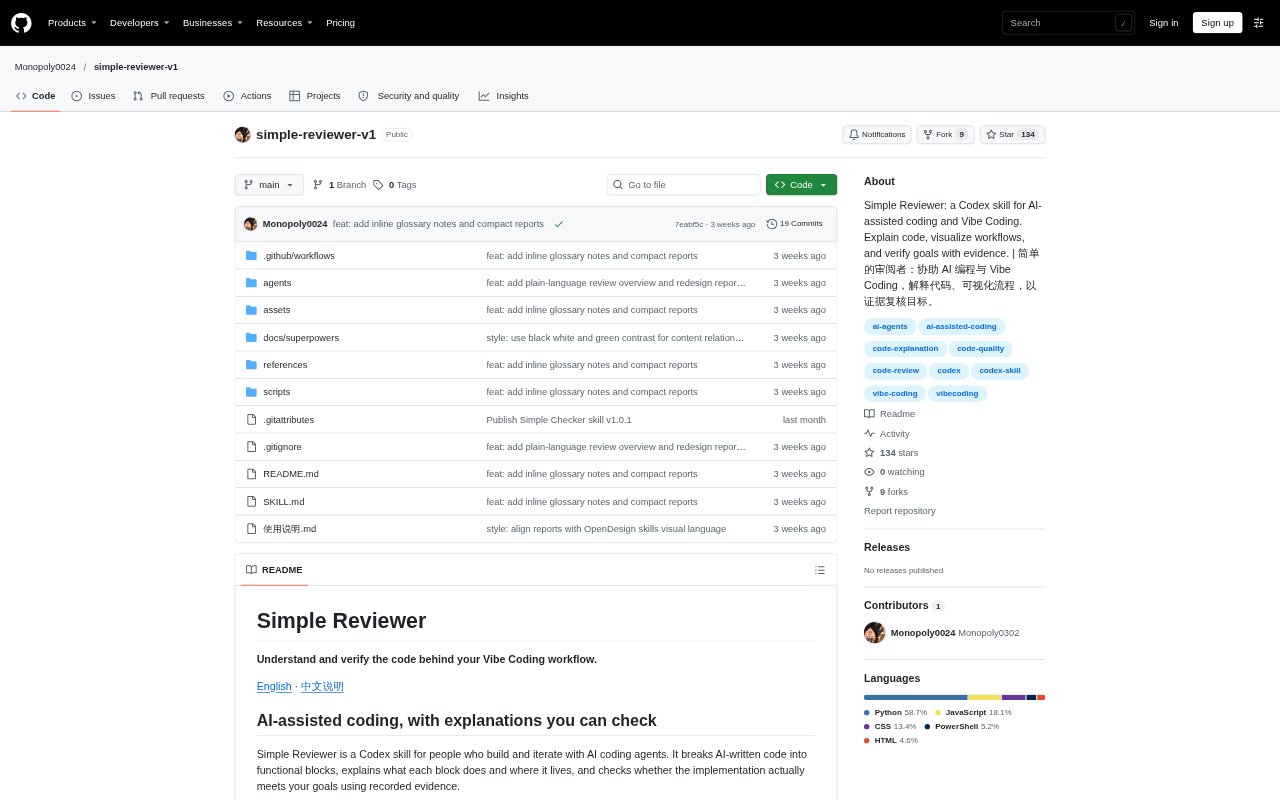
Simple Reviewer is a Codex skill for people who build with AI coding agents, including those who do not write code every day. It explains AI-written code in functional blocks, shows where those blocks live, and helps a reviewing agent check whether changes meet a stated goal. It produces readable HTML and Markdown breakdowns, with a fuller review report available when requested. The skill helps users examine evidence and limitations rather than treating plausible-looking code as proof that a feature works.
Simple Reviewer Features:
Goal Criteria: It turns a natural-language request into observable acceptance criteria, assumptions, and open questions before the implementation is reviewed.
Code Breakdown: It maps functional blocks and explains their inputs, processing, outputs, connected paths, source files, symbols, and line ranges.
Evidence Checks: It connects goals to checks and recorded observations, while distinguishing static reading, local test results, and working user paths.
Risk Notes: It records potential effects involving data, credentials, external services, cost, permissions, or deployment, including whether an action ran.
Review Reports: It generates offline HTML and Markdown breakdowns, plus a fuller report with goals, changes, acceptance, risks, and next actions.
Evidence Tracking: It can use SHA-256 snapshots to detect changes to registered source files and evidence logs that require revalidation.
Simple Reviewer Benefits:
Clearer Changes: Plain-language explanations help users understand what an AI-made change does before deciding whether to accept it.
Grounded Decisions: Separating code presence from checks and user-path results makes it easier to judge what has actually been verified.
Visible Limitations: Recorded scope and verification gaps help users avoid mistaking an incomplete check for proof that the original goal is met.
Safer Follow-Up: Concrete risk notes and prioritized next actions help reviewers focus attention on relevant checks or targeted fixes.
Reusable Records: Standalone offline reports give users a readable record they can revisit without relying on a hosted review workspace.
Use Cases:
After AI Coding: Review a feature after a Vibe Coding session by comparing the requested outcome with the changed code and recorded checks.
Before Acceptance: Inspect an AI-generated change before accepting it, including its behavior, source locations, evidence, and possible side effects.
Inherited Code: Get oriented in unfamiliar AI-generated code by reading a breakdown of its functional blocks and how they connect.
Goal Verification: Check a requested workflow, such as an upload feature, against visible acceptance criteria and observations from attempted checks.
Risk Review: Examine a proposed change for possible data, credential, service, cost, permission, or deployment effects before proceeding.