

What is Skillstore?
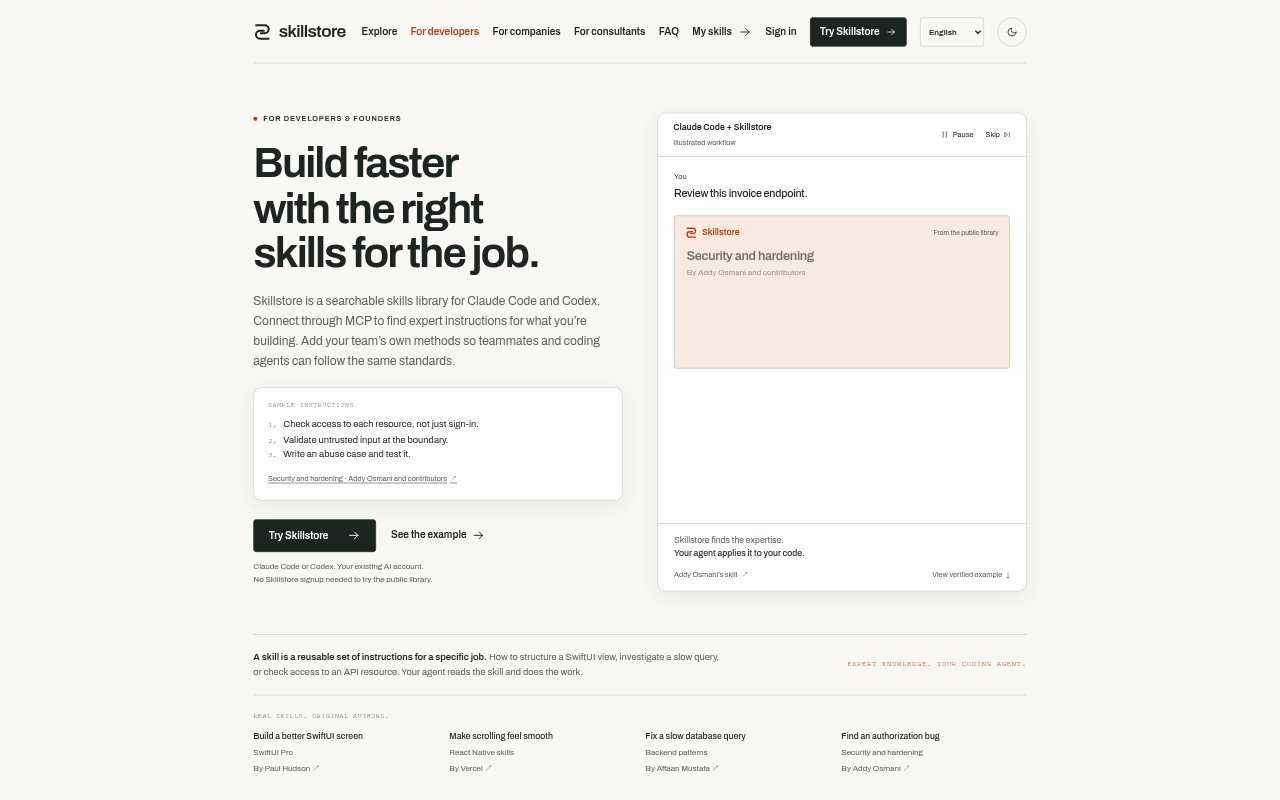
Skillstore is a searchable library of reusable instructions for Claude Code and Codex, aimed at developers, founders, and engineering teams. Through MCP, an agent can find methods suited to the task and project tools, then use the selected instructions and supporting files while working. Teams can also turn existing practices into private skills, share them with authorized colleagues, and refine recommendations with feedback. The public library can be tried without a Skillstore account, using an existing AI account.
Skillstore Features:
Searchable Skills Library: Search a library of engineering methods for tasks such as structuring a SwiftUI view, investigating a slow query, or checking API access.
MCP Skill Delivery: Connect through MCP so the agent can find skills relevant to the task and project tools, then receive the selected instructions and supporting files.
Private Team Skills: Create a skill from completed work or import existing instructions, save it privately, and share it with authorized teammates or contractors.
Skill Feedback: Give feedback on useful or poor matches to improve skill selection, and ask the agent to propose corrections for review before saving them.
Run Inspection: See which skill an agent used, how it changed the approach, and what the agent verified during a task.
Access Controls: Share private skills through an invitation or link, require recipients to sign in, and revoke access to stop future reads through that grant.
Skillstore Benefits:
Less Repeated Guidance: Developers can spend less time restating review criteria that would otherwise live in documents, old pull requests, or individual teammates’ memories.
More Consistent Reviews: When agents and developers use the same checks, teams can focus review discussions on findings and evidence rather than repeating the checklist.
Faster Method Finding: A searchable collection helps teams locate a relevant approach without having to assemble instructions from scattered sources for every task.
Easier Verification: Seeing the method used and what was checked gives developers a clearer basis for assessing an agent’s work.
Smoother Onboarding: New contributors can apply the team’s established criteria on an early change instead of waiting to learn them through repeated review comments.
Use Cases:
API Authorization Review: Ask a coding agent to check whether an endpoint verifies access to the requested resource, including a user’s organization ownership.
Slow Query Investigation: Use a backend method to investigate a database query that has become slow and guide the agent through the debugging work.
Performance Improvement: Give an agent a repeatable process to reproduce a performance issue, measure it, locate a bottleneck, and measure again after a change.
SwiftUI Development: Find reusable guidance for structuring a SwiftUI view when building or revising an iOS interface with a coding agent.
Team Review Standards: Capture recurring pull request checks as private skills so teammates and contractors can apply the same standards to code changes.