

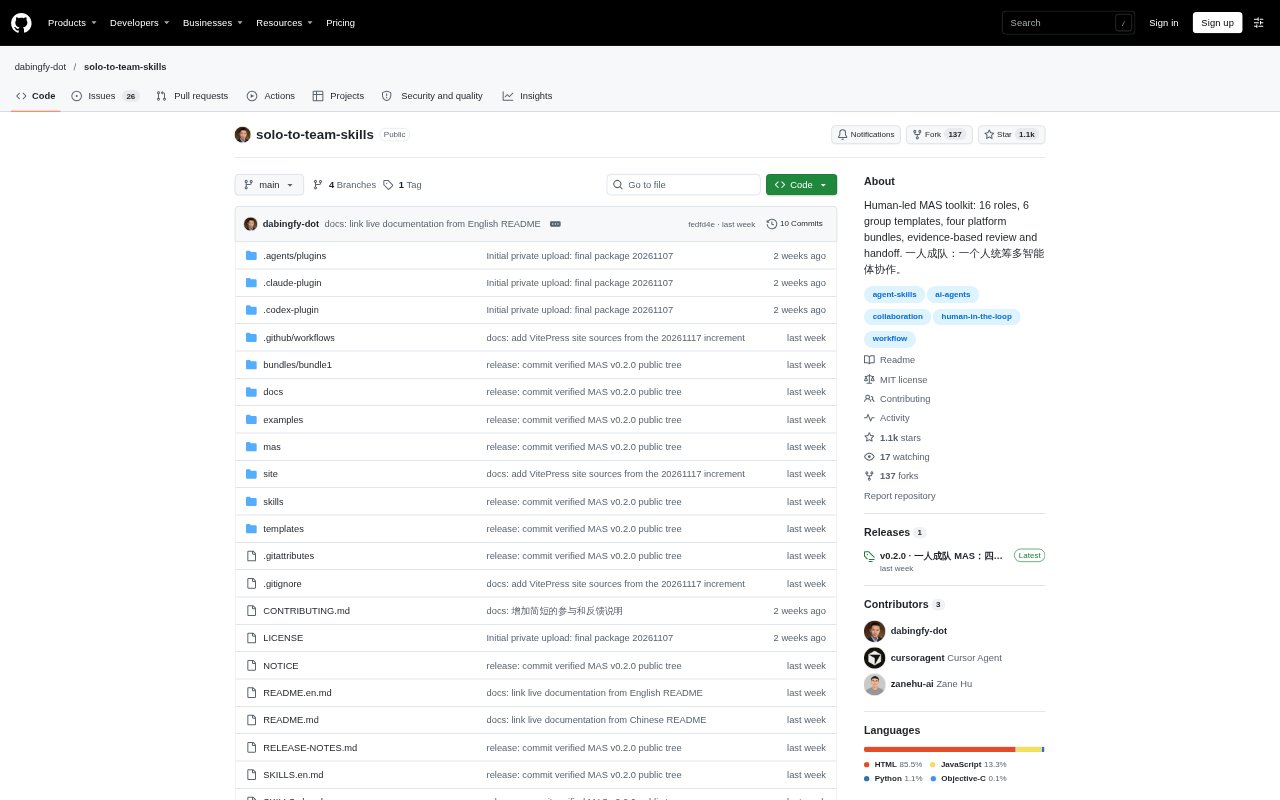
What is Solo to Team Skills?
Solo to Team is a toolkit for organizing human-led collaboration among AI agents, with one person setting goals and assigning work to chosen executors. It provides platform-specific packages for Grok Bot, WorkBuddy, DeepSeek Harness, and Open Master Bot, along with role guidance, workflow materials, and handoff tools. Teams can adapt its roles and group templates to a task rather than activating every role. It does not provide automatic cross-platform scheduling, and complete end-to-end use of all four packages has not been demonstrated.
Solo to Team Skills Features:
Platform Bundles: Each of the four platform packages includes a collaboration Skill, four foundational Skills, role and group guidance, templates, examples, and configuration materials.
Role Templates: A set of 16 roles, six suggested group templates, and 26 suggested membership relationships offers a starting structure that teams can adjust.
Task Workflow: The suggested workflow moves from a user-defined goal to an assigned executor, production, independent review, and return through the original entry point.
Independent Review: A separate reviewer checks the same version of a deliverable, and revisions can go back to the original executor.
Handoff Tools: The packages include continuation tools and records to support handoffs, alongside an offline team builder and task examples.
Platform Setup: Instructions explain how to select a platform package, use its main Skill, and provide the task materials for the work.
Solo to Team Skills Benefits:
Clear Accountability: Assigning work to chosen roles makes it easier to see who is responsible for producing, reviewing, and receiving each result.
More Verifiable Work: Having a separate reviewer inspect the same deliverable gives teams a distinct check before work is returned.
Traceable Handoffs: Keeping the return tied to the original entry point helps preserve context as work moves between roles.
Flexible Team Size: Turning on roles as needed lets a person coordinate a focused task without requiring every suggested role to participate.
Human Direction: The person setting the goal and selecting executors retains control over how the AI-assisted work is organized.
Use Cases:
Small Scoped Tasks: Start with a clearly bounded assignment to check that the selected platform can execute it and return the work as expected.
Reviewable Deliverables: Use the production and review sequence when a document or other task output should be checked by someone other than its creator.
Technical Revisions: Route a technical change to an executor, then assign an independent check to someone qualified who did not make that change.
Team Role Planning: Adapt the role and group templates when deciding which responsibilities and collaborators a particular project needs.
Platform Adoption: Use the package instructions to introduce the workflow in a team already working with one of the four supported platforms.