
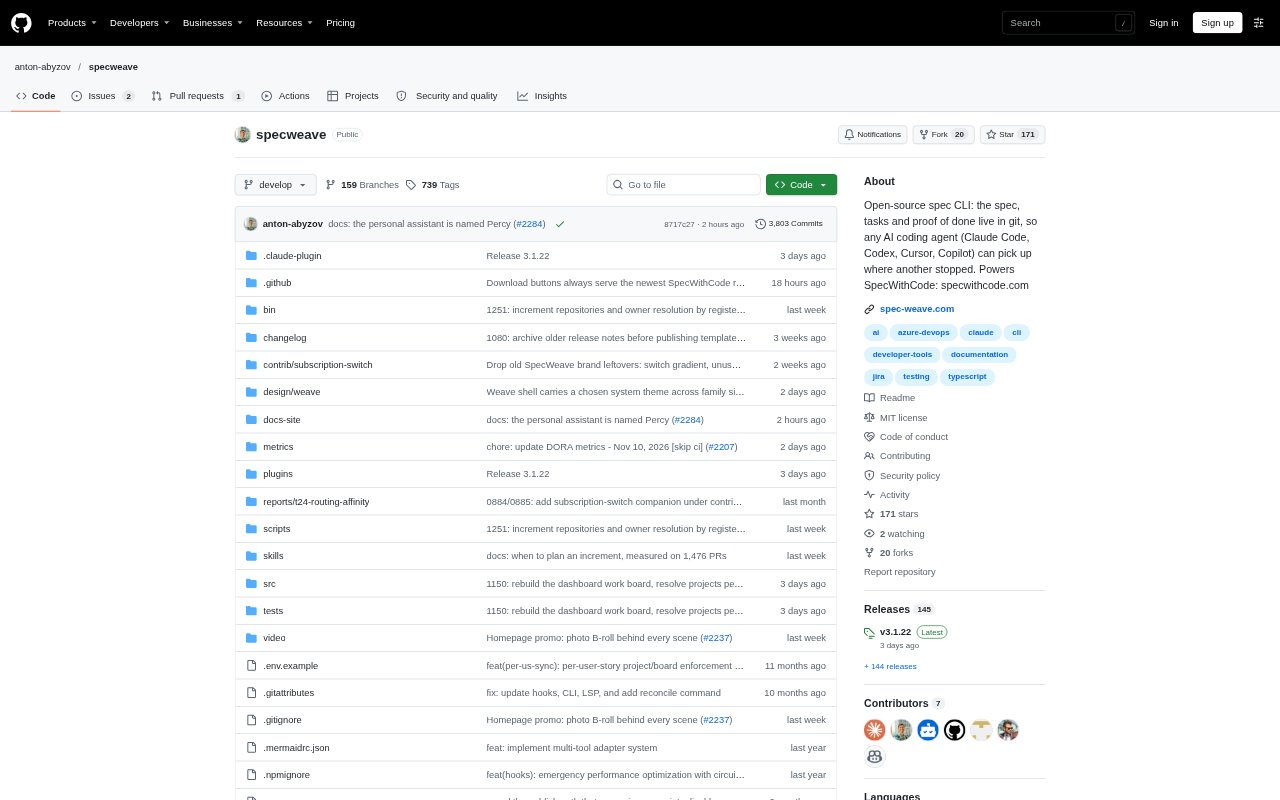
What is SpecWeave?
SpecWeave is an open-source CLI for planning software work with specifications, task records and test evidence stored in a Git repository. It is for developers using coding agents such as Claude Code, Codex, Cursor or Copilot, and also has a desktop workspace that coordinates agent threads on local machines. Teams can use it to carry work between tools or sessions without relying on a chat transcript as the only record.
SpecWeave Features:
Structured Specs: Create an increment with a problem, scope, approach, decisions, acceptance criteria and tasks in a spec.md file.
Git Task Ledger: Record task claims, completion, skips, blocks and releases as append-only events in ledger.jsonl alongside project code.
Test Evidence: Run a task’s named test when marking it done; the CLI rejects a failing test and saves its output.
Cross-Tool Handoff: Use handoff to release task claims, record the stopping point and push a branch snapshot for another tool to pick up.
Automatic Handoff: Enable handoff near a usage limit, with a default threshold of 90% or a different threshold you choose.
Review and Verify: Run tests, lint and build checks, then request a fresh-context review or pass the diff to another model family.
Desktop Coordination: Use SpecWithCode to coordinate agent threads across projects, view task progress and save worker reports beside each increment.
SpecWeave Benefits:
Shared Context: Because plans and project memory travel with the repository, a new agent or account can continue from the same decisions.
Fewer Duplicated Tasks: Recorded claims help collaborators see which work is already underway before assigning another agent the same task.
Traceable Completion: Saved test output makes it easier to check what supports a task’s completion rather than relying on a status update alone.
Less Manual Transfer: A handoff carries edits and next steps between sessions, avoiding the need to copy prompts, paths and progress by hand.
Clearer Progress: A task board built from the ledger gives collaborators a shared view without reconstructing progress from separate conversations.
Use Cases:
Switch Agents: Move a feature from Claude Code to Codex when one agent reaches a usage limit, keeping the task state and edits together.
Parallel Development: Coordinate agents working on separate tasks in one project, using task claims to show which work is already assigned.
Verify a Change: Define acceptance criteria and tests before implementation, then use the saved test evidence and review to check a proposed change.
Resume on Another Machine: Hand off a task from one checkout or session and pick it up elsewhere with the branch snapshot and next steps.
Coordinate Agent Threads: Use the desktop workspace to monitor multiple agent threads across a project and inspect their progress and reports.