

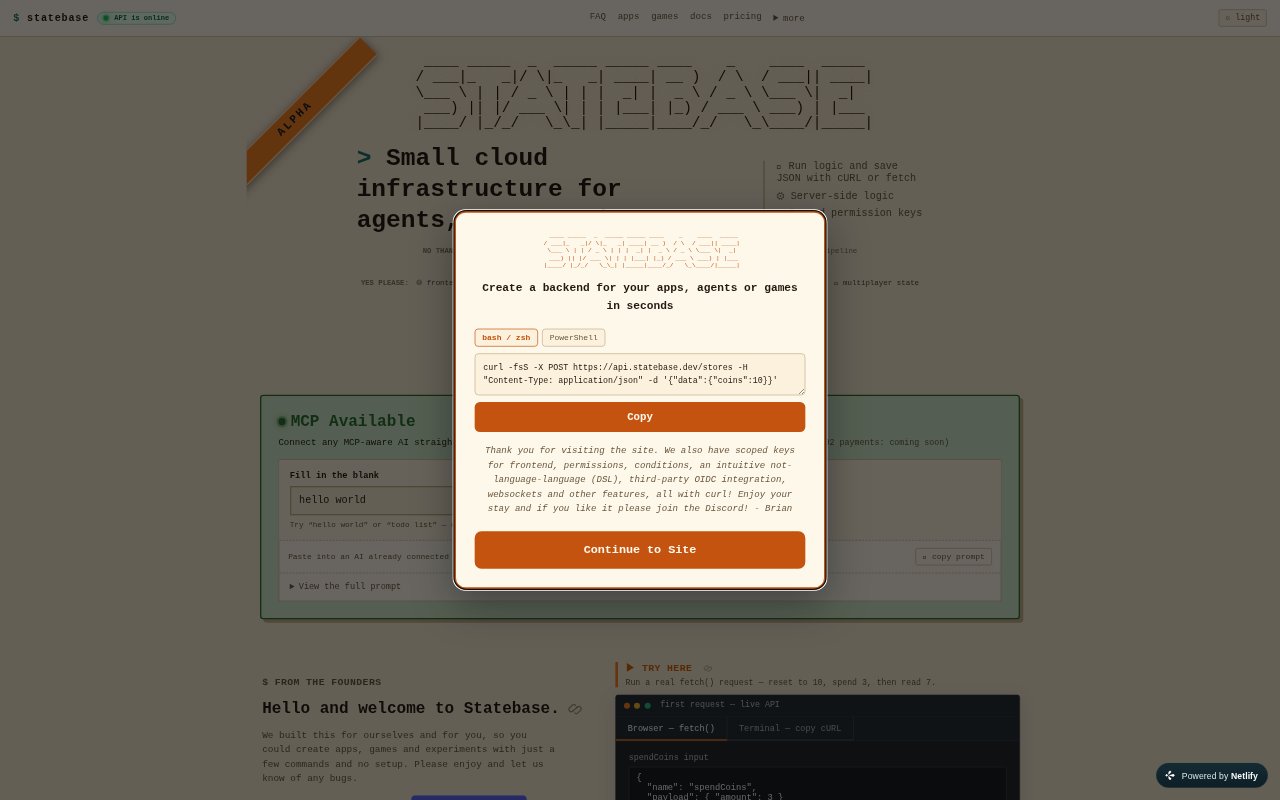
What is Statebase?
Statebase is a small cloud for apps, games, and agents that need to save JSON data and run server-side rules. Applications can interact with it using fetch() or another HTTP client, while permissions can be scoped. It is aimed at people building software that needs cloud-based data storage and server-side rule execution, including projects involving AI agents.
Statebase Features:
App and Game Cloud: Statebase is presented as a small cloud for apps and games, providing a place for these projects to save data and run server-side rules.
Agent Support: The cloud is also intended for agents, so projects built around agents can use Statebase for JSON data storage and server-side rules.
JSON Data Storage: Applications can save JSON data in Statebase, making it suitable for projects whose information is represented in that format.
Server-Side Rules: Statebase can run rules on the server, allowing a project to use server-side rule execution alongside its stored JSON data.
HTTP Client Access: Developers can interact with Statebase using fetch() or any HTTP client, rather than being limited to a single named client.
Statebase Benefits:
Cloud-Based Storage: Projects can keep JSON data in a cloud service, giving app, game, and agent builders a place to store information outside the immediate client.
Server Rule Execution: Running rules server-side gives teams a way to place rule execution on the server instead of relying solely on code running in an app or game client.
Scoped Access: Scoped permissions let builders set access boundaries, helping them avoid treating every permission as having the same scope.
Flexible Requests: Support for fetch() and other HTTP clients lets developers work with Statebase through familiar HTTP request methods.
Use Cases:
App Data Persistence: Use Statebase when building an app that needs to save JSON data to a cloud service and run rules on the server.
Game Data Storage: A game project can use Statebase to save its JSON data and use server-side rules as part of its cloud setup.
Agent State Storage: Builders creating agents can use Statebase when their project needs JSON data storage and server-side rule execution.
HTTP-Based Integration: Developers can connect a project to Statebase using fetch() or another HTTP client when working with its cloud data and rules.