

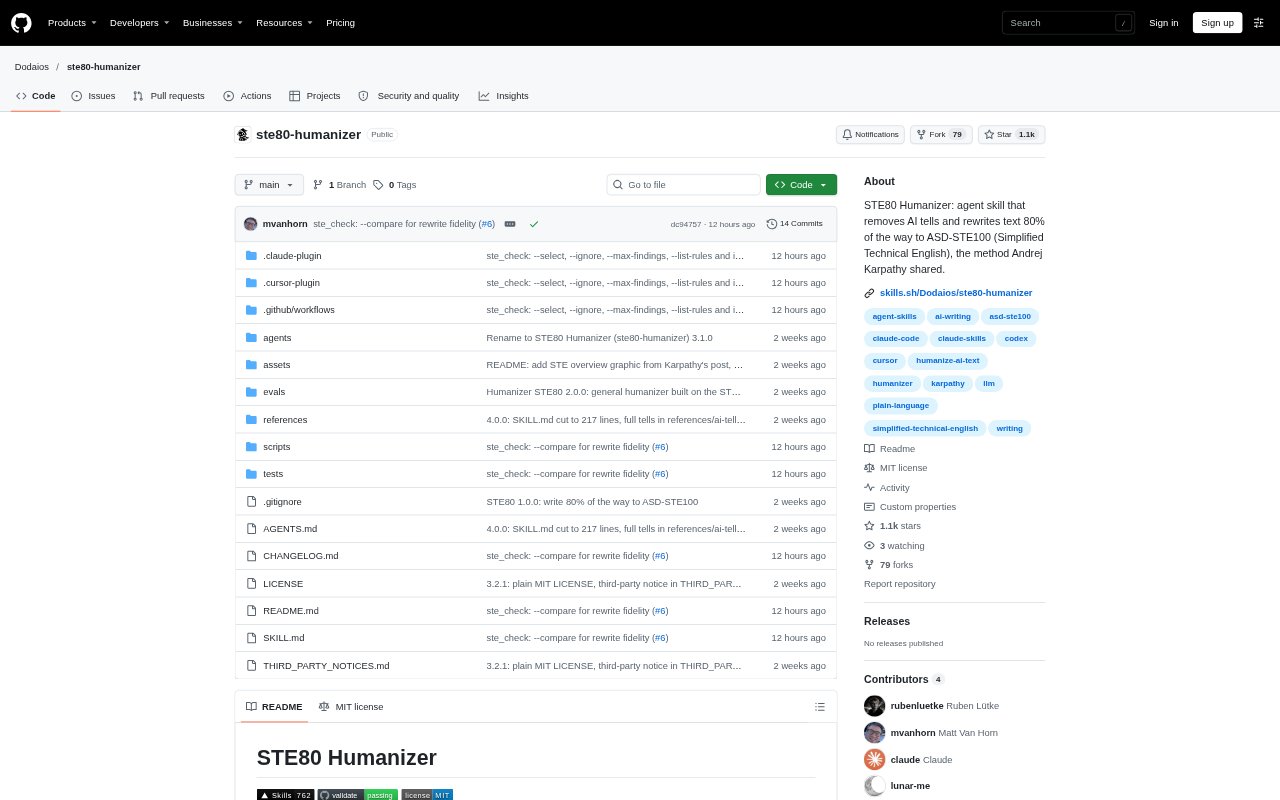
What is STE80 Humanizer?
STE80 Humanizer is a reusable skill for AI agents that revises AI-written or other text to make it easier to read while keeping its meaning. It is intended for people who use agents to draft or edit documents, explanations, emails, and procedures. The skill combines a pass that addresses common AI-writing patterns with a pass that reshapes sentences toward Simplified Technical English, and offers lighter or stricter editing options.
STE80 Humanizer Features:
Two-Pass Editing: The first pass addresses 26 patterns associated with AI writing, while the second restructures sentences using STE80 rules.
Sentence Structure: The STE80 pass favors active voice, simple tenses, one idea per sentence, and sentence lengths suited to the selected mode.
Editing Modes: Humanize is the default, Light makes limited structural changes, and Strict STE applies the full set of STE rules.
Voice Matching: You can provide a sample of your writing so the skill can match its sentence length, word choice, and punctuation.
Factual Fidelity: The skill aims to retain facts and quantities, avoid adding information, and flag contradictions in the text it edits.
Edit References: The skill reports edits by rule number, so you can look up the writing pattern or structure rule behind a change.
STE80 Humanizer Benefits:
Clearer Prose: Breaking up dense sentences can make technical explanations easier for readers to understand and act on.
Fewer Fact Checks: Preserving source details and flagging contradictions helps you focus review on the wording without losing track of the underlying claims.
Style Consistency: Applying the same editing principles across drafts can help a team produce more consistent, readable documents.
Adjustable Revisions: The choice of editing depth helps you avoid heavy changes when a draft only needs a light cleanup.
Traceable Edits: Rule references give you a way to understand and assess the changes instead of treating the rewrite as a black box.
Use Cases:
Documentation Cleanup: Revise a README or product document when its prose feels formulaic, wordy, or difficult to scan.
Runbook Procedures: Use Strict STE to rewrite operational instructions that need concise steps and one instruction per sentence.
Email Review: Check whether a draft email sounds machine-written, or request a light edit to remove its most noticeable patterns.
Technical Explanations: Ask an agent to explain a topic such as a TLS handshake in STE when readers need a simpler account.
Voice-Conscious Editing: Provide a writing sample when revising a draft that should retain your usual sentence length, vocabulary, and punctuation.