
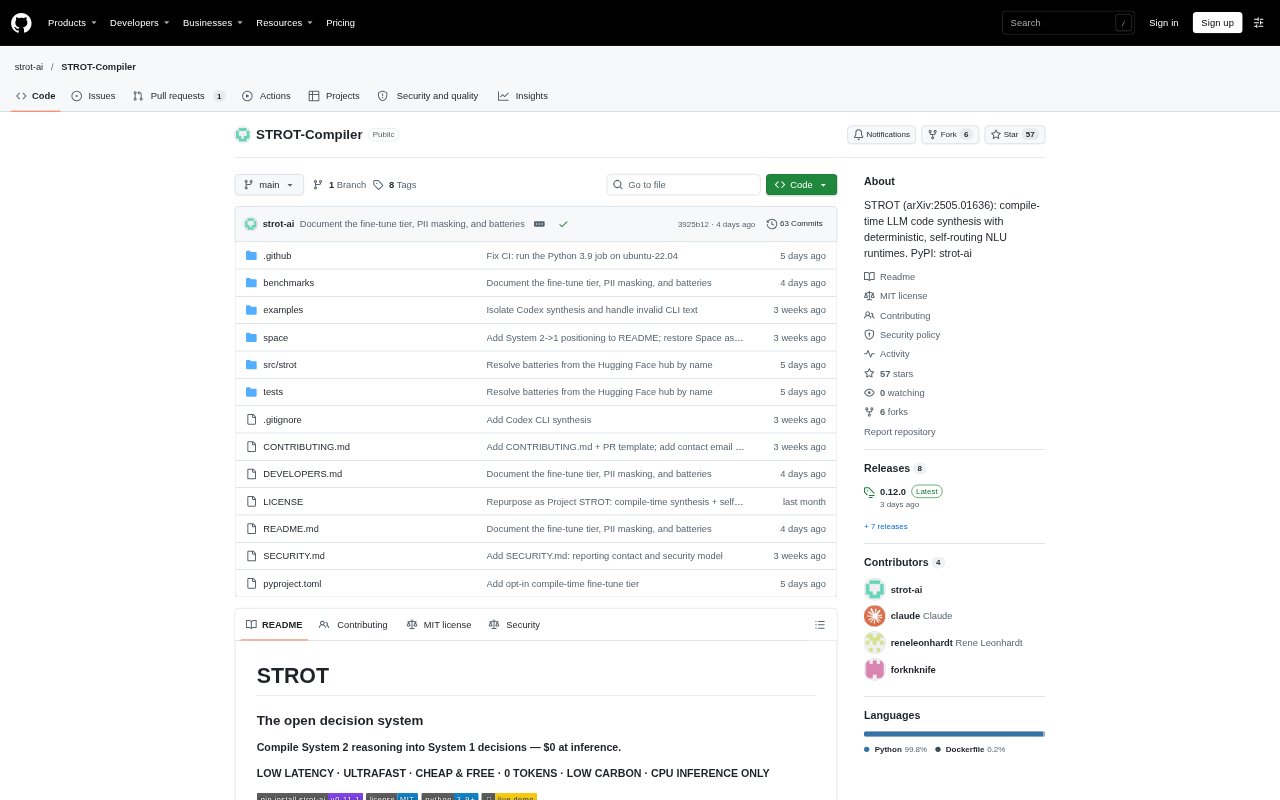
What is STROT?
STROT is a Python tool for compiling record-level decisions, such as routing, classification, and scoring, into reusable pipelines. An LLM helps set up a task once; after compilation, a small local model makes decisions on CPU without runtime LLM calls. It is aimed at teams handling text records who want a repeatable decision process, with confidence scores and optional abstention for uncertain results.
STROT Features:
Compile-Time Setup: Describe a task and its available actions, then use an LLM to compile them into a standalone Python artifact.
Action Routing: Use run() to route records to registered actions and execute the corresponding compiled handler.
Typed Decisions: Use decide() to return boolean, score, or choice results for each record, with probabilities and confidence.
Confidence Thresholds: Set an accuracy or risk target to fit a threshold that sends below-target records to fallbacks instead of dispatching them.
Golden Record Gate: Check compiled decisions against known answers and prevent an artifact from serving if it fails those checks.
Portable Batteries: Save a decision pipeline as a self-contained Python file or export its decision data as a bundle of JSON metadata and weights.
STROT Benefits:
Lower Runtime Cost: Once a task is compiled, its records can be processed without paying for an LLM call on each one.
Local Processing: CPU-based decisions let teams run the compiled pipeline without a GPU or runtime API connection.
Consistent Decisions: A frozen artifact applies the same task setup across records rather than asking an LLM to generate a fresh response each time.
Visible Uncertainty: Confidence scores and optional abstention make it easier to separate routine decisions from records that need another review path.
Safer Releases: The golden-record check gives teams a way to catch failures on known examples before a compiled decision pipeline serves records.
Use Cases:
Support Triage: Sort incoming support tickets into workflows such as billing disputes and technical defects, then send uncertain cases to a fallback.
Text Classification: Assign text records to a defined set of categories, such as billing, engineering, or spam.
Sentiment Scoring: Score customer messages on a chosen numeric scale, such as rating sentiment from one to five.
Boolean Screening: Flag records that meet a defined condition, such as whether a report mentions crashes or errors.
Risk-Based Triage: Apply record-level decision pipelines to cyber, financial, or insurance text and route below-threshold cases for further handling.