

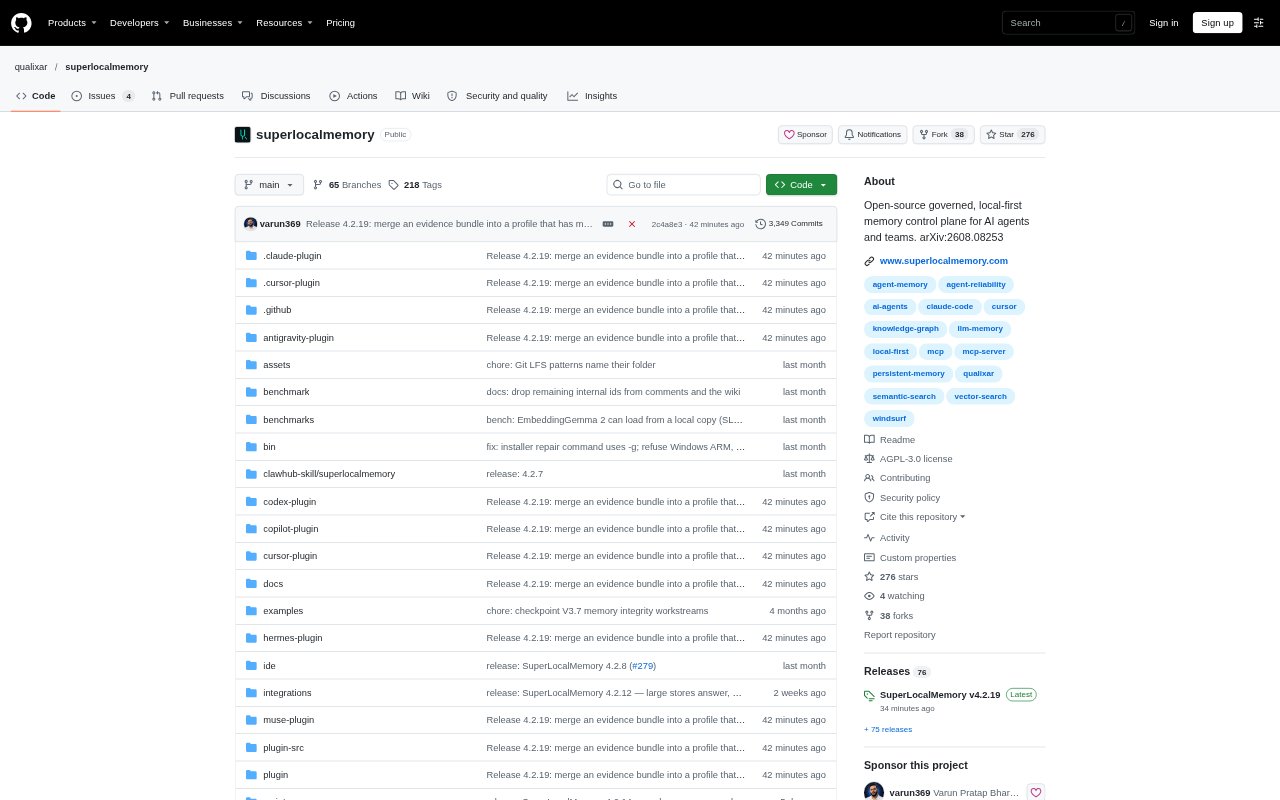
What is SuperLocalMemory?
SuperLocalMemory is a local-first memory system for AI agents, bots and chat apps. It stores information on your computer and makes it available across connected tools, with controls for who can save or access shared memories. Agents can recall decisions, documents and images, while an answer check distinguishes supported answers from incomplete or missing information. It runs on Windows, Linux and Apple Silicon Macs, and offers an open-source core under the AGPL-3.0 licence.
SuperLocalMemory Features:
Cross-Agent Memory: Connect tools such as Claude Code, Codex and Cursor to a shared memory, with each saved item attributed to the agent that wrote it.
Answer Checking: Recall returns supported answers, nearby memories when the information is incomplete, or a clear notice when nothing relevant is stored.
Document and Image Search: Index PDFs, screenshots and supported image formats locally, then search with descriptions or text found through OCR; answers cite the file and page.
Memory Governance: Use workspace roles, scopes, save receipts, retention rules, a hash-chained audit trail, and erasure that reaches derived copies.
Time-Aware Recall: Track when a fact happened and when it was learned, replace outdated information with undoable corrections, and ask what was true earlier.
Agent Collaboration: SLM-Mesh lets local agents and connected web bots exchange messages and shared state, while locks help prevent simultaneous edits to the same file.
SuperLocalMemory Benefits:
Fewer Unsupported Answers: Agents can avoid treating a loosely related memory as fact when the stored information does not answer the question.
Private By Default: Core remember and recall can run without a model-provider call, and local document and image processing keeps those files on your computer.
Less Repeated Context: A shared memory lets connected agents retrieve earlier decisions and information instead of requiring people to restate them in each session.
Safer Corrections: Undoable changes and review before memory health fixes take effect help teams recover when stored information needs adjustment.
Clearer Accountability: Receipts, role controls and an audit trail make it easier to review who saved or accessed information in a workspace.
Use Cases:
Project Decision Recall: Give a coding agent access to prior technical decisions, such as deployment or rollback procedures, across separate work sessions.
Team Knowledge Sharing: Let multiple agents retrieve shared project information while keeping personal, shared and global memories in separate scopes.
Find Visual Documents: Search for a presentation slide or screenshot by describing its contents, or find PDF material using indexed text and page citations.
Review Changing Facts: Replace outdated project details, such as a database version or port, and retain the option to undo the correction.
Coordinate Agent Tasks: Pass work between local agents and connected web bots using messages and locks when several agents contribute to a task.