

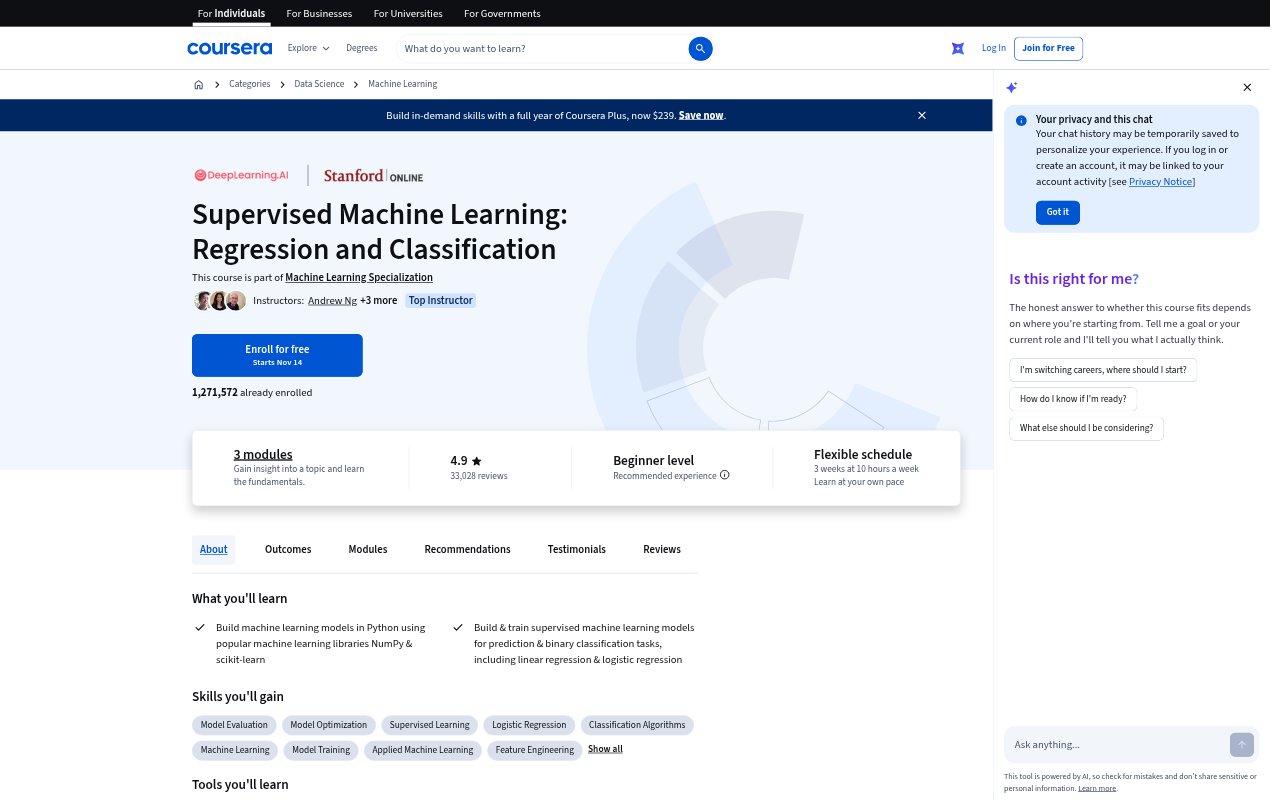
What is Supervised Machine Learning: Regression and Classification?
Supervised Machine Learning: Regression and Classification is an online introductory course for learners who want to build prediction and classification models in Python. It covers linear and logistic regression, with guided practice using NumPy and scikit-learn. The course is the first part of the Machine Learning Specialization and includes lessons, quizzes, programming assignments, and optional labs. Learners can also earn a shareable career certificate.
Supervised Machine Learning: Regression and Classification Features:
Linear Regression: Learn to represent a linear regression model, calculate its cost, and train it using gradient descent.
Multiple Features: Work with regression models that use several input variables, including vectorization, feature scaling, and feature engineering.
Polynomial Regression: Explore polynomial regression as a way to extend linear models to fit more varied relationships in data.
Logistic Regression: Build classification models with logistic regression and study sigmoid functions, decision boundaries, and logistic loss.
Model Regularization: Study overfitting and practice regularizing linear and logistic regression models to address it.
Python Practice: Use NumPy and scikit-learn in programming assignments and labs focused on implementing regression and classification.
Course Certificate: Earn a shareable career certificate after completing the course.
Supervised Machine Learning: Regression and Classification Benefits:
Build Practical Skills: Hands-on assignments give learners a chance to apply course concepts in code, not only recognize them in lessons.
Understand Model Training: Working through cost functions and gradient descent helps learners reason about how a model learns from data.
Improve Model Choices: Coverage of feature scaling, learning rates, and regularization helps learners make more informed training decisions.
Connect Concepts: Studying regression and classification together clarifies how supervised learning handles numeric predictions and category predictions.
Show Course Completion: The shareable certificate gives learners a credential they can add to a resume, CV, or LinkedIn profile.
Use Cases:
Learn Machine Learning: A beginner can use the course to build a foundation in supervised learning before moving on to later specialization courses.
Practice Predictions: A learner can implement linear regression in Python to explore how input features are used to predict numeric outcomes.
Practice Classification: A learner can implement logistic regression to model tasks where the prediction is one of two categories.
Study Model Tuning: Someone training a regression model can use the lessons on feature scaling, convergence, and learning rates to inspect its training process.
Address Overfitting: A learner working with a classification model can study regularization as a way to address overfitting.