
What is synapseForge?
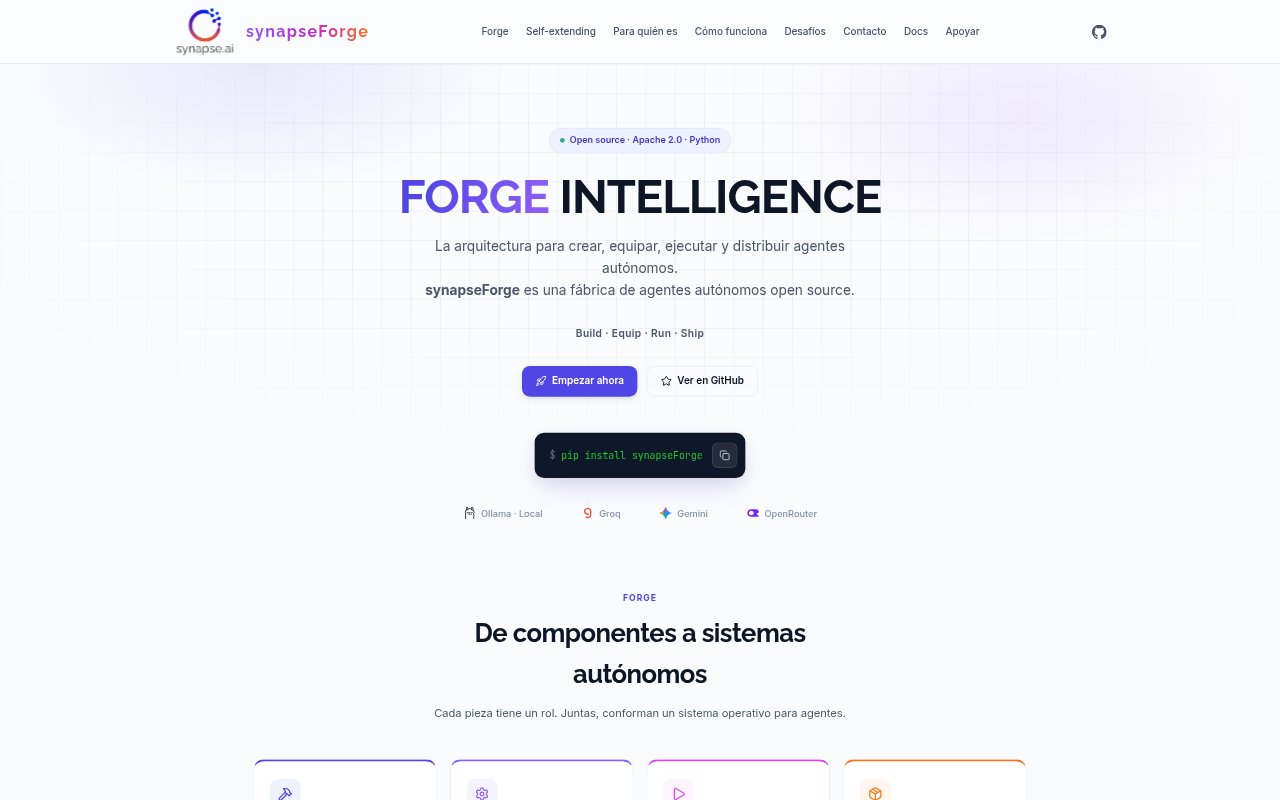
synapseForge is an open-source platform for creating, equipping, running, and distributing autonomous agents. Developers can define agents, skills, tools, and knowledge, then connect them to model providers and control their permissions. Businesses can use it to build specialized systems for tasks such as finding information, drafting content, and executing processes. It supports local operation as well as deployment through desktop packages or Docker, with agent creation and editing assisted by an LLM.
synapseForge Features:
Agent Builder: Define agents with specific roles, behavior, and permissions, and organize their capabilities using structured skills and tools.
Tool Connections: Equip agents with built-in or external tools, including tools connected through the Model Context Protocol.
Model Providers: Choose among Ollama, Groq, Gemini, and OpenRouter, and configure model settings such as temperature, top_p, and reasoning.
Knowledge and Memory: Add files and web pages as knowledge, use semantic search across collections, and retain indexed memory between sessions.
Agent Runtime: Run an agent loop that reasons, calls tools, and executes tasks, with streaming responses, scheduled jobs, and usage metrics.
Assisted Generation: Describe an agent, skill, or tool and have an LLM generate its code and structure, while checking for existing items to reuse.
Deployment Options: Package systems as self-contained desktop builds, Docker images, or native launchers, and control agents remotely through Telegram.
synapseForge Benefits:
Less Repeated Setup: A shared agent loop and project scaffold let developers spend less time rebuilding common agent infrastructure for each project.
Controlled Access: Per-agent, deny-by-default permissions help keep each system limited to the actions its operator has allowed.
Local Data Control: Running with Ollama on a local machine lets teams keep their information out of cloud services when they choose.
Task-Based Model Choice: Selecting a model provider for each task makes it easier to balance model cost and capability across different workflows.
Faster Iteration: Generating and adjusting agent components without restarting the runtime makes it easier to test changes during development.
Use Cases:
Internal Research: Create an agent that searches company documents and web pages to gather information for staff.
Routine Drafting: Set up a specialized agent to prepare recurring written materials from the knowledge and instructions it has been given.
Scheduled Processes: Configure agents to handle recurring tasks on a schedule and send notifications when work is due or complete.
Sensitive Workflows: Run an internal assistant locally when a team needs to work with sensitive information under its own control.
Client Deliverables: Package a purpose-built agent as a desktop application or Docker deployment for delivery to a client or another team.