

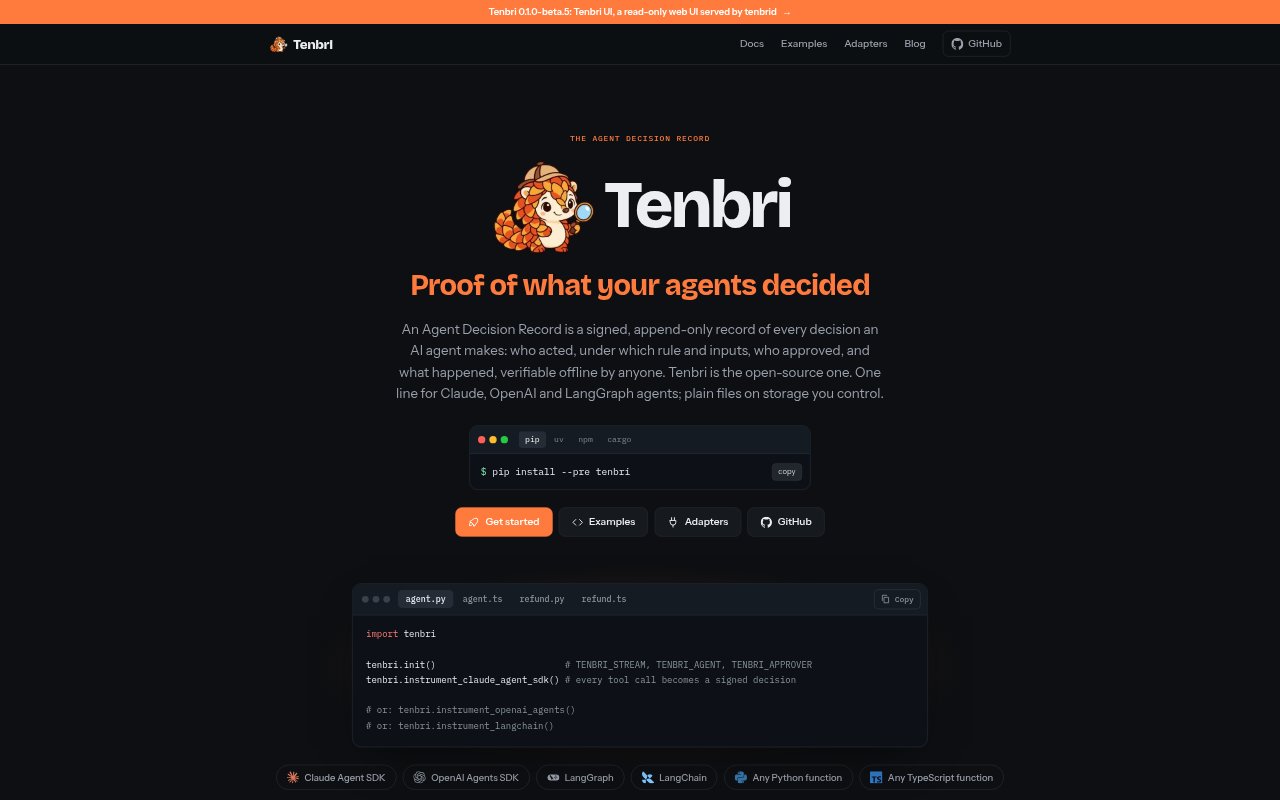
What is Tenbri?
Tenbri is an open-source audit trail for AI agents, creating signed, append-only records of what an agent decided, which rules and inputs it used, who approved, and what happened. It is aimed at teams that need evidence for audits, incident reviews, policy changes, or disputes. Developers can record decisions from Python and TypeScript agents, including Claude, OpenAI, and LangGraph workflows, and keep the resulting files on storage they control.
Tenbri Features:
Signed Decision Records: Tenbri records an agent’s intent and outcome in a hash-chained stream, with entries signed using Ed25519 before they reach storage.
Agent Integrations: Python and TypeScript SDKs support Claude, OpenAI, and LangGraph agents, with a CLI for appending records.
Offline Verification: The CLI, Python, and Node tools can check canonical bytes, the hash chain, signatures, and keys without access to the original systems.
Controlled Storage: Decision streams are plain files that can be stored locally or in Cloudflare R2 or MinIO, with signing keys kept separately.
Policy Version Queries: Teams can query and review decisions made under a particular policy version, with returned answers checked against storage.
Receipts and Checkpoints: Receipts provide proofs for specific entries, while checkpoints help detect truncation or forks in a stream.
Tenbri Benefits:
Independent Review: Auditors, customers, or other reviewers can check records themselves instead of relying on access to a company’s systems.
Clearer Incidents: A signed record of decisions and outcomes gives teams concrete evidence to examine during an incident or dispute.
Policy Comparisons: Teams can identify decisions made under an earlier policy version and review them when rules change.
Selective Proof: Entry receipts let teams prove particular decisions without handing over the entire stream.
Privacy With Verification: Encrypted record bodies and keyed input digests allow a subject’s keys to be deleted while the chain remains verifiable.
Use Cases:
Agent Incident Review: Investigate an agent action by checking its recorded decision, outcome, signature, and place in the stream.
Customer Disputes: Provide a customer with a receipt that proves specific agent decisions without exposing unrelated records.
Policy Change Audits: Find decisions made under a previous policy version and assess them after a rule or policy changes.
Regulatory Evidence: Hand an auditor a decision stream and fingerprint so they can verify the records offline.
Agent Development: Add decision recording to Python or TypeScript workflows built with Claude, OpenAI, or LangGraph agents.