

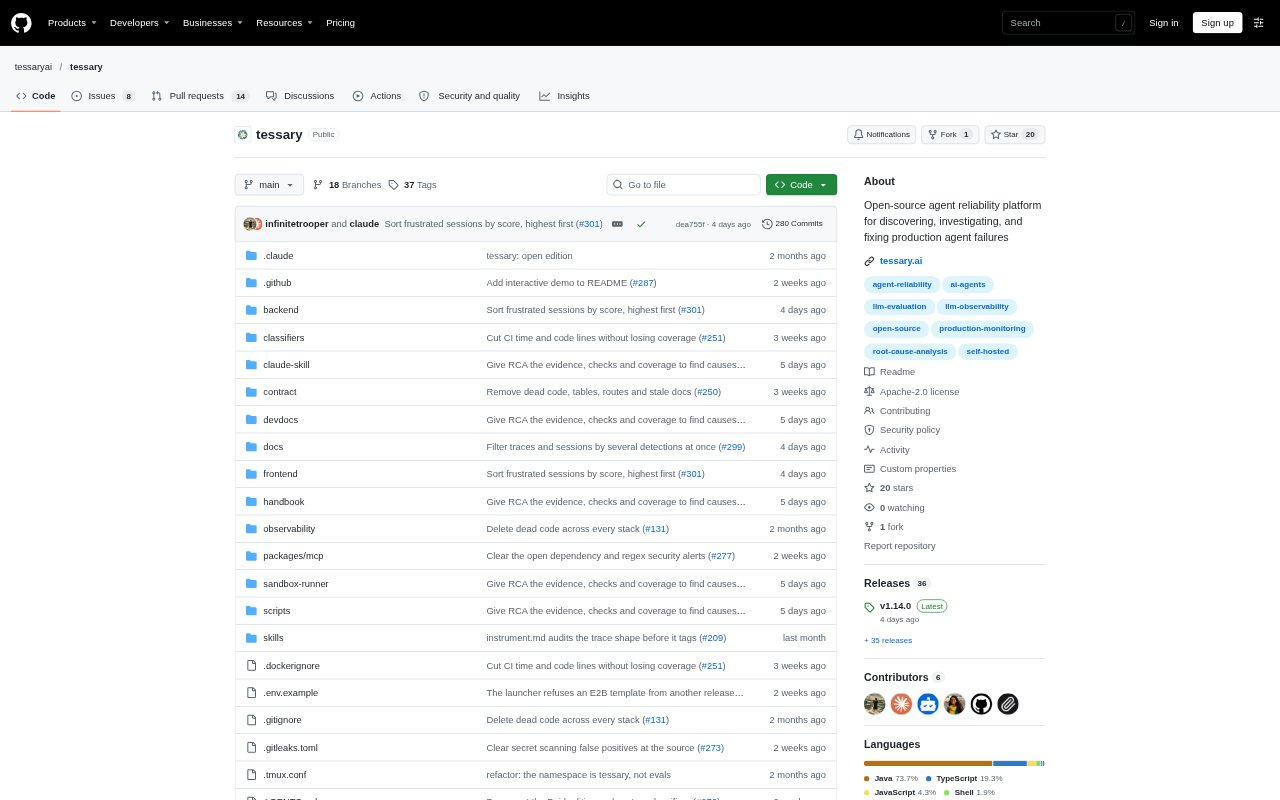
What is Tessary?
Tessary is an open-source reliability platform for engineers running AI agents in production. It monitors agent traces, checks them for issues, groups related findings into cases, and investigates causes using trace evidence and, when connected, repository code. Teams can use Tessary Cloud or self-host it. It accepts traces over OTLP HTTP or gRPC, as well as SDK push, and normalizes them to OpenTelemetry gen_ai conventions.
Tessary Features:
Trace Monitoring: Tessary reads every incoming production trace rather than sampling, and its ingestion step does not require an LLM call.
Built-In Classifiers: Classifiers check traces for drift, tool errors, secret leaks, malformed output, user frustration, and groundedness.
Finding Groups: Related findings are grouped into cases, giving teams one place to investigate and track recurring issues.
Case Triage: An LLM triage step evaluates whether findings represent real deviations, with secret leaks and rising frustration handled as exceptions.
Root Cause Analysis: Tessary analyzes failing traces and, if a repository is connected, the code behind them, returning causes with supporting evidence.
Trace Privacy: Personally identifiable information is redacted before traces are stored, and traces can arrive through OTLP HTTP, OTLP gRPC, or SDK push.
Tessary Benefits:
Fewer Missed Issues: Checking every trace helps teams catch production problems that a sample-based review could overlook.
Less Repeated Triage: Grouping related findings into cases helps teams focus investigation on the underlying issue instead of handling each trace separately.
Evidence-Based Diagnosis: Trace and repository evidence gives engineers a clearer basis for deciding what caused an agent failure.
Production-Scale Checks: Cheap classifiers make continuous checks across production traces practical without relying on an LLM call for each trace.
Shared Issue Tracking: Cases give teams a consistent way to investigate, track, and resolve validated agent problems.
Use Cases:
Prompt Regression Checks: Investigate a rise in incorrect agent responses after a prompt change, using failing traces and connected code as evidence.
Tool Failure Review: Find and group agent traces affected by tool errors so engineers can inspect the recurring failure.
Secret Leak Detection: Monitor production agent traces for secret leaks and route confirmed findings into the team's case workflow.
Conversation Drift: Check an agent's behavior over time for drift, malformed output, or rising frustration among users.
Groundedness Checks: Evaluate agent answers against retrieved documents to investigate whether responses are grounded in their supplied material.