

What is Together AI?
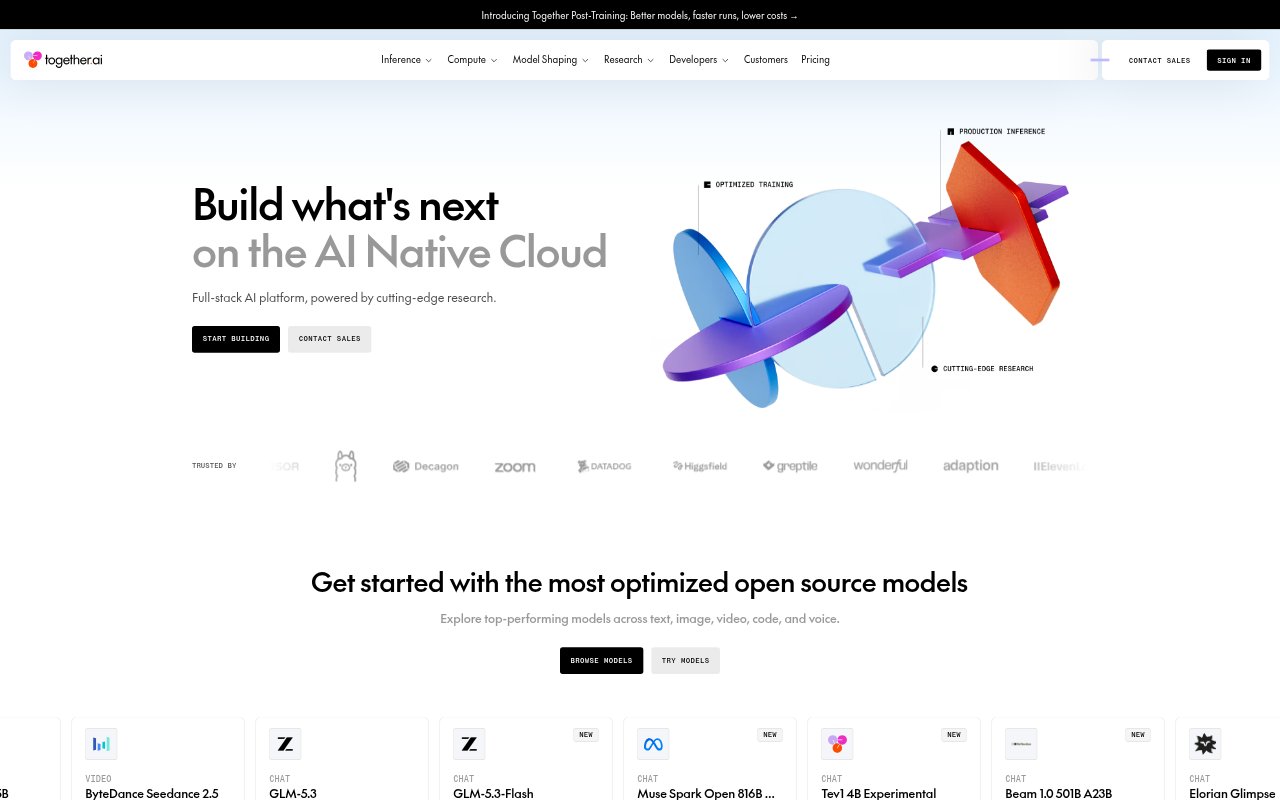
Together AI is a cloud platform for building and running AI applications, with services spanning model inference, fine-tuning, post-training, and GPU infrastructure. It gives developers and businesses access to open models for text, image, video, code, vision, and voice tasks. Teams can use hosted inference services, run models on dedicated infrastructure, or shape and evaluate models for their own applications.
Together AI Features:
Open Model Catalog: Browse open-source models for chat, image, code, vision, video, and voice, and use the model library to find options for your work.
Inference Options: Choose serverless APIs, batch inference, provisioned throughput, dedicated model inference, or dedicated containers for custom models.
Model Fine-Tuning: Launch managed supervised fine-tuning and direct preference optimization jobs for supported open-source models.
Post-Training Controls: Define reinforcement learning and supervised fine-tuning loops to shape model behavior.
Model Evaluations: Measure model quality with evaluation tools as part of the model development workflow.
GPU Infrastructure: Run workloads on GPU clusters, with hardware options including B200, H200, and H100 GPUs.
Together Link: Run open models inside an existing harness using Together Link.
Together AI Benefits:
Flexible Deployment: Teams can choose an inference setup that suits a workload, from API-based access to reserved capacity or custom hardware.
Faster Model Trials: A shared catalog of models and inference options makes it easier to compare approaches without first building model infrastructure.
More Relevant Outputs: Fine-tuning and post-training give teams ways to adapt models to their tasks rather than relying only on their default behavior.
Clearer Model Choices: Evaluations provide a way to assess model quality while developing or selecting a model for an application.
Room to Scale: The range of inference and GPU options lets teams expand from initial experiments toward larger or more specialized workloads.
Use Cases:
AI Chat Applications: Build a chat product by selecting an open model and serving it through an inference API.
Offline Workloads: Run large volumes of prompts as batch inference jobs when results do not need to return interactively.
Custom Model Behavior: Fine-tune or post-train an open model for a product that needs responses shaped around its specific tasks.
Voice Agents: Combine speech-to-text, language, and text-to-speech models to build voice agents on co-located infrastructure.
Model Quality Checks: Evaluate candidate models during development to help decide which one fits an application.