

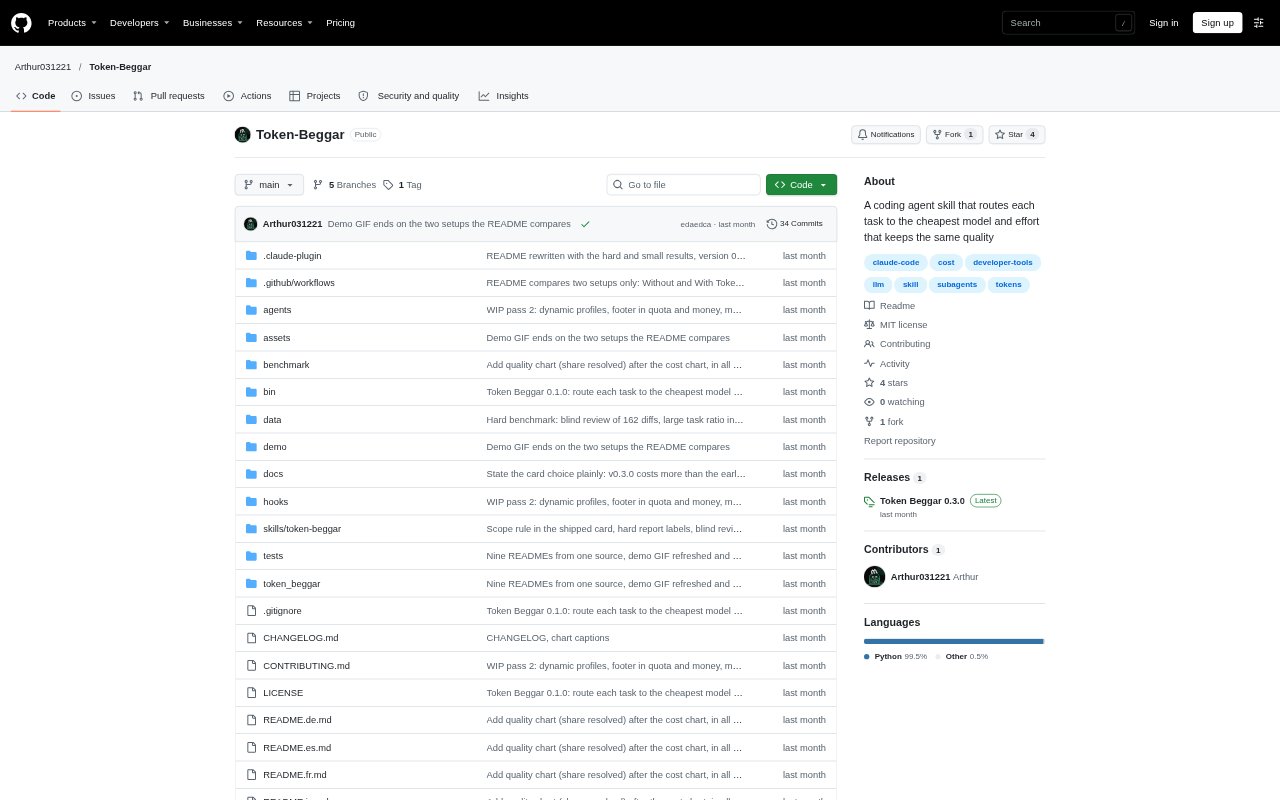
What is Token Beggar?
Token Beggar is a plugin for Claude Code that evaluates a coding task and can delegate larger jobs to a lower-cost model, while keeping the conversation, design decisions, and final response with the model you selected. It is intended for developers who want to control model costs while working in Claude Code, particularly on substantial coding tasks. In a benchmark of 18 Python bug fixes, it used less quota and money with a similar share of issues resolved; results vary by model and task, and small edits may see little change.
Token Beggar Features:
Task Sizing: A routing card helps the chat model classify work as small, which stays in the chat, or large, which can be delegated to a worker.
Model Routing: For eligible tasks, the plugin selects a cheaper model and effort based on the current chat model and measured routing modes.
Worker Review: After delegation, the chat model reviews the full git diff, runs tests, checks the worker's report, and can send it back to address omissions.
Model Ceiling: A ceiling based on the chat model and effort prevents workers from exceeding the configured level, such as sending work to a higher model.
Cost Footer: When routing produces a measured saving, a stop hook adds an estimated cost comparison to the reply, using the task's cost and a measured ratio.
Session Guard: Hooks can save a short context note before compaction and restore it afterwards to help preserve information in long sessions.
Local CLI: The command-line tool includes doctor, mode, stats, inventory, and ask commands, and can check whether routing is working.
Token Beggar Benefits:
Lower Task Costs: On the tested set of 18 bug fixes, the plugin reduced measured cost by 29 percent while issue resolution was 69 percent versus 70 percent without it, a tie within the study's spread.
Spend Where Needed: Keeping small tasks in the chat avoids sending straightforward edits to a worker when the measured saving is too small to distinguish from normal run-to-run variation.
Retain Oversight: The selected chat model remains responsible for reviewing delegated code and test results, so workers do not replace the final review step.
See Cost Impact: An estimated comparison at the end of routed replies makes the potential cost difference visible without requiring users to calculate it themselves.
Limit Project Changes: Because the plugin writes to its own folder rather than project files or agent settings, it can be tried without changing a codebase's configuration.
Use Cases:
Unfamiliar Repository Bugs: Delegate an issue in a repository the chat model has not yet explored, then have it inspect the proposed changes and run tests.
Multi-File Fixes: Use task sizing for a bug or feature that spans several files and requires an edit-and-test cycle rather than a quick one-file change.
Growing Small Tasks: Let a task that begins as a small edit be reconsidered for routing if the work expands beyond a few steps.
Long Coding Sessions: Use the compaction guard when a Claude Code session is long enough that preserving a short context note could help maintain continuity.
Routing Health Checks: Run the doctor command when a session does not appear to route work, or use mode and stats to inspect its current behavior.