

What is Tokenome?
Tokenome connects lines of AI-written code to the conversations that led to them, helping developers recover the reasoning behind a change rather than relying on chat history or commit messages alone. It reads transcripts from Claude Code, Claude Desktop, ChatGPT and Gemini, then indexes them locally for search and agent access. Individual use runs on macOS and Linux without sending data to a cloud service; teams can opt selected projects into sharing on a server they operate.
Tokenome Features:
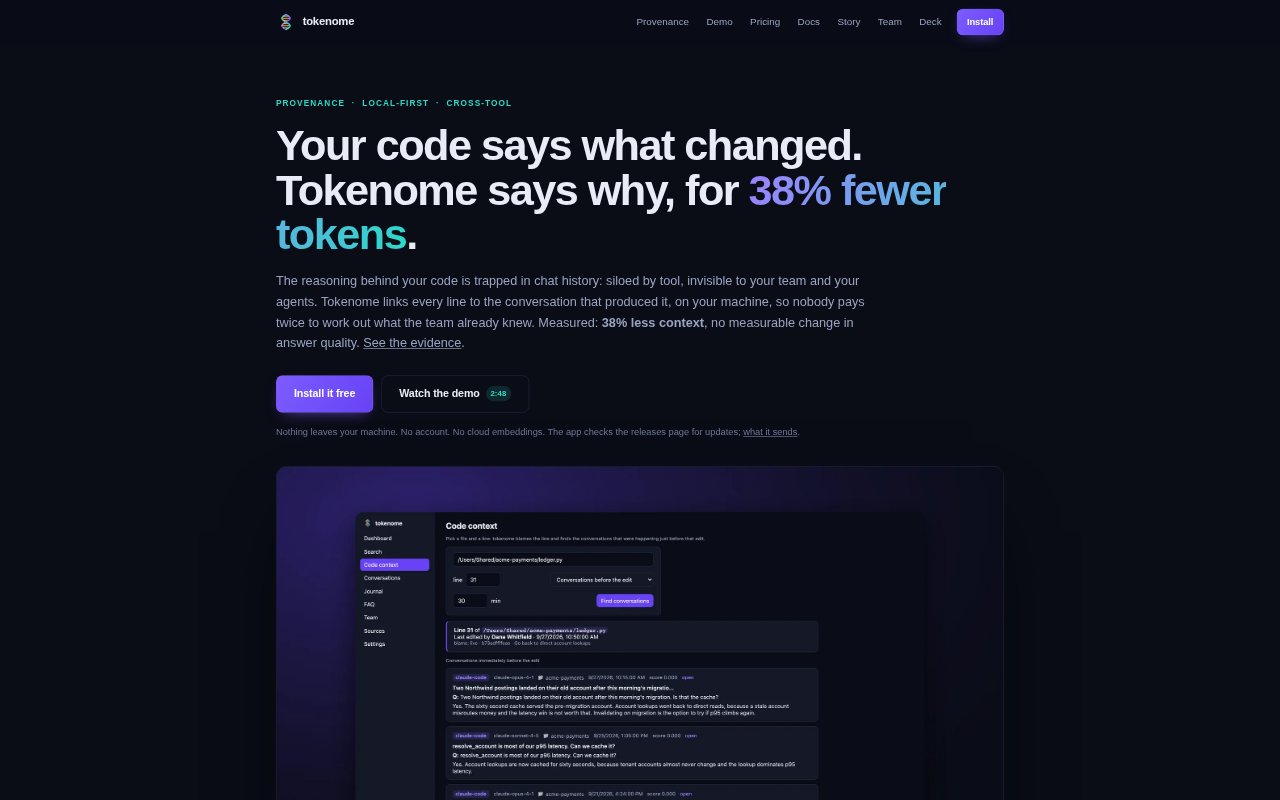
Code Provenance: Point to a line of code to find the conversation associated with the change and read the discussion behind it.
Local Transcript Index: Tokenome captures transcripts from Claude Code, Claude Desktop, ChatGPT and Gemini, then segments, embeds and indexes them on your machine.
Search Interfaces: Search the local index through the command line, a web interface or an MCP server running on your machine.
Agent Access: An agent can ask why a decision was made and receive the decision, any later reversal and links to the cited conversation turns.
Daily Decision Journal: Tokenome creates a daily record of decisions and their reasoning, quoting the source sentence for each reason.
Team Sharing: Teams can search opted-in projects together with contributor attribution, while secrets are redacted before data is sent to a self-hosted server.
Tokenome Benefits:
Recover Rationale: Developers can understand why code works a particular way without reconstructing the history from memory or relying on incomplete commit notes.
Avoid Repeated Context: Finding an earlier discussion can keep a developer or agent from asking teammates to explain a decision they have already made.
Smoother Handoffs: People reviewing or inheriting work can see the tradeoffs and follow-up decisions that may not be apparent from the code itself.
Keep Data Local: Individual users can search their history without sending transcripts to a hosted service or depending on cloud embeddings.
Measured Context Savings: Tokenome reports that its evaluation used 38% less context with no measurable change in answer quality.
Use Cases:
Investigate Code: When a function has an unexpected retry, workaround or other unusual behavior, trace it to the discussion that explains the choice.
Review a Change: During code review, look up the conversation behind a changed line to understand the intended behavior and any tradeoffs.
Ask an Agent: Give a coding agent access to prior decisions so it can answer questions about why a function or implementation was chosen.
Onboard Teammates: Help a teammate joining a shared project find the reasoning behind existing code without relying solely on another developer's recollection.
Search Team History: Search opted-in project conversations across a team when deciding whether a past solution or discussion applies to current work.