

What is Toolmaker Agent?
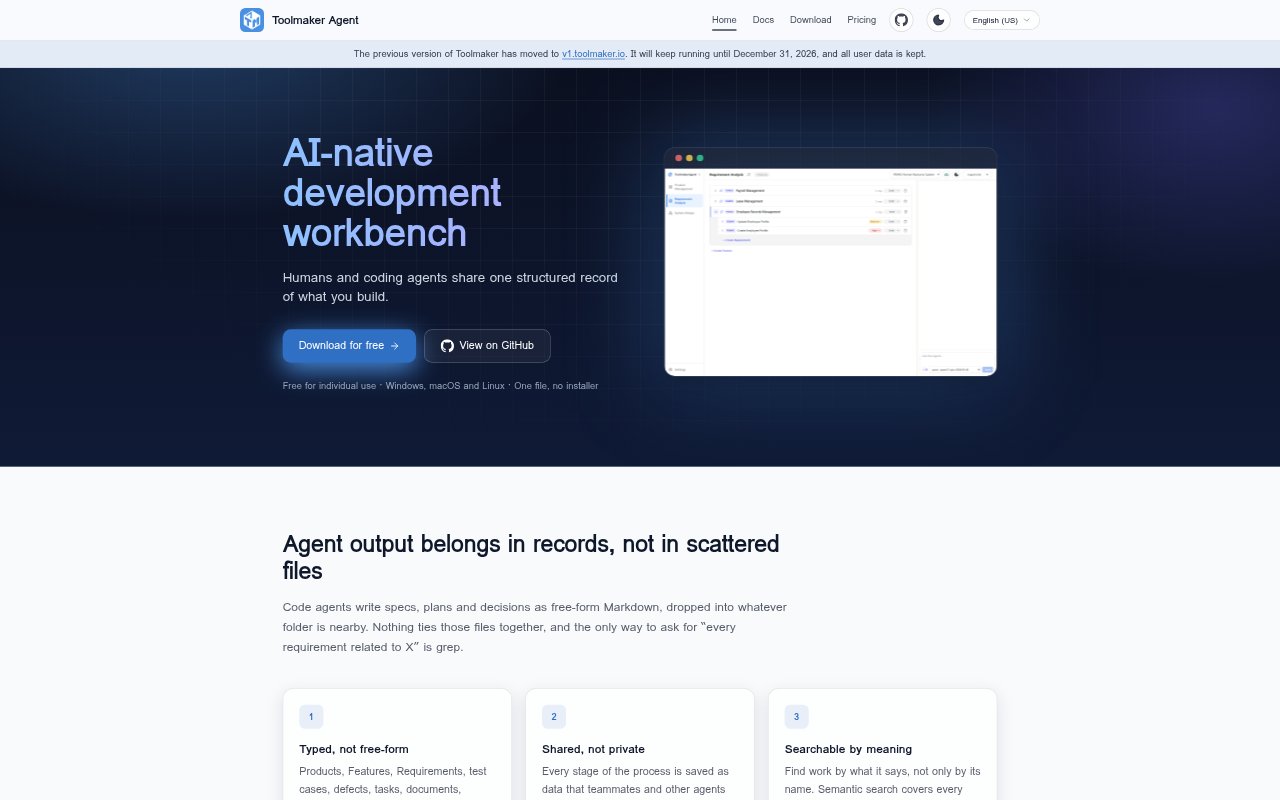
Toolmaker Agent is an AI-native development workbench for people building software with coding agents. It gives humans and coding agents a shared, structured record of what they are building, providing a common reference for the work. The application is free, delivered as a single binary, and runs locally. Its described focus is the shared record at the center of human-and-agent development, making it relevant to developers who want a local workbench for that collaboration.
Toolmaker Agent Features:
AI-Native Workbench: Toolmaker Agent is designed as a development workbench for work involving AI, with coding agents included in its core collaboration model.
Shared Build Record: The workbench provides a structured record of what is being built that both humans and coding agents can share.
Human Participation: People working on a project can use the same structured record as the coding agents involved in the work.
Agent Participation: Coding agents can share the project record with humans, placing their work within a common account of what is being built.
Single-Binary Delivery: The application is distributed as a single binary rather than described as a collection of separate components.
Local Execution: Toolmaker Agent runs locally, making a locally operated development workbench available for human-and-agent work.
Free Access: The workbench is offered free, so trying it does not require paying for access.
Toolmaker Agent Benefits:
Shared Context: A common structured record gives the person and coding agent one reference point for the project, helping keep their understanding aligned.
Less Repetition: Keeping project information in a shared record can reduce the need to explain what is being built separately to each collaborator.
Local Control: Because the workbench runs locally, users can work with it in a local environment instead of depending on a hosted application.
Lower Cost: Free access lets developers try the workbench without setting aside a software budget for its use.
Simpler Packaging: A single-binary delivery gives users one application package to work with rather than a set of separately described components.
Use Cases:
Agent-Assisted Building: Use the workbench while building software with a coding agent, keeping the person and agent connected to a shared record of the project.
Project Handoffs: Keep a structured account of what is being built available to both a human contributor and a coding agent during ongoing project work.
Local Development: Run a development workbench locally when you want the human-and-agent working record available in your local environment.
Work With Agents: Use a shared project record when a coding agent is participating in development and needs to work alongside a human.
Free Evaluation: Try a local, single-binary workbench for AI-assisted development without paying for access first.