

What is Tracely?
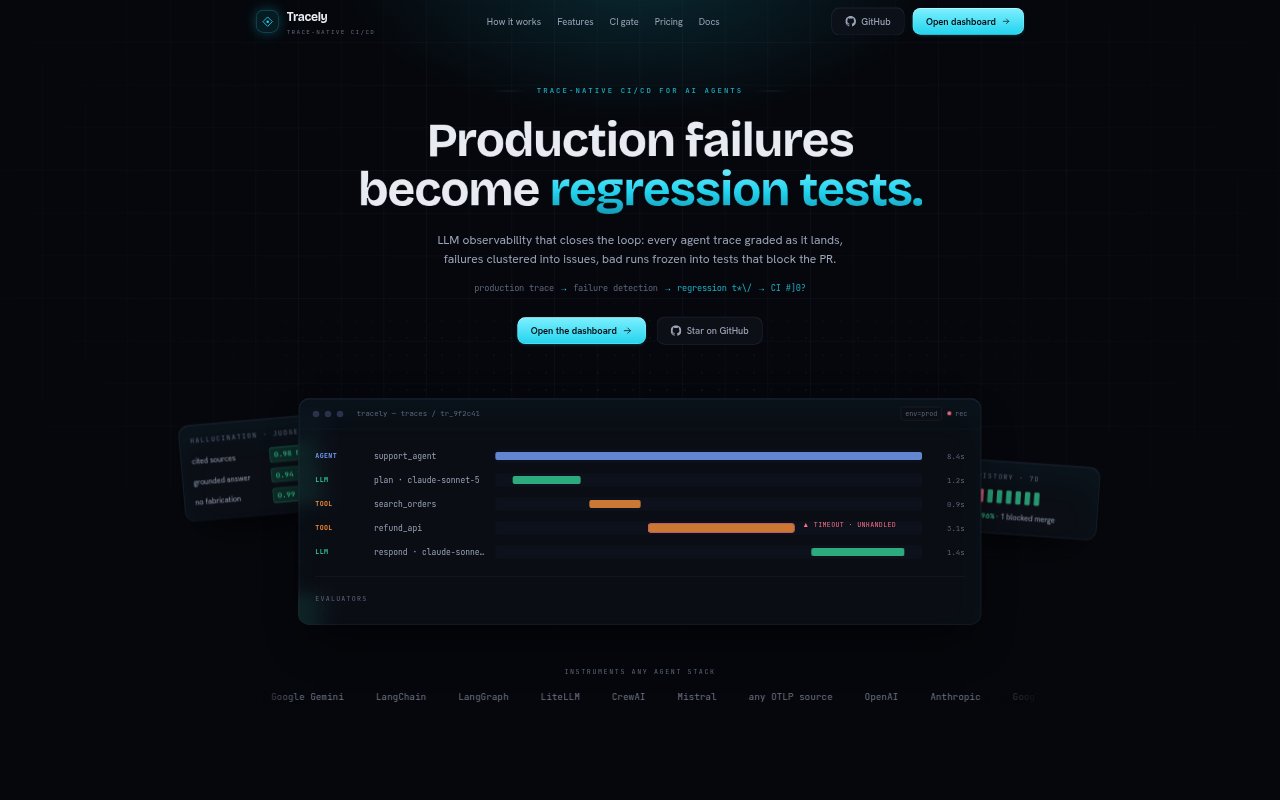
Tracely is an observability and evaluation platform for teams building AI agents. It collects production traces, grades runs with structural checks and LLM judges, groups failures into issues, and turns selected failures into replayable regression cases. Its CI gate runs those cases on pull requests, helping teams catch repeated production failures before merging. Tracely supports self-hosting or a hosted option, and its instrumentation is designed to work with existing agent stacks.
Tracely Features:
Trace Ingestion: Production runs stream in over OTLP, with agent, conversation, tool, and span data stored as searchable fields.
Online Evaluation: Evaluators grade traces at conversation, run, or span level, with LLM-as-judge and structural evaluators available.
Failure Clustering: Structural and semantic clustering groups failed traces into issues with descriptions, proposed fixes, and suggested evaluators.
Hermetic Cases: A selected failing trace becomes a replay case with recorded inputs, tool and LLM fixtures, and a fail-to-pass contract.
Pull Request Gate: The replay command runs cases on each PR and can fail the check, publish commit status, and update a PR comment.
Judge Calibration: Teams can compare evaluator verdicts with human labels, measure agreement, and identify judges that over-flag.
Tracely Benefits:
Fewer Repeat Incidents: Guarding against behaviors seen in production helps teams avoid shipping the same agent failures again.
Lower-Cost CI Checks: Offline replay with recorded fixtures avoids model calls and inference spend during routine regression checks.
More Focused Debugging: Recurring failure groups and trajectory differences help developers investigate underlying causes instead of sorting through isolated traces.
Clearer Release Decisions: A pass-or-fail signal on each pull request gives maintainers a consistent basis for deciding whether an agent change is ready to merge.
More Reliable Evaluations: Checking judge results against human review can reveal unreliable evaluators before teams rely on them for release decisions.
Use Cases:
Regression Testing: After a production incident such as a tool timeout, preserve the failing run and check proposed fixes in later pull requests.
Agent Change Reviews: Add the gate to a pull-request workflow to test promoted cases before merging changes to prompts, tools, or orchestration.
Production Monitoring: Evaluate incoming assistant conversations as traces arrive, then investigate issues formed from clusters of failed runs.
Evaluator Validation: Compare judge results with human review while tuning evaluations for a specific agent or workflow.
Agent Trend Analysis: Review daily failure and gate pass-rate trends alongside per-agent analysis to identify shifts and outliers.