

What is Transformer Explainer?
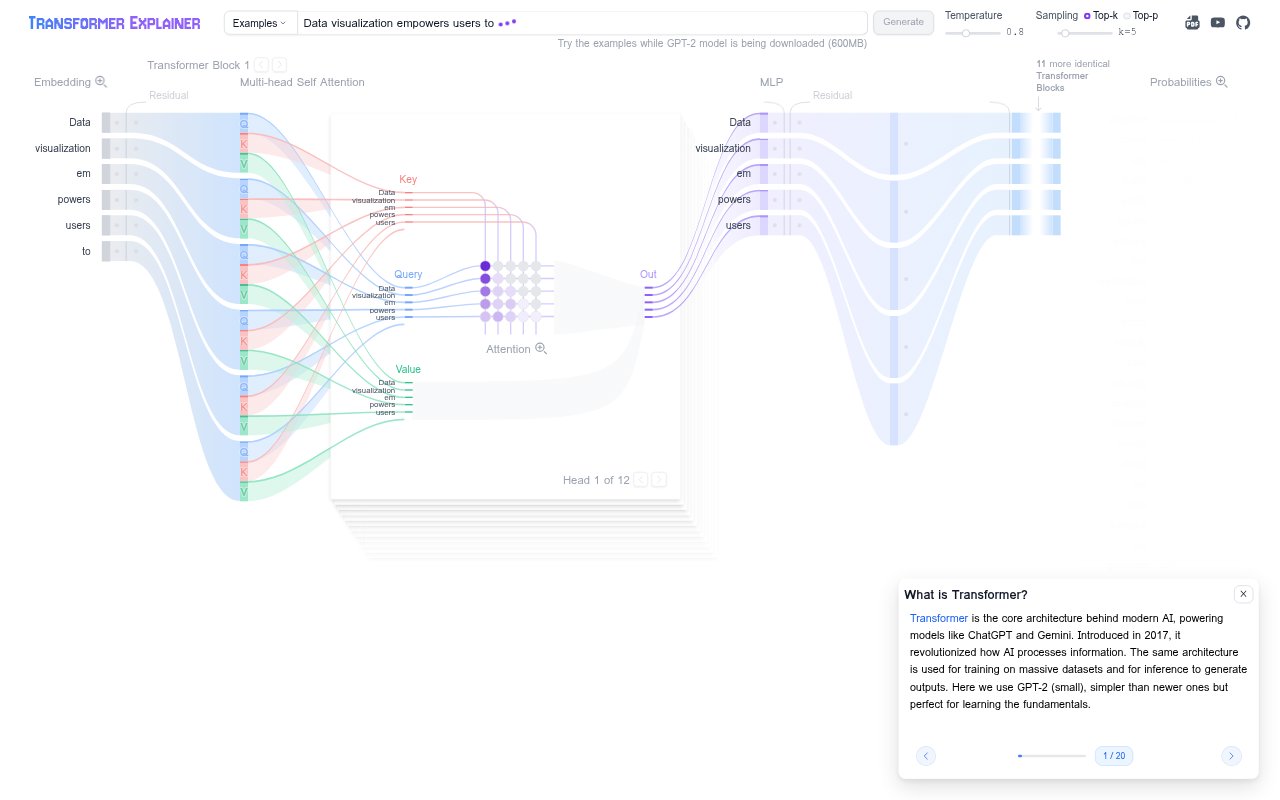
Transformer Explainer is an interactive visual guide to how transformer models process text and predict the next token. It uses GPT-2 small, a 124-million-parameter model, to demonstrate components and principles also found in larger language models. It is suited to learners, educators, and anyone who wants a visual introduction to transformer architecture rather than a tool for building or deploying models.
Transformer Explainer Features:
Tokenization Steps: The walkthrough shows how a text prompt is divided into word or subword tokens, each represented by an ID.
Embedding Process: It explains how GPT-2 small combines token embeddings with learned positional encodings to represent meaning and sequence position.
Transformer Blocks: The guide breaks down the attention and MLP layers inside transformer blocks and notes that GPT-2 small has 12 blocks.
Attention Heads: It follows how token representations become query, key, and value vectors, then split across GPT-2 small's 12 attention heads.
Masked Attention: The visualization covers dot-product scores, scaling, masking, softmax, and dropout in the self-attention calculation.
Next-Token Output: It explains how final output probabilities let a text-generating transformer predict the next token in a sequence.
Transformer Explainer Benefits:
Clearer Concepts: Following each stage in sequence can make abstract transformer components easier to understand than learning them as isolated terms.
Connected Picture: Seeing how embeddings, attention, and output relate helps learners form a coherent mental model of text generation.
Concrete Example: A familiar GPT-2 example gives learners a specific model to refer to while studying principles shared by modern transformers.
Accessible Teaching: Visual explanations give instructors another way to introduce technical ideas to students with different levels of background knowledge.
Process Awareness: Understanding the stages behind next-token prediction helps readers interpret what a language model is doing with a prompt.
Use Cases:
AI Fundamentals: Use the walkthrough when learning the basic architecture behind text-generative models such as GPT, Llama, and Gemini.
Classroom Lessons: Bring the visual guide into a lesson on tokenization, embeddings, attention, or transformer blocks.
Self-Study Review: Work through the model stages when reviewing how a prompt becomes a next-token prediction.
Attention Tutorial: Use the query, key, and value explanation to introduce how tokens attend to other tokens in a sequence.
Model Comparison: Use GPT-2 small as a reference point when discussing architectural principles found in newer transformer models.