

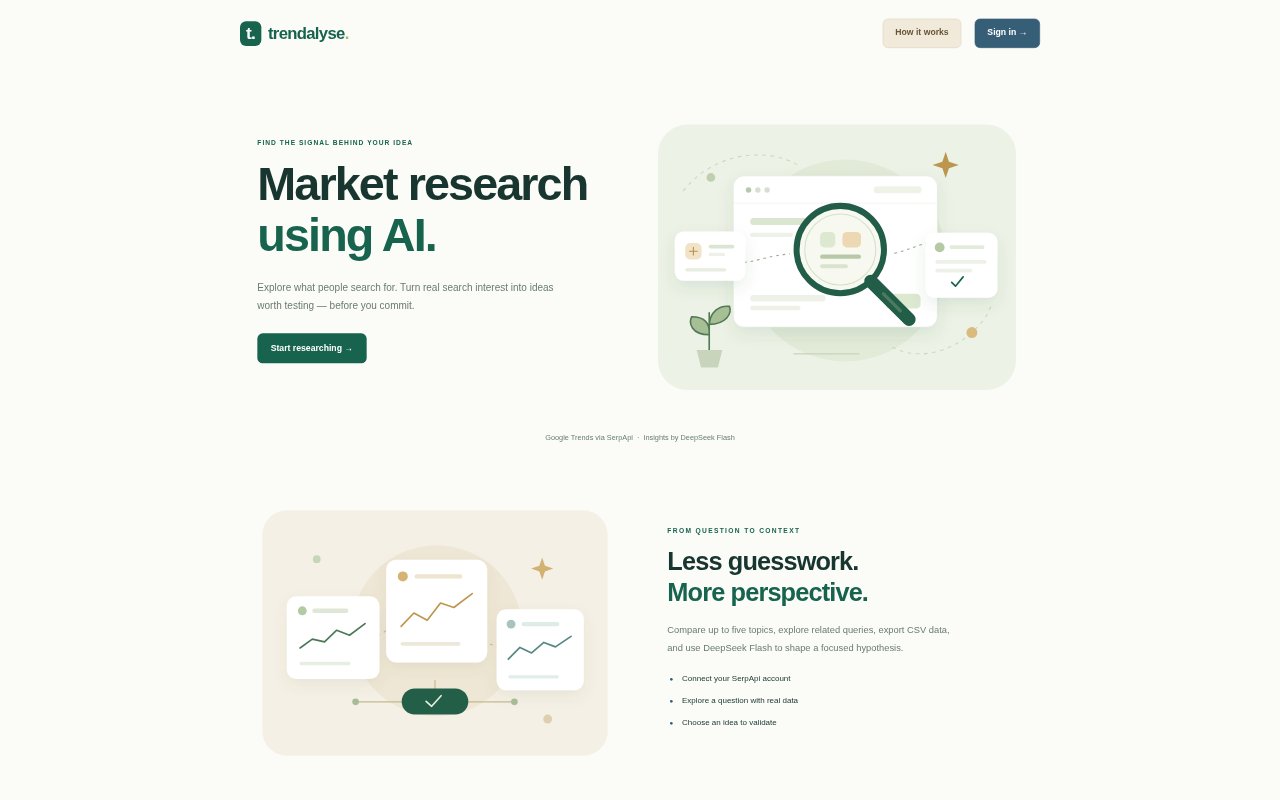
What is Trendalyse?
Trendalyse is an AI-assisted market research tool for founders and others assessing an idea through online search behavior. It draws Google Trends data through SerpApi, then uses DeepSeek Flash to help turn topic comparisons and related-query exploration into a focused, testable hypothesis. Users can compare up to five topics, examine what people search for, and export data as CSV. Search interest serves as evidence for exploration, not as proof of purchase intent.
Trendalyse Features:
Google Trends Data: Trendalyse uses SerpApi to bring Google Trends search-interest data into an exploration of a market question.
Topic Comparison: Users can compare search interest for up to five topics to examine how ideas relate in the available data.
Related Queries: The tool lets users explore queries related to their topics and see what else people search for.
CSV Export: Search data can be exported as a CSV file for further examination outside the tool.
AI Hypothesis Support: DeepSeek Flash helps shape findings into a focused hypothesis that can be tested with real customers.
SerpApi Connection: Users connect their SerpApi account to explore a question using Google Trends data.
Trendalyse Benefits:
Earlier Idea Screening: Search-interest evidence offers a way to examine an idea before committing to it or investing in a larger effort.
More Topic Context: Comparing several topics can help put alternatives in perspective instead of evaluating each idea in isolation.
Sharper Questions: Related queries can give researchers more angles to investigate when they are still defining a market question.
Testable Direction: A focused hypothesis gives customer conversations and small experiments a clearer proposition to examine.
Grounded Expectations: Treating search activity as interest rather than purchase intent helps keep the findings in perspective.
Use Cases:
Startup Idea Screening: A founder can compare search interest around a new product concept with related topics before deciding what to validate next.
Market Question Research: A small business owner can explore related queries to broaden an initial question about what people are searching for.
Concept Comparison: A team weighing several product directions can compare up to five topics and export the data for review.
Customer Interview Prep: A researcher can use a search-based hypothesis to frame questions for conversations about a potential idea.
Early Validation Planning: An entrepreneur can use the hypothesis as a starting point for testing willingness to pay and trying a small real-world experiment.