

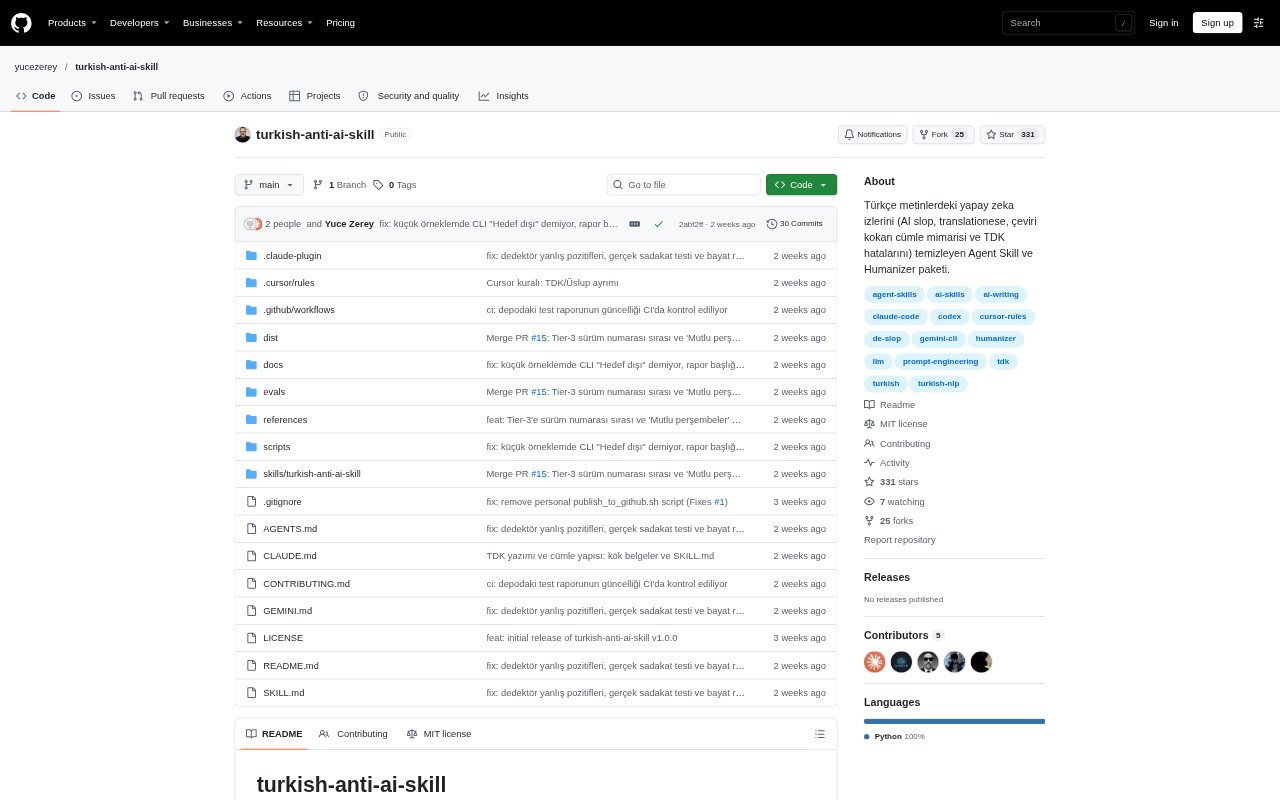
What is Turkish Anti-AI Skill?
Turkish Anti-AI Skill is an open-source agent skill for rewriting, drafting and reviewing Turkish text. It targets Turkish-language writers and teams who use AI coding or writing assistants and want prose that follows Turkish sentence structure, TDK spelling guidance and the conventions of a chosen register. It can also audit text without changing it, using a local Python command-line detector to flag patterns and surface-level writing issues.
Turkish Anti-AI Skill Features:
Writing Modes: The skill supports rewriting existing text, drafting new Turkish text and auditing a passage without editing it.
Register Calibration: It adapts guidance across blog and essay, technical, corporate, academic and literary registers, with nine style dimensions for each.
Sentence Repair: Its rules address English-influenced sentence structures, mechanical conjunctions, passive phrasing, repetitive sentence endings and uniform sentence lengths.
Pattern Dictionary: A three-tier glossary covers more than 60 patterns associated with formulaic or translation-influenced Turkish, including bureaucratic and SaaS marketing phrasing.
TDK and Phonetics: The skill applies TDK spelling guidance and checks suffixes against the Turkish pronunciation of foreign technical terms rather than their written form.
CLI Detector: A Python script scans Markdown or text for patterns, spelling issues, frequent -mAktAdIr endings and sentence-length variation, with optional register-aware scoring and JSON output.
Agent Installation: It can be installed for Claude Code, Cursor, Codex, Gemini CLI, Windsurf and other supported agent environments, or added to some web AI tools as project instructions.
Turkish Anti-AI Skill Benefits:
Clearer Reading: Replacing stiff, translation-like constructions with Turkish sentence patterns can make passages easier to understand on a first read.
Fewer Fabrications: The rewrite mode is instructed to preserve source facts and not add unsupported figures, dates, names, claims or causal links.
Consistent Tone: Register-specific guidance helps writers avoid applying the same sentence style to a blog post, technical explanation and formal document.
Focused Editing: Audit results can point writers toward patterns to review without requiring the tool to rewrite text they want to keep intact.
Local Checking: The detector runs without external libraries or network access, so teams can inspect text from a terminal or CI workflow.
Use Cases:
Blog Revision: Rewrite a draft that opens with generic scene-setting, leans on stock transitions or closes with a broad lesson.
Technical Drafting: Create a Turkish explanation of a software topic while keeping technical terms and applying suffixes by Turkish pronunciation.
Corporate Review: Audit company copy for repetitive formal endings, passive constructions and patterns that sound translated.
Academic Editing: Review formal Turkish writing using academic register settings rather than treating every formal expression as an error.
Content Pipeline: Run the detector on Markdown files or in GitHub Actions to flag possible surface-level issues during a review process.