

What is Wren AI?
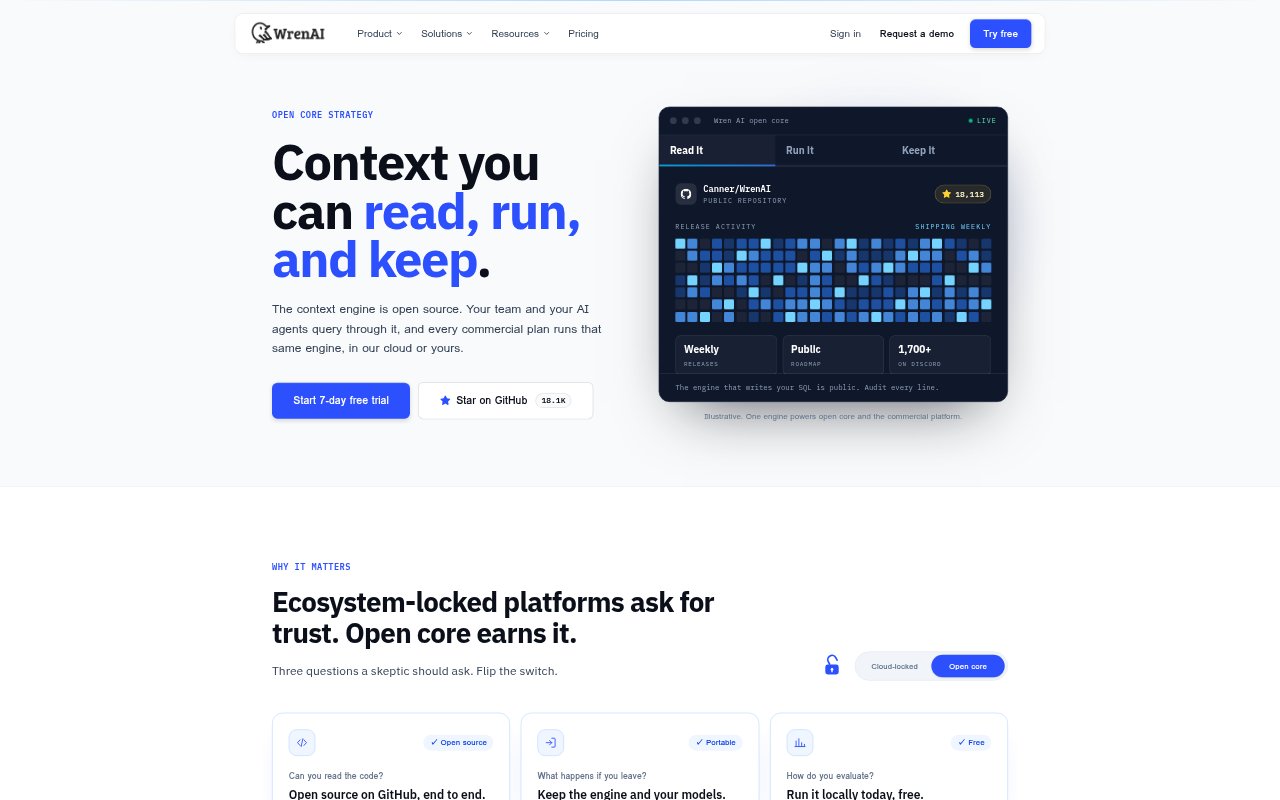
Wren AI is a governed generative BI platform for data teams and organizations that want people and AI agents to ask questions about company data in plain language. It applies a shared context layer of business metrics and definitions before generating SQL, so teams can get answers through its interface or agents can connect over MCP. The open-source engine can run locally; commercial options add a team platform in the cloud or in a company’s own environment.
Wren AI Features:
Data Connectors: Connects to more than 20 data sources, including Snowflake, BigQuery, PostgreSQL, Databricks, and Redshift.
Context Modeling: Creates a context layer for business metrics, relationships, and definitions, with an onboarding agent drafting it for data-team review.
Text to SQL: Applies the context layer to natural-language questions and runs governed SQL against connected data.
MCP and CLI: Provides an MCP server for AI agents and a CLI for individual developers using the open-source engine.
Dashboards and Spreadsheets: Turns business questions into dashboards that users can filter and drill into, and supports AI-powered spreadsheets.
Deployment Controls: Offers cloud, self-hosted, on-premises, and air-gapped deployment options, with row- and column-level controls on eligible plans.
Wren AI Benefits:
Shared Definitions: People and agents can work from the same business definitions, reducing conflicting interpretations of company metrics.
Verifiable Answers: Seeing an answer’s reasoning and SQL gives teams a way to check how a result was produced.
Data Stays Put: Querying data in place avoids moving it into a separate analytics stack for Wren AI.
Inspectable Engine: Teams can review the open-source context engine and keep its models, supporting evaluation without committing to a closed engine.
Flexible Rollout: Unlimited members on the paid plans let organizations roll out access without licensing each named user separately.
Use Cases:
Marketing Analysis: Compare channel efficiency, customer acquisition cost, and campaign segments to inform budget allocation.
Team Data Questions: Let colleagues ask everyday business questions in Wren, Slack, or Teams and explore the resulting dashboards.
Agent Data Access: Connect Claude, ChatGPT, or a custom AI agent to company data through MCP using the shared context layer.
Embedded Analytics: Add a branded data agent to a product so its users can ask questions about data within the app.
Regulated Deployments: Run the platform in a VPC, on-premises, or an air-gapped environment when data and security requirements call for in-network deployment.