

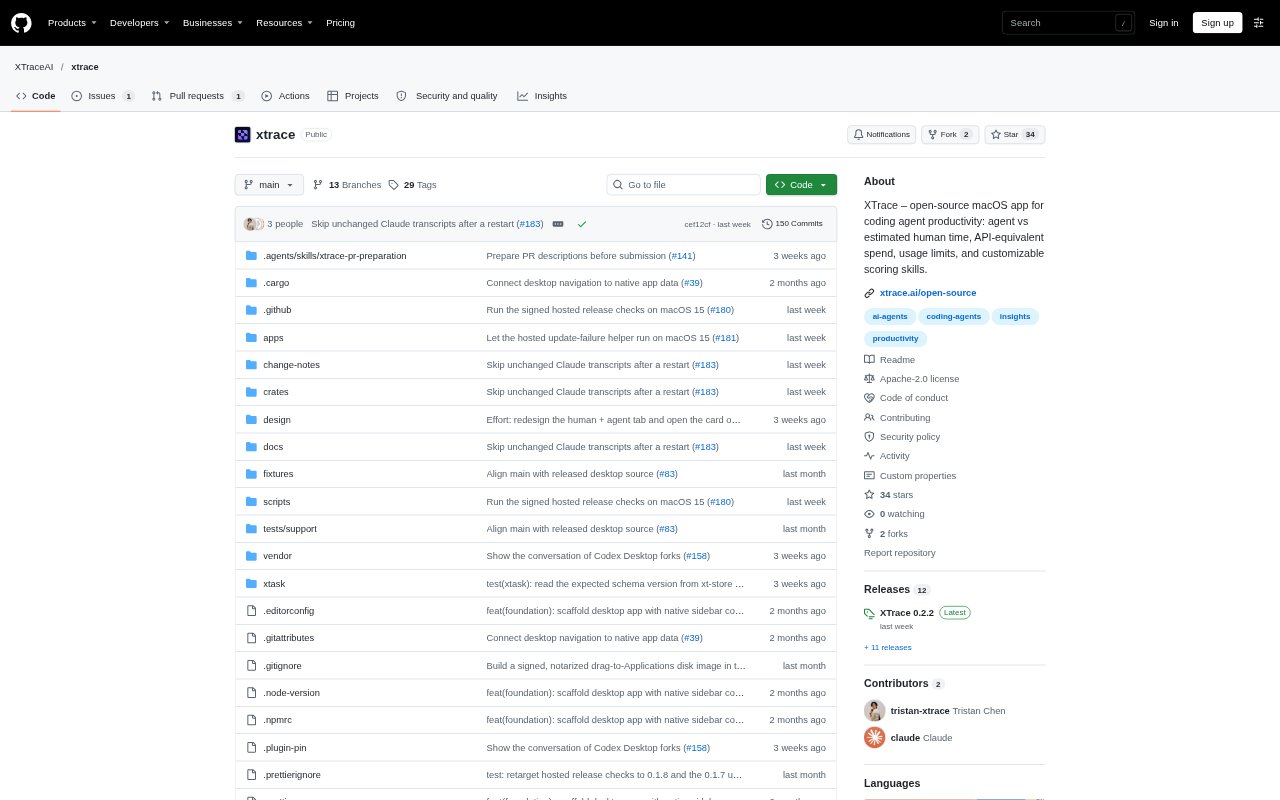
What is XTrace?
XTrace is a free, open-source Mac app for people who use Claude Code, Codex, or Cursor to write code. It indexes agent history already stored on the Mac and brings activity, estimated human time, API-equivalent costs, sessions, and linked pull requests into one place. The public beta requires macOS 14 or newer on Apple Silicon; Codex and Cursor history also require Python 3.10 or newer.
XTrace Features:
Daily Effort Charts: View daily agent and estimated human hours, concurrent sessions, hands-off time, and comparisons with a previous period.
API-Equivalent Costs: Review estimated costs by day or session using published API rates, rather than treating them as a subscription bill.
Cross-Tool Sessions: Browse indexed Claude Code, Codex, and Cursor sessions, then filter by tool or search by repository, branch, or session ID.
Session Timelines: Inspect activity spans, prompts, recorded context compactions, and the full conversation for an indexed session.
Session Warnings: Flag patterns such as repeated prompts, failed tool calls, interruptions, corrections, or an agent acknowledging a mistake.
Project Scoring: Run scoring skills against project instructions, code comments, documentation, or agent setup, and review rubric-based findings and suggested fixes.
Usage Pace: Check Claude and Codex account usage, remaining limits, and a forecast based on average use during the current weekly window.
XTrace Benefits:
Grounded Comparisons: Previous-period views help you investigate whether a change in tools or workflow affected effort, without assuming that more agent hours mean more productivity.
Better Cost Context: Separating API-equivalent estimates from subscription charges helps prevent usage analysis from being mistaken for an actual bill.
Faster Session Review: Search and warning details make it easier to find conversations worth examining instead of scanning every saved session.
Actionable Improvements: Scoring findings explain how a result was reached and suggest changes, giving developers a clearer starting point for refining project guidance.
Local Transcript Handling: Local history indexing keeps conversation transcripts off the cloud by default, which can make reviewing agent activity more suitable for privacy-conscious workflows.
Use Cases:
Workflow Changes: Compare activity before and after adopting a coding agent or changing how a team prompts it.
Cost Reviews: Investigate which days, sessions, or models contribute to estimated API-equivalent usage.
Session Troubleshooting: Open a session flagged for repeated failures or corrections to inspect the exchange around the problem.
Project Instruction Reviews: Use a scoring skill to find gaps in a repository’s instructions, documentation, or agent setup.
Usage Planning: Check whether current Claude or Codex usage is ahead of or behind an even pace before the weekly limit resets.