
What is zams?
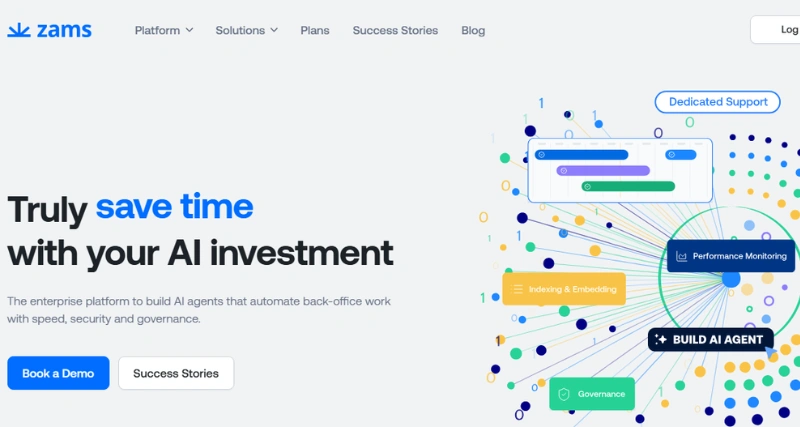
Zams is an enterprise-grade platform that enables businesses to develop AI agents capable of autonomous reasoning, decision-making, and action-taking. It facilitates the creation of predictive models and intelligent agents that can automate complex workflows, integrate with existing systems, and scale across various business functions.
zams Features:
Agentic AI Platform: Supports the development of AI agents with memory, reasoning, and real-time knowledge, enabling them to perform multi-step tasks and drive context-aware outcomes.
Predictive AI Models: Allows businesses to build, deploy, and scale predictive models for classification, regression, time series forecasting, and optimization without coding.
Multi-Agent Systems: Enables the creation of networks of autonomous AI agents that collaborate to achieve individual and shared goals, enhancing flexibility and efficiency in complex environments.
Seamless Integrations: Offers out-of-the-box integrations with over 120 applications and tools, facilitating real-time and batch processing with low-latency execution.
Security and Compliance: Built with enterprise-grade security and compliance at its core, including SOC 2 Type II, HIPAA, and GDPR certifications.
zams Benefits:
Accelerated Deployment: Transform ideas into fully operational AI agents within two weeks, addressing diverse business challenges efficiently.
Enhanced Decision-Making: Leverage predictive analytics and AI-driven insights to make informed, data-driven decisions.
Operational Efficiency: Automate routine tasks and complex workflows, reducing manual effort and increasing productivity.
Scalability: Handle growing data volumes, user demands, and complex AI workloads without compromising performance.
Customization: Build AI agents tailored to specific business needs and integrate them seamlessly into existing systems.
Use Cases:
Customer Retention: Predict churn, optimize pricing, and personalize engagement to boost retention rates.
Operational Automation: Automate back-office tasks such as data entry, document processing, and compliance checks.
Predictive Maintenance: Forecast equipment failures and schedule maintenance to minimize downtime.
Supply Chain Optimization: Enhance logistics by automating carrier selection, fulfillment processes, and inventory management.
Healthcare Analytics: Analyze patient data to predict outcomes, optimize treatment plans, and improve patient care.