
What is Absent Author?
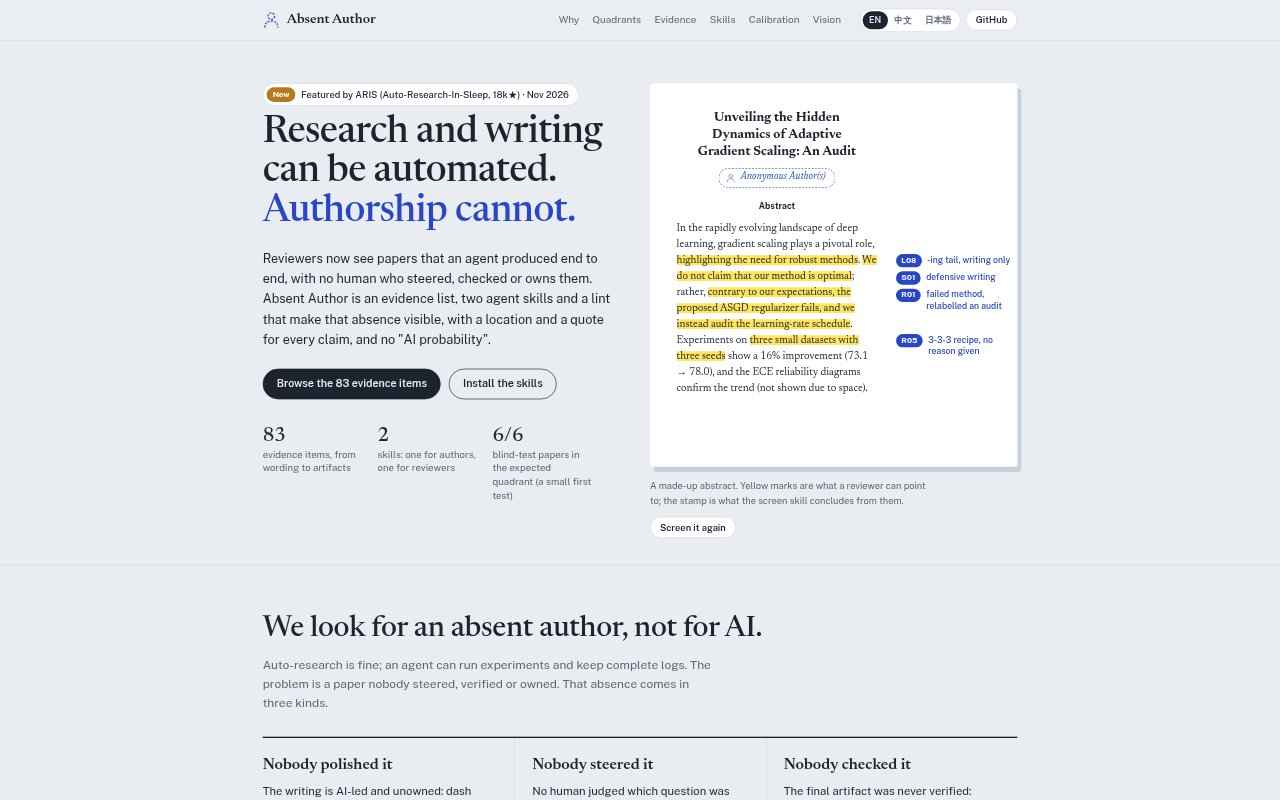
Absent Author is an evidence list, two agent skills and a calibrated lint for examining whether research papers have a responsible human author. It is aimed at paper authors, reviewers, area chairs and co-authors who want to assess whether research was steered and checked, rather than decide whether text was written by AI. Findings use checkable locations and quotes, not AI-generated authorship probabilities, and ordinary paper quality is assessed separately.
Absent Author Features:
Evidence List: Each evidence item includes its strength, the assessment axis it may affect, a note on how a person might produce it innocently, and source details.
Author Pass: The author skill prompts a human to assess the paper’s story, pivots, claims, argument, references, numbers and code before submission.
Reviewer Screen: The reviewer skill checks references, chatbot residue, watermarks, research steering, promised versus shown results, numerical consistency, scale and novelty.
Separate Axes: The assessment separates AI-led writing and unowned research from ordinary quality concerns, using W and R scores alongside a quality axis.
Traceable Findings: Findings include a location and quote, and the reviewer screen produces flags, an auditability rating, a substance-focused review paragraph and questions for authors.
Calibration Tests: The lint was calibrated against 59 pre-ChatGPT arXiv papers and 20 AI-generated papers, while the screen skill was blind-tested on six documents.
Absent Author Benefits:
Grounded Reviews: Reviewers can point authors to specific, verifiable problems instead of relying on a general suspicion that a paper was AI-written.
Fairer Assessment: Separating writing, research responsibility and paper quality helps prevent weak work or non-native writing from being treated as proof of absent authorship.
Clearer Ownership: The author checkpoint makes it harder to mistake polished prose for understanding, and asks authors to understand, defend and sign their work.
Useful Corrections: Authors can see which parts need checking or explanation, while reviewers can distinguish evidence of unverified work from ordinary weaknesses.
More Auditable Work: The assessment recognizes disclosed AI use alongside checkable artifacts such as code and logs, giving teams a way to make responsibility visible.
Use Cases:
Before Submission: A research author can run the author pass to examine the paper’s direction, explain its claims and verify references, numbers and code before signing.
Preprint Triage: A reviewer can screen an arXiv preprint for concrete signs that its research was unsteered or its final results were not checked.
Coauthor Review: A co-author can use the evidence list to check whether the team can explain research choices and support the paper’s stated findings.
Area Chair Follow-Up: A reviewer can pass provenance concerns to an area chair as questions authors can answer, rather than make a public accusation.
Result Verification: A team can investigate mismatched numbers, references that cannot be verified, or analyses promised in the text but absent from the paper.