

What is Cleanlab?
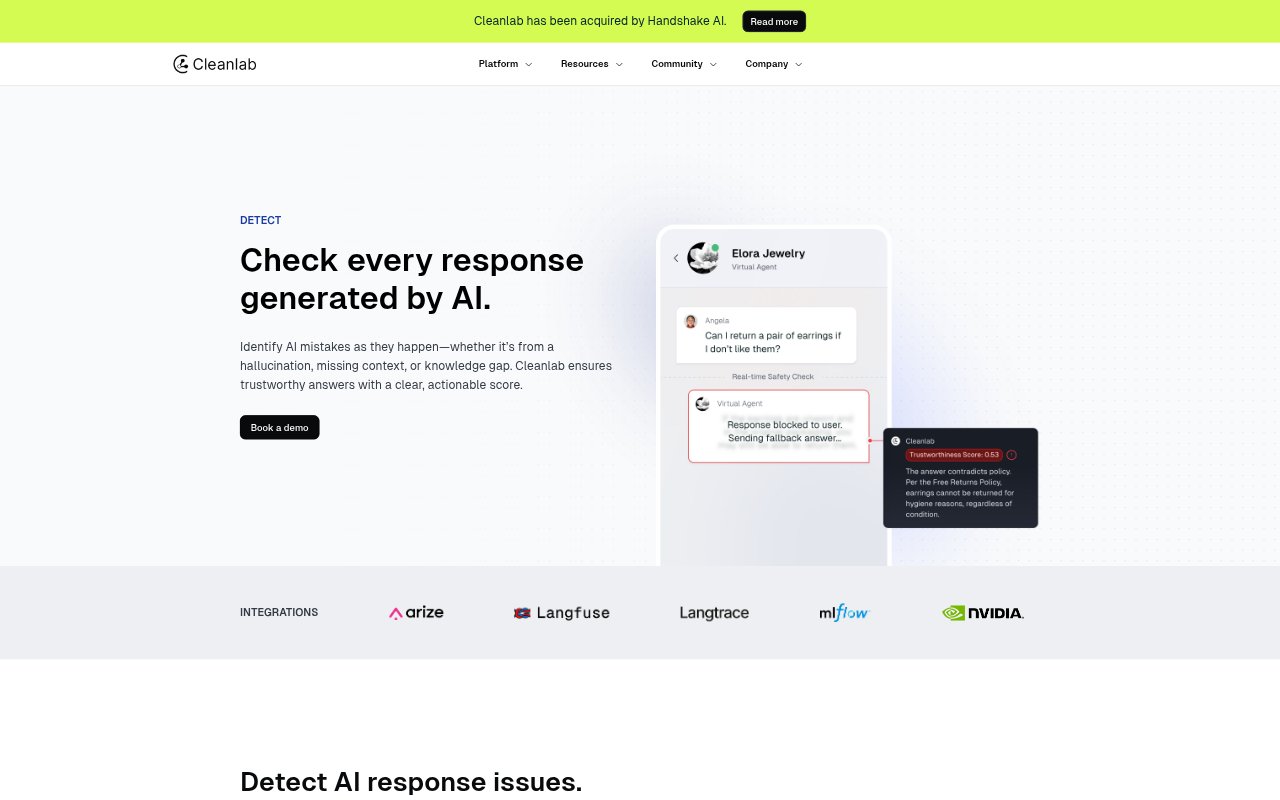
Cleanlab Detect adds a real-time trust and accuracy check to AI-generated responses. It identifies problems such as hallucinations, irrelevant retrieved context, and unanswered knowledge gaps, then provides a score that can guide what happens next. Teams can use it with AI systems and knowledge bases to make customer-facing agents more reliable, while keeping their existing stack in place. It is designed for production use, with SaaS and private cloud deployment options.
Cleanlab Features:
Response Issue Detection: Detect identifies hallucinations, wrong context, and knowledge gaps in AI responses, including cases where an agent answers without relevant context or says it does not know.
Trust Scoring: Each response receives a trustworthiness score that can help an agent decide whether to answer, use a fallback, or hand the conversation to a person.
Policy Guardrails: Teams can apply brand and policy standards, block unsafe or non-compliant outputs, and prevent personal information from appearing in customer interactions.
Model Settings: More than 15 evaluation models and five quality settings let teams choose a balance between detection accuracy, cost, and response latency.
Deployment Options: Cleanlab can run as a SaaS service or privately in a company's cloud, and is designed to work with existing AI systems and knowledge bases.
Multimodal Support: The platform supports AI interactions involving voice, text chat, and images, including documents and other media.
Cleanlab Benefits:
Fewer Bad Answers: Catching unreliable responses before they reach customers helps protect trust and reduce the disruption caused by incorrect AI guidance.
Safer Automation: Confidence-based handoffs let AI handle routine interactions while people take over when an answer is risky or needs judgment.
Less Engineering Work: Pre-optimized evaluation choices and a lightweight integration can reduce the effort involved in adding response checks to an AI system.
Controlled Latency: Teams can tune the accuracy and speed tradeoff to fit production needs, with response times optimized as low as 300 milliseconds.
Stack Flexibility: An independent deployment layer allows teams to add safeguards without replacing their AI system or knowledge base.
Use Cases:
Support Chatbots: Check answers to customer FAQs, refund questions, and troubleshooting requests, and route uncertain cases to a support agent.
Lead Qualification: Use trust scores and policy checks while an AI agent asks screening questions and guides prospective customers through qualification.
Application Guidance: Monitor an agent that helps users complete an application, routing edge cases instead of allowing it to give unsupported instructions.
Voice Support: Apply response checks to spoken AI interactions on calls or voice-enabled devices, with a path to human support for risky answers.
Image-Based Assistance: Monitor AI responses that interpret or generate images, such as interactions involving photos, documents, or other visual media.